Indiana University Athletics
Field Hockey 101 (8-20-02)
8/20/2002 12:00:00 AM | Field Hockey
August 20, 2002
Field hockey is a well-known international sport, however, it is still a growing sport in the United States. Not many spectators are familiar with the terminology or the basic rules of the game. For all of you Indiana field hockey fans, below are the fundamentals of the game.
How long does a field hockey game last?
A collegiate field hockey game is divided into two halves each lasting 35 minutes in length. Half time lasts seven minutes. At half time, the teams switch playing sides. If a game is tied at the end of regulation, there will be two seven-minute periods of play. The game ends when one team scores a goal. If there is still a tie after overtime, there will be a penalty stroke competition. Each team selects five players to take alternating penalty strokes against the opposing goalkeeper.
How many players play on the field?
Each team has 11 players on the field, including the goalkeeper. Only seven players, including the goalkeeper, compete during overtime play.
How big is the field?
The field hockey field is 100 yards long and 60 yards wide, divided by a centerline and a 25-yard line on each side of the field. A striking circle is marked 16 yards from each end line.
How many different ways are there to pass the ball?
There are a variety of ways to pass the ball to your teammates:
Drive: Players drive on passes, "free hits," and shots on goal. A player takes a hard stroke at the ball using a good back swing motion with both hands together at the top of the hockey stick. The back swing should go no higher than your hip on the back swing or follow through.
Flick: This pass is lifted in the air for quick passes or shots. The ball must not lift more than eighteen inches above the ground. To execute this pass, the player snaps their wrist
Push pass: This is a quick wrist stroke with no back swing. The ball is pushed and directed along the ground. It is considered the most accurate pass in the game.
Slap: This is the most powerful stroke in the game. It is a hard, quick pass or shot on goal, done with a half back swing with hands slightly apart.
What are the different positions?
Teams may line up in various formations. One formation consists of four forward-line players, three midfielders, three defenders, and one goalkeeper. The second most common formation consists of three forward players, three midfielders, three defenders, a sweeper, and a goalkeeper.
Forwards: These players make up the front line of the offensive attack.
Midfielders or links: These players are considered the most versatile players on the field. They play both offense and defense. They are positioned between the forwards and defenders. They are mainly responsible for moving the ball from the defenders to the forwards.
Backs: They play in their team's defensive half in front of the goalkeeper. Defenders help keep the ball out of the striking circle by clearing it up to the midfielders.
Sweepers: This is the last player before the goalkeeper. They have similar responsibilities as the backs.
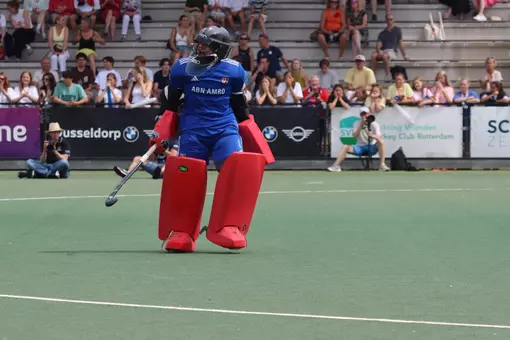
Goalkeeper: These players play directly in front of the goal to block shots by the opposing players. The goalie is the only player on the field allowed to touch the ball with any part of the body, but can do so only when she is inside her own striking circle. Goalies must always wear a helmet, chest protector, throat guard, leg guards, and gloves.
How do you get the ball away from another player?
There are a variety of techniques used to steal the ball from an opposing player:
Jab: A technique of poking at the ball until the player with the ball loses possession.
Marking: When a defender closely guards an opponent on or off the ball.
Tackle: A defensive maneuver in which a player uses her stick in an attempt to take the ball away from an opponent.
The whistle seems to blow so much, why?
A player can make many fouls. A player may only strike the ball with the flat side of the stick, and cannot raise it above the shoulders. Players may not trip, push, charge, interfere with, or physically handle an opponent in any way. Other rule violations include stick inference, back sticks, undercutting, and touching the ball with your feet:
Obstruction: Called against a player who cuts between an opponent and the ball or uses her stick, shoulder, or body as an obstruction to the ball.
Third-party obstruction: Occurs when a player positions herself between the ball and an opponent allowing a teammate an unobstructed play on the ball.
Back sticks: When a player used the rounded side of the stick.
Stick interference: Called against a player for intentionally or unintentionally uses her stick to hit an opponent's stick.
Undercutting: Chopping at the ball, to lift it in an unsafe manner.
What happens when a player commits a foul?
All foul result in a free hit or a penalty corner:
Free hit: A free play awarded on any foul awarded outside the scoring circle. It usually takes place at the location of the violation. All opposing players must stand at least five yards from where the hit is taken. If the free hit takes place within the 25-yard line, every player on the field must be five yards away.
Penalty corner: Awarded when the defense commits a foul inside the striking circle or intentionally hits the ball out-of-bounds over the end line. They can also be awarded if an intentional or dangerous play takes place within the 25-yard line. A penalty corner is taken by an attack player along the end line at a spot ten yards away from the nearest goal post. All other attack players much stand with both their sticks and feet outside of the striking circle. Five defenders, including the goalie, stand behind the end line, as the rest of the defending team must go to the 50-yard line. Once contact is made with the ball, the defenders are able to move. On attack, typically the ball will be hit to a teammate positioned outside the striking circle. An offensive player will stop the ball with the stick while another player will strike the ball at the goal.
Long corner hit: Occurs after the ball goes out-of-bounds off a defender's stick. The attacking team gets the ball five yards from the corner of the field up the sideline.
How is a team awarded a penalty stroke?
A penalty stroke is awarded to the team on offense when an official believes that a defensive infraction within the striking circle has prevented what would have been a sure goal. In addition, a penalty stroke can be awarded if the referee feels that the opposing team intentionally committed a foul, or put harm to the opposing player. The ball is placed on the seven yards from the goal with a striking player going one-on-one with the keeper. The shooting player may take one step to shoot. The player must push, flick, or scoop the ball. No back swing is permitted. The goalkeeper may not move off the line until the player has touched the ball with her stick.
What is the substitution procedure?
Each team must have substitution cards, which is kept at the scorer's table. A player must report to the scorer's table to substitute. After reporting, the player will stand in the designated area and hold up the card. The exchange of the card between players at the sideline signifies the substitution has been made and the player may enter the game. The player going into the game can not enter the field until their teammate is off the field. Substitutions are unlimited at all times, with the exception of penalty corners.