Indiana University Athletics
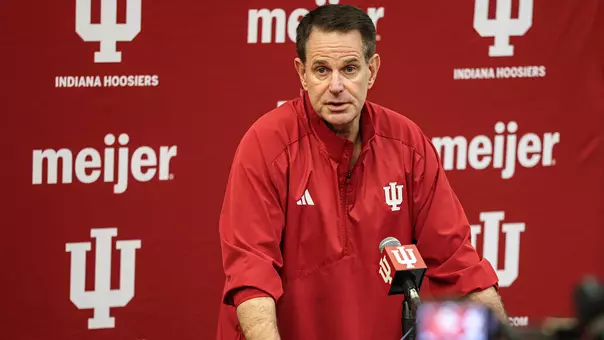
Indiana Head Football Coach Gerry DiNardo
9/3/2002 12:00:00 AM | Football
September 3, 2002
Coach, please begin with an opening statement if you would...
GD:Utah is a very physical team.
I think you would want to start with their defense. Most of their players are back. If you look at the Mountain West honor teams most of their guys, if they're not first team candidates they are somewhere in there.
Garrett Smith is a defensive lineman, an Outland Trophy candidate and an All-American candidate. He's really a great player. Sheldon Deckart is a legitimate big-time linebacker who can play anywhere in any scheme. Antwoine Sanders is a fantastic free safety. Ron McBride (Utah's head coach) calls him the best safety in the conference. Those are just three of their defensive players. Their defense has been nationally ranked for several years and I want to say nine of their starters are back.
Offensively Jordan Gross, their left tackle, is a first-round draft pick. He's 6'5, 306 pound tackle. He'll be wealthy here in a couple years.
Utah's quarterback (Lance Rice) is an established guy who has played two years.
They have five receivers that are interchangeable and could all play. They've got the two tailbacks - Marty Johnson and J.R. (Peroulis), who is the faster of the two.
They're physical and talented. It's the first time that we'll travel with our team. That will be another first-time experience for the new staff and the new players.
Other than that, it's just another Tuesday.
Q: Can you talk a little bit about the altitude situation and how that might affect the team?
GD: I've lived at altitude when I was at Colorado. My experience is that the bigger change is when you go from altitude to humidity.
When I was at Colorado we came to Michigan State early in the year and we played in the Kickoff Classic against Tennessee and we wilted in the humidity. We could hardly stand up in the fourth quarter. The teams that came into Boulder at altitude, it wasn't that big a deal.
I don't see any adjustment whatsoever. In fact I'm going to tell our guys there's no adjustment.
Q: Can you talk about Brian Lewis? What's his status?
GD: He's day-to-day with a shoulder injury. He will not practice today, he definitely will not go today. I would expect him to practice tomorrow.
Our policy is that if you don't practice Tuesday or Wednesday, you can't play. You can't just get healthy on Thursday and play. We'll know in a little more than 24 hours from now whether he'll play. But he won't practice today.
Q: Is it a sprain or separation?
GD: Sprain.
Q: How about Yamar (Washington)?
GD: Yamar is back today.
Q: What did the video tell you about the last 35 minutes defensively? Have you had a chance to sit down and critique things?
GD: I think we played hard. We had that sideline foul which was totally uncalled for. We had a couple blitzes that were called that we didn't come on. We lost containment. We have our share of things that we have to fix. The positive is that the effort was pretty good there.
Q: Can you talk a little bit about your recruitment of John Panozzo?
GD: There were several players in that high school, Poly Prep in Brooklyn. Dino (Mangiero, IU's director of football operations) was the head coach there. They were ranked 10th in the country and hadn't lost a game in two years.
One player that we visited went to Virginia. Another went to Georgia Tech and John came here. One went to Duke and we recruited him as well.
That school has had a lot of players since Dino's been there. So we knew about John. Sometimes when you have a guy who is not the most highly-recruited in a group of guys, you never know how it will turn out. It's hard for someone to go into a high school as an assistant coach and visit five guys. The head coach is wondering about these players after watching video.
That's a lot - to have five major college prospects on one team, but in this case they did. Steve Adazio had been to Poly Prep before, he'd recruited there. Dino and I had gone back a long way.
The fact that his name ends in a vowel was appealing. You can't question that. His dad's a New York City cop. We just got in there, watched the film and we really liked him.
Fullback isn't a position that is highly-recruited and there aren't a lot of two-back teams. A lot of teams are running one back. John was a fullback/linebacker. He was just kind of a perfect fit for us.
Q: Can you talk a little about the running game in general? How concerned are you about that?
GD: I'm very concerned. It has to get better. I said to the team at halftime against William and Mary that our ability to run the football in the second half would have a lot to do with the outcome of the game, not knowing that the defense was going to win it for us in the end.
We didn't generate much running game in the second half. We're not going to invent new plays. We're going to get back, we're going to block better than we did. We're going to work hard.
Our offensive line, I felt in the locker room after the William and Mary game, felt like they could play a lot better. They are familiar with the Utah team, how good they are, how physical they are. It's just back to work, but it's a huge concern for sure.
Q: With Brian Lewis out does that change anything for you?
GD: Nothing other than the fact that it will give us a look at some new guys. I'm going to look at Yamar, I'm going to look at Chris Taylor. As far as what we're doing offensively, you lose the veteran experience because Brian is a heady kid and he'll pick up a blitz He's smart and he knows the package. You lose a little bit of that. I don't know that we need to start calling different plays. The upside is that we'll see some other guys play if he can't come.
Q: Now that you've had a chance to look at the tape and evaluate Tommy (Jones') performance can you comment on that?
GD: Sure. He can play a lot better. He can be a lot better fundamentally. Throwing mechanics, setting his feet, just basic fundamental things that he knows he can do better. He can play a lot better.
Q: When you say 'better' are you referring specifically to turnovers or incompletions?
GD: Both. I think some of the turnovers, you get the ball down in that one route, although the ball could have been caught. Turnovers and quarterback-center exchange we fumbled. Two of the first three plays the ball was on the ground. I'm not saying that was Tommy's fault, but all those things have to get better.
Q: How important is ball security?
GD: It's significant, but I don't know more so than anything else. We used to say that in the wishbone it was more important because turnovers get you behind, obviously. It was harder to catch up in the wishbone. Other than that, no more or no less than any other offense.
Q: Did you feel like the problem was blocking or a problem of the running backs not seeing openings?
GD: We were off track a couple times, but not very often. I would say for the most part our running backs were fine. We were outnumbered in the box, but you're always going to be outnumbered when you have two backs in the backfield.
Part of what the West Coast offense is, is that you know that going into it and you're going to what we call book the extra guy, and you're not going to block him. The back is going to have to make them miss or break the tackle. In exchange for that, there's going to be single coverage and we're going to throw the ball.
That's where it broke down. We knew what we were getting. We knew that the answer was to throw the football versus single coverage. We lost confidence that we could do that.
Rather than put the game in jeopardy, and this is why perhaps I'm not a lot of fun to be around if you're a defensive player, at some point the defense has to win the game.
I think I mentioned that I did the Miami-Boston College broadcast last year and Miami turned the ball over four times. The only reason Miami beat Boston College is because they were playing good defense and they could run the ball. We couldn't even run the ball. But we won the game because of our defensive play.
If our defense doesn't play the way they played Saturday, we lose that game. Our offense certainly wasn't going to win it for us. You have a chance to win every time you put a good defense on the field. If you don't put a good defense on the field, you can score 35 points, it doesn't mean you're going to win.
We knew what was going on. There was nothing we could do. That's one of the reasons I don't call offense or defense. I try to manage the game and I was managing the game at the end that the defense would manage it. You're living on the edge there as well. You have to score some points.
Q: Any other significant losses besides Brian Lewis?
GD: We're pretty healthy. We're getting more guys back than we're losing. We get Yamar back, we get Will Lumpkin back, we get some bumps and bruises back. So we're healthier than we were seven days ago, with the exception of Brian.
The guys who were banged up are obviously a little healthier. We don't do a lot on Sunday's, we did nothing yesterday. The Dielman's and Enoch's who have been banged up should be better coming into this game.
Q: Can you talk about the attitude that the defense needs to have? Do you think they are now starting to understand the attitude a little better or do you think they are just thinking they are done learning?
GD: A little bit of both. My experience is that they will forget quickly if you don't remind them.
At practice, we're pretty aggressive coaching. If they think we're going to change now because we're 1-0 that would be our fault and we would deserve what we would get. My experience is that youth have short memories. If they think they are a finished product, it'll be our job to make sure they understand that we still have some work to do. My guess is that they may think they are a finished product.
Q: Were you pleasantly surprised at what they were able to do?
GD: Yes. I'm not going to change my stance. I told them that I didn't know if they knew what it was all about. So now, just because they looked like they knew what it was all about for one game, I'm not going to say they know what it's all about. Now we'll see if they know what it's all about this week.
Q: Did you see that attitude among the guys on special teams on Saturday?
GD: Some. We have some problems. We're not coming after kickoffs the way that we should. That last series, part of the problem was that Brian kicked the ball two yards into the endzone and our guys almost stopped and didn't run all the way to the endzone because they think the William and Mary guy is going to down it.
So right away we give up bad field position. Before you know it we give up a third down and the kids start scrambling around. Then a kid gets a 15-yard penalty. We tried to give it away.
There are some efforts that are good. I'd say Leonard Bryant was outstanding. He's leading our special teams' point system right now. He hustled and really played well.
There are too many guys that aren't scoring in our points system on special teams.
Q: Your secondary came up with several big plays and that hasn't always been the case in the last couple years. How would you evaluate their performance?
GD: I thought A.C. Carter probably played better of the two safety's. A.C. Carter's played a lot of plays.
I think our corners continued to make improvement. I say that cautiously because that corner position - you get matched up one-on-one and you can go from having a good day to having a really bad day. It's one of the few positions other than quarterback and kicking that there's a lot of experts in the stands because they're just out there in the open. There's a lot of kicking coaches, there's a lot of quarterback coaches and there's a lot of corner coaches in the stands each week.
They played okay, but you're on the edge out there as well. You blitz and they lock up your blitz, you're one-on-one.
It's a tough duty. That's why those guys get paid so much. Not necessarily here, but in other leagues. No...in the NFL.
Q: How you will go from facing a I-AA defense to turning around and facing a top-10 defense in Utah? What kind of challenge is that for your program?
GD: It's a pretty significant challenge. Obviously they have one of the best defenses in the country.
You just get ready. You study. You hope you are improved because obviously what we did last week in the run game will certainly not be good enough this week if we expect to move the ball. It's just back to work and trying to block those guys. That's all we can do.
Q: With Utah's offense geared towards the running game is that a strength of your defense? Is that something to focus on or are you looking at the wide receivers?
GD: I think any game plan, even if you're going against a spread offense, you have to start by defending the run. Northwestern, Clemson and Tulane reinforced that two or three years ago when they all got in the spread and people defended the pass first and they ran up and down the field on them.
I don't know that we've been tested like Utah's offense is going to test us this week in the run game. Again, William and Mary was not a physical, running team. They were a balanced team, but they were a finesse team. Utah's not really a finesse team. It's very much like the Illinois offense because that's where their coordinator came from and it's very much like our offense. Well, it's trying to be, as far as being physical in the run game.
Q: What has Yamar's injury been?
GD: He's got a sprained knee.
Q: A lot of the guys are really pointing to the Utah game and looking to that game as the one that kept them out of a bowl last year. Is that something you would use as motivation?
GD: No, I wouldn't. I didn't know that. I don't really get into all that. Focusing on a bowl game is the wrong goal for a team like us.
It's the analogy of trying to climb a mountain and looking at the mountain. You're going to trip because you're not looking where you're going. We're just going to take it one step at a time and if we get in that position, we get in that position. The teams' thinking, if it is that way, it's a little distorted. It's something I may talk to them about this week.
To answer the question, I don't see it as motivation at all. That's never really - the revenge and all that stuff - it's never really done much for me.
Q: What did you think of the atmosphere in the stadium and the attendance? Did that meet your expectations and what you're expecting in the future?
GD:What people tell me is that it is the largest opening crowd we've had in several years. The atmosphere was terrific. I was thrilled that there were that many students there. Evidently perhaps that's been an issue in the past.
Again, my feeling on the crowd, because I get the question asked often, is that I want people to come and see a team that's playing really hard, that's well-coached, that's disciplined. I want people to see there is a foundation being laid, regardless of the outcome.
We fully know that the outcome, fairly quickly, is going to be the only measuring stick. In the mean time, how we play is going to, in my opinion, get people back. Ultimately, winning will keep them coming back.
Having said that the crowd was good. I hope they like what they saw, I hope they'll come back. Hopefully as we win more, more will come back with us.