Indiana University Athletics
Schmitt Travels Long Road Back to Pool
11/6/2006 12:00:00 AM | Women's Water Polo
Nov. 6, 2006
It is a sunny day at the end of August 2005. Students recently returned to Bloomington are reading in a field, throwing a frisbee or enjoying their lunch on an outdoor terrace. One student is riding her bike down the street, taking full advantage of the lovely weather.
Then, for Emily Schmitt, everything went black. The senior had been struck from behind by a van, sending her and her bike crashing to the ground. And for the student-athlete preparing for her final season of water polo, everything changed.
Schmitt had two fractured vertebrae, one of which was a burst fracture. In a burst fracture, the vertebra shatters and goes in many different directions. When someone suffers a burst fracture, the result is usually a spinal cord injury, usually inducing paralysis.
"I put my fork down, got my coat on and went down to the hospital," head coach Barry King said. King was at home, eating dinner, when he received a phone call telling him about the accident. "My first reaction was that I was pleased that I wasn't making a phone call home with a lot worse news. My second was to take care of whatever needed to be taken care of for her."
Schmitt had escaped with relatively minimal damage from her injuries. Doctors inserted titanium rods around the burst fracture to stabilize the vertebra.
"I had a back brace and spent a couple weeks in the hospital," Schmitt said. "Then I spent a couple of weeks living with my mom and then there was lots of rehab until I got back into the water."
Once the doctors had a firm grasp on Schmitt's injuries, the plan of attack was easily laid out. After much rehab, Schmitt would likely be able to return to the water for the spring of 2007.
"Once we had a better idea of what had actually happened, then it was just a matter of establishing a timeline and a goal structure for completion of her academics and moving her toward physically rehabbing," King said. "But it was pretty clear what she would be able to do the next year. There was never any question about what she would be able to do to play heading into this season."
"They told me [redshirting] was the best idea," Schmitt said. "The way they explained it to me was, `you've worked so hard, it's your last year, you don't want to go through it and not be at full strength. You want to be able to get back your strength, you want make sure you can make the most of your last year. You would miss a lot of preseason, so it's just best to wait it out.'"
It wasn't an easy decision for the Beaverton, Ore., native. She could have gone forward with her class schedule that fall and graduated in 2006. Instead, she decided to take a year to recover and extend her education to fit her career goals. Schmitt is hoping to move to Africa to work in social services or pursue a graduate degree.
"I would have had to stay for summer school last year, because I had one class left," Schmitt said. "I dropped requirements last fall after the injury, and took some different things. So, as of now, I have one class left to finish my degree and then I picked up a minor, so I am still working on that. I am getting a degree in social science, and last year I finished a certificate in African studies. Right now, I have two more classes left to get a minor in Swahili."
Despite the fact that she "doesn't like to be told she can't do something," Schmitt decided to listen to her doctors and focus on her rehab. But it was certainly hard for her to accept the fact that she couldn't take part in water polo for the 2006 season.
"The first day I met my rehab doctor, he told me I should probably redshirt that year. My thoughts were, the season doesn't start until January, it's only September, you can't tell me that I am going to redshirt. I was just convinced that I could be back by the end of the semester, or I could be back by spring break. I just kept thinking, the more I do the faster I can get back to the team. That was my determination, to get back in the water to be with the team."
Schmitt did get back in the water, but not to prepare for the 2006 season. She was preparing to regain normalcy in her life, to strengthen her muscles and re-learn many of the things that she had done subconsciously throughout the years.
"I was with a rehab unit that was connected to the hospital," Schmitt said. "I started just by getting back to walking while I was in the hospital. When I got out of the hospital, I started doing walking exercises to make sure I was lifting my feet the right way, and things like that. From there I did a lot of squat lunges, just a lot of strength focus. I was able to do a lot of aqua therapy that gave me a chance to get back into the water.
"I was able to go to practice when everyone was practicing and was able to do my aqua-robic exercises in the shallow end," she continued. "If I was at practice doing my rehab, I felt like I was with the team and doing as much as I could while they were practicing or scrimmaging. The aqua part really made me feel like, `I'm back in the water, I'm doing really well, I can keep going and join the team hopefully soon.'"
But even though Schmitt was able to be in the pool while her teammates were in practice, it wasn't easy for her to be a spectator while the Hoosiers went through their 2006 season.
"She was frustrated a lot," King said. "She knew that she could help us in a lot of places that we might have been compromised in. I think that fueled her dedication to her rehabilitation and her desire to get back. It was never a destructive frustration though, it was always constructive."
Luckily for Schmitt, she participates in a sport that is conducive to rehabbing the spinal cord. Had she not been a water athlete, the strain of running might have been too much for her back, but the support that the water provides was actually good for her recovery. Even now, a year and a half later, basic daily activities are still hampered by her injury.
"I get a big discomfort sometimes when I do certain things," Schmitt said. "I haven't been able to run because it is uncomfortable. Sitting in class for a long amount of time is very uncomfortable. I've been told that there are things that will never go away, and it's just about trying to manage them. If I played any other sport, my doctor wouldn't have released me. The support you get from being in the water, you're not on a soccer field or running up and down a basketball court."
Schmitt's hard work during the offseason showed her head coach just what kind of effort he could expect from his longest tenured player. And according to King, that serves as an inspiration for her teammates to work just as hard.
"We certainly got a really good look at her hard work last year when she was going through her rehab and making her way back," King said. "By the middle of the season last year, she was physically in a position where we knew that she would be able to come back and play. Her dedication to her rehab and her clear vision of what her goal was served as a pretty big inspiration to the rest of us."
Though Schmitt has worked very hard to get back in the pool for IU in 2007, she still has not gotten back to the level that she was at when she first got hurt. But for someone who came within centimeters of losing any function in the lower part of her body, she certainly is ahead of where most people would expect.
"I think a lot of it is that I haven't played since the May before my accident, so it's been a long time since I've played water polo," Schmitt said. "Some stuff just naturally takes longer to get used to, but there are a lot of new rules, so there's going to be a little transition to the way the game feels to me with the new rules. So hopefully I'll be able to transition back into playing when everyone else is learning the new rules, too."
"We really haven't tested her fully, because I don't know that we've gone 100 percent yet," King said. "In live scrimmage action, she looks solid. It's more of a fitness question than recovering from the injury and getting used to moving at a faster pace."
Schmitt is reluctant to label herself as a leader for the Hoosiers - "I think that our team is so close so any given day, anyone can be a leader." - but by virtue of simply being the longest-standing member of the team, she is a natural leader on the squad. Add to that the dedication she showed by putting off graduation and working hard in the pool, and it becomes clear her teammates look to her for guidance.
"Anytime you have that experience around it's a good thing," King said. "Her desire to want to come back - she could have easily graduated last year and been done - garners a lot of respect from the team. People are going to follow her lead a lot. She's also the last remaining person who played on our team when we went to the NCAA Championships in 2003, so she can offer a good perspective of what it means to compete hard and get rewarded at the end of the year."
"The more time you have been here, the more experience you have," Schmitt said. "You naturally have the advice and the experience to share with everyone who is younger. With our team, you naturally become a leader as you get older because you have been through it all. I know I wouldn't have tried as hard as I did to get back in the water if it wasn't for my team. To be told I'm a leader, I feel like I worked hard for my team and now everyone else does the same."
So after a year and a half of working constantly to improve her physical well being, Schmitt is back in the pool and ready to be back in the action.
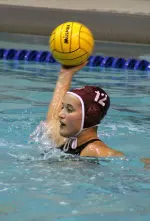
"It feels pretty good," Schmitt said. "At the end of the year, I was swimming with the team and doing drills. But when it came time to do more contact stuff, I would get out of the pool. When we scrimmage we wear a cap, and of course I didn't get to last year. So the first day this year, I got a cap, and I was really excited. I finally got to get in and play as a team and it felt really good."