Indiana University Athletics
Johnson Carving His Blocks of Limestone
8/17/2006 12:00:00 AM | Football
Aug. 17, 2006
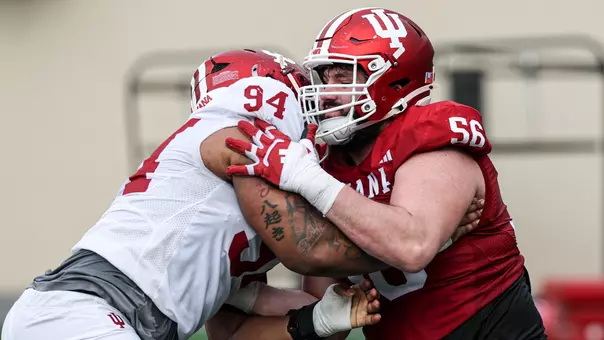
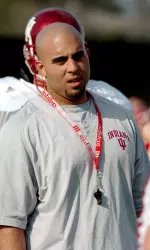
Limestone is a common building material - one that has good strength, but can be carved or molded to its owner's specifications. That's why it makes perfect sense that Indiana offensive line coach Bobby Johnson refers to the seven true freshmen on the line this season as the "Seven Blocks of Limestone."
For true freshmen, adjusting to the college game can be a difficult transition, but it's been so far, so good for the newcomers, who Johnson hopes will be the building blocks of his offensive line for years to come.
"They've done a pretty good job, I've been very pleased with them," Johnson said. "They're all talented kids, I'm not disappointed in any of them and I'm glad we got all seven of them. Some of them are a little bit further along than others for various reasons. A couple aren't physically ready, but they have the tools and once they get in the weight room for a year they'll be really good."
According to Johnson guards Pete Saxon and Cody Faulkner and tackle Mike Stark are closer than the rest to making an impact for 2006. The other four - James Brewer, Alex Perry, Rodger Saffold and Jarrod Smith - have adjusted to the mental aspect of college football, but need to make gains in the weight room before they can be impact players for the Hoosiers.
"Cody and Pete have set themselves apart because of their sheer physical girth, they're big enough and strong enough to hold up in there," Johnson said. "Mike is also a big kid, but different. He's a long, rangy kid. He can do some things and use leverage and his length to help him. So those three guys have physically caught on and mentally are really into it. The other four are really into it mentally, but for physical reasons aren't quite ready yet."
For the freshmen, moving from the high school game to the college game is a big change. And it doesn't just challenge them physically.
"The mental part has probably been more difficult because we're all big, strong, physical guys and we prepared really hard coming into the season," Faulkner said. "But the mental part is hard, memorizing a whole new offense. Obviously in high school if you're a big guy like that you can pretty much dominate everybody. The way we prepared through the summer and during the spring has really helped out physically."
"There's a big difference when it comes to plays," Saxon said. "It's a lot more complicated and there's a lot more technique involved. But once you adjust to that a lot of the basics are the same. It's a more physical and a faster game, but other than that it's pretty similar."
But the mental adjustment isn't just significant for on-the-field work. In addition to undergoing the rigors of learning plays and schemes, the freshmen have their first college workload looming on the horizon. For Saxon, that is far from a worry at this point.
"I'm actually excited to get to classes," Saxon said. "Coach Hep says `Play as a champion on and off the field' and wants 100 percent graduation. I want to be one of the guys up on the board with GPAs over 3.0. So I'm excited to get in there and get at that."
Many of the incoming offensive linemen showed a tremendous amount of success at the high school level, with a number of state and district championships among them. For Johnson, though, physical ability and size is far more important than the success of a player in high school.
"We look more for a body type or athleticism and then teach them what we want them to know," Johnson said. "It's great if a kid has carryover from his high school offense, I think that's why Cody's so far along. His high school coach has brought his team down the last couple years for team camp, so there's carryover - he's already heard it from me for a year or so before he got here. Other guys, it's a total departure from what they did in high school, so you have to get over that hump. It's great if they can adjust quickly, but I don't worry about what they ran in high school. As long as they show me the size and athleticism, then that's what I recruit."
According to Johnson, Saxon and Faulkner have a slight advantage in making the adjustment from high school to college due to their position. The differences between the two levels are not as stark for a guard as they are for a tackle.
"They are able to play guard and be ready because it's a smaller area, everything's more compact," Johnson said. "It's a power game, which they are built for. I think it is a bigger adjustment for a tackle to play because the speed on the edge and the space that you get put in because you're on the end of the line, that's a different animal, they're not used to kids coming off the edge that fast. Mike has done a pretty good job because he's so long, he covers so much space so quickly, that he can handle that speed. I'd say it's probably a little bit easier to play guard, if you're big and strong enough, which those two kids are - they're just fortunate for their size."
The challenges of having such a large number of true freshmen at his position are numerous for Johnson, who played offensive line for Miami (Ohio) as a freshman in 1991. In practices, Johnson faces the task of not only fine-tuning the skills of his players, but of teaching the fundamentals of the position to the newcomers. But that's not necessarily a bad thing.
"It's not overwhelming because it causes me to slow down and really teach fundamentals," Johnson said. "Sometimes as coaches, we get going so fast on teaching schemes and that type of stuff that you stop teaching some fundamentals that you should never stop teaching.
"I think that's what it's really forced me to do is focus on fundamentals, and what I've realized is that there are some older guys that still need that," Johnson continued. "So I'm glad that I have that situation, it's probably taught me a few things coaching-wise, and I'll probably lean toward teaching that way even when I don't have as many freshmen, because you have to keep stressing the fundamentals."
And as Johnson continues to mold his seven blocks into a strong base for the Hoosier offense, those fundamentals will bring Indiana Football to new heights in 2006 and beyond.