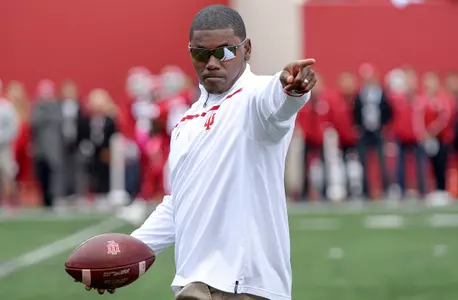
BLOOMINGTON, Ind. - Deland McCullough is the first to admit he doesn't know everything about football.
There are smarter coaches out there, the fifth-year Indiana running backs coach says. There are coaches that are better at teaching technique. Some draw up better plays. Others know how to train their players more effectively.
But McCullough doesn't doubt himself. Not for a second. He may have built a career around football, but life has never revolved around the game.
It revolved around the players.
"The one thing I've always prided myself in is being able to get the most out of people," McCullough said. "I can get you at another level if you'll let me. I'm going to work you, and it might not always be fun, but we'll get there together."
McCullough's career didn't start off easy, but, a teacher at heart, McCullough knew he would rather help a kid through a difficult moment in his life than teach him how to avoid a tackle.
Coaching simply wound up being his platform.
***
Understanding McCullough begins with understanding Harmony.
Harmony Community School, formerly located in Cincinnati, Ohio, was where McCullough's teaching and coaching careers began. With a student population that consisted mostly of kids coming from socioeconomically-challenged backgrounds, many of McCullough's students lived near the poverty line, surrounded by drugs and crime. Some showed up to school wearing the same clothes every day.
Others hardly showed up at all.
McCullough was working as a group home manager in Cincinnati when a former teammate told him about potential job openings at Harmony. McCullough, then an aspiring teacher, saw Harmony as an opportunity to make an even greater impact on underprivileged kids.
He met with David Nordyke, Harmony's founder, one day in the spring of 2001 in front of the school and wasted no time getting involved. Within two weeks, he was teaching a high school class. The next year, he was coaching the football team in its second full season.
"I took the job not knowing exactly what to expect, but knowing I could be successful with it," McCullough said.
Months before his first full season as football coach, news broke out that Harmony was beginning the school year without a building. Classes were being held in a downtown public library. Soon after the discovery, Harmony held classes at Lower Price Hill in former corporate offices and a warehouse of a fountain drink company.
Harmony's football players, carrying their unmatched gear, had to walk a half-mile down the road to the practice field from the school building. Then, they'd walk a half-mile uphill on the way back.
McCullough and his players knew their time at Harmony would be just that: an uphill battle.
"Playing football at Harmony wasn't like most schools," said Wymon Parham, one of McCullough's first running backs he coached at Harmony. "We dealt with what we had. And we didn't have much of anything."
But Harmony, as people knew it, was about to change. Deland McCullough with one the first running backs he ever coached at Harmony, Wymon Parham ***
Getting the job was one thing. Earning the students' respect was another.
Many of McCullough's students were "street kids," Parham said. They were the ones looking for trouble for the sake of trouble, the types of kids who didn't always respect authority figures.
Yet here McCullough was, a 28-year-old fresh face in the school coming off an accomplished NFL career, walking into their territory. Early on in his tenure, there was a certain tenseness to things, Parham said. The students weren't going to back down to McCullough, and he made it clear he wasn't going to back down to them.
"McCullough came in and set the tone," Parham said. "Not many people could have walked in there and started doing the things McCullough did."
McCullough earned his students' respect by showing he could relate to them and that he cared about them.
He told them he grew up in Youngstown, Ohio, which he describes as anything but a "Utopian circumstance." As a kid, drugs, crime and violence were nearby, but he managed to keep it out of his life while earning a scholarship, getting drafted into the NFL and beginning his post-sports professional career.
When he became a coach, McCullough was determined to help his players do the same. He shared his own story with his players, relating everything he did to them. He was always honest and went out of his way to make a connection, even if it meant going to a student's home or staying with them late after class.
For the first time in their lives, Parham said, he and his teammates started to believe in a world outside of their own.
"The young people would listen to him for the simple fact that he's coming from the same place, the same background," Parham said. "It's not Mr. Roger's neighborhood, you know? Football and education was your ticket out. You needed to take it and you could make it like he did."
McCullough earned the players' respect with a no-nonsense, but loving attitude, Parham said. When a stadium-wide fight broke out in the middle of a football game with rival Dayton Jefferson, McCullough calmly broke up fights between parents, coaches and kids and ushered his players safely back onto the bus.
While everyone in the stadium was losing their heads, McCullough kept his. He needed to set an example for his players.
"McCullough never backed down," Parham said. "That wasn't what we did. He set the example right there. That wasn't us. That wasn't his Harmony."
***
Over seven years at Harmony, McCullough was responsible for sending over 100 student athletes to college on scholarships.
Parham was his first.
Before McCullough was hired, Parham was teetering on the verge of dropping out of school. Parham was one of many kids at Harmony who went through the day feeling unappreciated. At 15 years old, Parham didn't see the point in attending class.
McCullough wouldn't stand for it.
He worked with Parham after class and convinced him to stay in school and play football. He gave him a chance at running back, and Parham earned it.
To this day, Parham credits McCullough for saving his life.
"Coach McCullough, he believed in me when nobody else did," Parham said. "I'll be real, if it wasn't for coach McCullough, I wouldn't have just not graduated. I would be dead. Plain as that. I would be dead."
Parham rushed for over 1,000 yards his senior season. He earned a football scholarship at Urbana and later walked on at Cincinnati. After his college career, McCullough helped Parham get a tryout with the Cincinnati Bengals, but he was unable to make the roster. He's still pursuing an NFL career to this day.
"Anyone who had an excuse for why they weren't going to make it out, McCullough obliterated it," Parham said. "The man made kids who had no reason to believe in themselves start to care."
***
Zak Nordyke, the son of Harmony's founder David Nordyke, describes his father as "almost impossible to impress."
McCullough impressed him.
David would give McCullough ambiguous tasks like "make Harmony a winning football team" or "improve test scores" without much direction. Every time, McCullough surpassed expectations.
"Deland took it upon himself from day one to take initiative and prove he could get results," Zak said. "My dad always respected that."
One of McCullough's major projects was a co-curricular group called Sports Academy. The program incorporated sports and sports marketing into core classes like English, math and science. McCullough's goal was to generate student interest in school by relating classroom studies to sports.
Only 16 students enrolled into the new program the first year, but by the end of the second year, 88 kids were involved in Sports Academy, many of whom were receiving the best grades of their academic careers.
Sports Academy was a booming success.
"When my dad saw what Deland did with Sports Academy, I think he knew he had a special person working for him," Zak said. "The students all respected him in a way not many other teachers were."
David died in 2003, two years after hiring McCullough in front of the school. Before passing away, he asked McCullough to take on an expanded role as the school's athletic director. It was his first step toward working in administration.
McCullough was involved in practically everything in his student's lives. He coached the football team, taught class, made schedules, spent Tuesdays and Thursdays teaching a weight training class and focused all other remaining time on growing the school.
Within a few years, he was named Harmony's principal, leading the school to become one of the top-ranking academic and athletics schools in the state of Ohio. All at the same time, he never gave up his role as athletic director.
"He was good at it because he loved it," Parham said. "He loved Harmony. Nobody loved Harmony back then. McCullough made people care about school, about us and about themselves. There's a lot of kids that would have done anything for him."
But why did he do it? Why was McCullough so invested in these kids nobody otherwise cared about?
"Those were my guys," McCullough said. "You've got to have your guys."
*** Harmony Community School closed Dec. 31, 2008.
It was one of multiple charter schools in the Cincinnati area to close around that time. When it did, McCullough essentially became an administrative free agent. Within a year, he was named principal of Cincinnati's King Academy School which taught grades K-8.
There were no sports programs at King Academy, and that bothered McCullough. When he suggested starting competitive teams, the woman running the school told him the school was strictly academic.
McCullough said he enjoyed working with the students, but the gap in his life without sports was too burdensome. He only stayed at King Academy for one year before agreeing to return to Miami (Ohio), his alma mater, as an offensive and special teams intern in 2010.
"I was really fortunate that they wanted me," McCullough said. "I saw it as an opportunity to get back into the game I loved."
McCullough returned to the RedHawks coaching staff in 2011 as the running backs coach. He spent one season there before head coach Kevin Wilson hired him to fill the same position at Indiana on March 2, 2011. McCullough had previously played under Wilson at Miami from 1992-95 while Wilson served as the RedHawks' offensive coordinator.
McCullough still keeps in touch with the woman at King Academy who told him he couldn't start a sports program.
Looking back, he said he's glad she told him no.
"She kind of makes fun of me to this day," McCullough said, laughing. "Like, 'Hey, I really should have let you start that team.' That's what really pushed me in a new direction and ultimately brought me to Indiana."
***
Before the start of every practice, McCullough and his running backs outline their standard together.
Every goal starts the same:
"Today, I will..."
One by one, each player adds something to the list. When one says it, they all do it.
Redding says he wants to have 100 percent ball security. They write it down.
Howard says he wants to run with velocity. Add that to the list, too.
Together, McCullough and his running backs develop their positional standard each and every day. It's a fluid list, changing over time while keeping the same values of being a good teammate, playing every down hard and not settling short of your ultimate goals, among other things.
"Coach McCullough really gives us freedom to be what we want to be," Redding said. "As a group, we sort of decide who we are. I don't think many coaches would do that."
McCullough admits he's not an "X's and O's" type of coach. He prides himself in being a motivator. He knows firsthand what it takes to be a successful running back and primes his players to be the same by focusing on the intangibles rather than fretting over fitting a mold.
The results: Indiana's rushers have broken 19 school records in a little over five seasons under McCullough. Tevin Coleman, his star pupil, was drafted in the third round of the 2015 NFL Draft by the Atlanta Falcons. Stephen Houston, another McCullough product, split time between the New England Patriots and Pittsburgh Steelers.
His current one-two punch of Howard and Redding have already grabbed national headlines this season, and they both still have two and three years of eligibility remaining, respectively.
Ask McCullough and he says their success is a reflection of the standard they set together every practice.
His peers say it's a result of McCullough's relationships with his players. Whether that means spending an hour with Coleman in a car in the Memorial Stadium parking lot discussing life late one night before the NFL Draft or playing NBA 2K with Howard on a recruiting visit, McCullough finds ways of understanding and bonding with his running backs.
"He does a tremendous job of relating to his players," IU offensive coordinator Kevin Johns said. "He has a very high standard of what it looks like to be a running back that's going to play for him in our offense. That shows a great teacher. That shows a great recruiter."
It's a skill not easily taught, one that's developed over years of working with students on all levels from all backgrounds.
"Deland is an awesome coach, has a great relationship with those guys," Wilson said. "We're blessed to have him."
***
McCullough's accomplishments haven't fallen on deaf ears. His list of suitors is growing.
This past summer, he was a coaching intern with the Atlanta Falcons through the Bill Walsh NFL Minority Coaching Fellowship. He completed the same internship with the New Orleans Saints and Seattle Seahawks the previous offseasons.
Wilson has said multiple times that NFL franchises were calling about McCullough, never going into the specific details. Now in his sixth year of coaching collegiately, McCullough's late-blooming coaching career has left the 42-year-old with options.
Today, McCullough has no interest going anywhere.
"I'm not leaving my guys. They're my guys," McCullough said. "I like the community and all, but it's my guys. These are the guys I fought for. These are the guys I want to see successful. These are the guys that want to be coached by me. It's important that I do everything I can to put myself in the position to keep teaching them and getting the most out of them."
"Teaching them...getting the most out of them."
In that sense, McCullough has never changed.
He's still the upstart football coach who was teaching kids the value of hard work at Harmony. School is, and always will be, a platform for learning more than facts or football. McCullough's ultimate lesson is on being a better person.
"He's saved, not just coached, but saved so many kids that you can't keep count," Parham said. "But you want to know the best part about coach McCullough? I don't think he knows. I really don't. I don't think he has any idea how deep his roots go, the difference he's made."
Maybe Parham's right. Maybe McCullough doesn't truly understand the span of his reach.
Or maybe he prefers to stand off to the side and soak everything in. He doesn't like shouldering any of the credit for his running backs' accomplishments on or off the field. He never really has.