Indiana University Athletics
Indiana University Announces Reconciliation with "IU 10"
5/28/2015 3:58:00 PM | Football
BLOOMINGTON, Ind. - Thanks to a reconciliation effort initiated by former Indiana University football player Michael Adams, Indiana University has formally welcomed back the "IU 10" and is recognizing the important role they played in drawing attention to, and thereby improving, race relations at Indiana University during a tumultuous era in American history. Mr. Adams played as a sophomore on the 1967 Big Ten championship team that played in the 1968 Rose Bowl and started on the 1968 and 1969 teams.
In 1969 ten African-American members of the Indiana University football team boycotted the last three games of the season because the coaching staff would not adequately address their concerns about unequal treatment on the basis of race. Coach John Pont allowed the players to keep their scholarships. Earlier this year, Mr. Adams led an effort to reach out to Indiana University, through President Michael McRobbie's office, to address issues lingering from the 1969 boycott by the players who later became known as the "IU 10".
In response, the president's office embraced this opportunity and invited all surviving members of the IU 10 to Bloomington to meet with senior university officials to hear their concerns and to explore ways they might be addressed. These meetings were quickly arranged and took place on campus in early April.
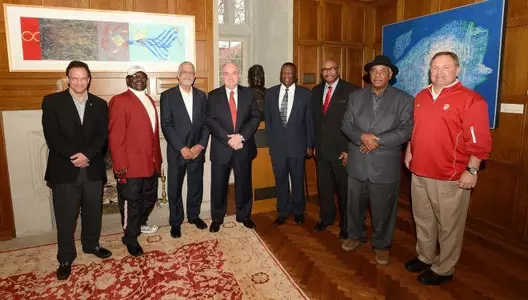
Five of the eight surviving members of the IU 10 attended: Mr. Adams; Charlie Murphy; Benny Norman; Clarence Price; and Don Silas. Gordon May, Greg Harvey, and Larry Highbaugh did not attend. Sadly, Greg Thaxton and Bobby Pernell are deceased. Also attending on behalf of the IU 10 was Trish Geran, activist and author, who served as special advisor to Mr. Adams. Representing the university in these meetings were: James Wimbush, Vice President for Diversity, Equity, and Multicultural Affairs and Dean of University Graduate School; Fred Glass, Vice President and Director of Intercollegiate Athletics; Kurt Zorn, Associate Vice-Provost and Faculty Athletics Representative; Clarence Boone, Jr., Alumni Relations Officer and Director of Diversity Programs, Indiana University Alumni Association; Anthony Thompson, Associate Athletic Director for Student-Athlete Wellness & Performance and Sport Administrator for Football; Mattie White, Associate Athletic Director for Academic Services/Excellence Academy and Senior Woman Administrator; and Mark Deal, Assistant Athletic Director for Alumni Relations.
"The sharing, listening, and understanding that occurred over the three days was nothing less than extraordinary and is one of the great experiences of my professional life," Glass said. "While the process is not complete, the reconciliation we were able to achieve is a testament to what can be accomplished when people of good will, come together in good faith, to address even the most sensitive and complicated issues."
"The idea of reconciliation concerning the 1969 football boycott has haunted me for 46 years," stated Adams. "The sacrifice made by the IU 10 definitely hindered their potential to pursue professional football careers. In retrospect, the long term impact of the boycott has had a positive effect in race relations and civil rights at IU, as exemplified by the addition of the Neal Marshall Cultural Center and the diversity positions in both academia and athletics."
The culmination of the discussions on their last day was an enthusiastic, celebratory meeting of the IU 10 representatives with President McRobbie in his office along with other representatives of the university administration, plus current Indiana University football coach Kevin Wilson and men's basketball coach Tom Crean.
"I was pleased to have the opportunity to meet these fine men and tell them directly that I appreciated their efforts in helping to bring reconciliation to this challenging episode in our university's history and their role in improving race relations at Indiana University both then and now," McRobbie said.
"As an African-American who has enjoyed great opportunities at Indiana University as a student-athlete, assistant head football coach, and now as a senior administrator in the athletic department, I can't help but feel like I'm standing on the shoulders of men like the IU 10 who stood up for what they believed in at great personal cost," said Anthony Thompson.
"Like George Taliaferro, Bill Garrett, Herman Wells, Adam Herbert, and so many others, the IU 10 helped to improve race relations at Indiana University," noted Wimbush. "While our work in this area can never be done, all of their commitment, and that of so many others, has helped make Indiana University a national leader in matters of racial equality."
Don Silas was a freshman on the 1968 Rose Bowl team and a starter on the 1968 and 1969 teams. He led the 1968 team in tackles. "I am so pleased that the university was willing to listen to us now in a way I felt they wouldn't in 1969," Silas said. "I feel like the cloud has lifted. I'm glad that Coach Pont and I were able to make peace by both saying we were sorry before he passed."
Charlie Murphy, a great defensive tackle, was on the 1967 Big Ten Champion and 1968 Rose Bowl team and also played on the 1968 and 1969 teams. "Our meetings in Bloomington enabled me to leave my bitterness at the Indianapolis Airport on my way back home," said Mr. Murphy.
Benny Norman played on the 1967 Big Ten Championship and 1968 Rose Bowl team as a split end. Moved to defense in 1968, he started and set an IU school record with three interceptions (in one quarter) in his very first game against Baylor, a record he still shares. He also started in 1969. "While we needed to boycott in 1969 to address issues that needed addressing, that wouldn't be the case today given the progress that has been made," said Mr. Norman. "We all love this school. It's a great school."
Clarence Price was a powerful defensive end who was a major reason why the 1967 team held nine of 11 opponents to two touchdowns or less during its Big Ten Championship run. He also started in 1968 and 1969. "I am thankful that Michael Adams and Trish Geran started this dialogue and for the university's role and participation in this effort," said Mr. Price. "This is a great first effort; we all feel like we can support the university again."
On behalf of the university, we would like to add our thanks to Trish Geran who played such a positive role, along of course with Mike Adams and the rest of the IU 10, in helping to bring honest and open dialogue, and ultimately reconciliation, to this situation," added Glass.
"Having watched these very players compete along with many others during my long association with Indiana University, I'm proud of the way we have been able to come together, to listen to each other, and to start to heal wounds that had festered for too long," said Clarence Boone, Jr.
"It should be emphasized that I never felt any racial problems from any teammates, black or white," said Mr. Adams. "I feel close to all of them and cherish their friendships."
Harry Gonso was IU's starting quarterback in 1967 (which also included the 1968 Rose Bowl team), 1968, and 1969. He was a team captain, an All Big Ten selection, and an Academic All-American. "Like Mike, I never believed there were ever any racial issues among us as teammates. I'm very pleased this reconciliation is taking place. It was great seeing most of these guys at our Rose Bowl Reunions in 2007 and 2012, and I hope to see all of them at our 50th in 2017," said Mr. Gonso.
E.G. White was a letterman in 1967, 1969, and 1970. He was a team captain and Academic All Big Ten. "I'm so glad that these players are formally back in the fold," said Mr. White. "As far as I'm concerned, they've always been my teammates."
Mike Deal lettered in 1967, 1968, and 1969 and played in the 1970 Senior Bowl. "This is great! We always considered this group to be our 1969 teammates, and we always wanted them to officially be back," Deal said.
As part of its reconciliation with the IU 10, Indiana University has: formally reinstated each of them to the 1969 team; provided them "lettermen's blankets" which they would have otherwise received at the end of their senior years; and made them Life Members of the Indiana University Alumni Association.
In addition, as part of the university's Bicentennial Project to record oral histories of our most significant alumni and events, the university will take complete oral histories of all available, surviving members of the IU 10 and make those histories a permanent part of the Bicentennial Collection.
The university will also establish permanent displays in both the Henke Hall of Champions and the Neal Marshall African-American Culture Center identifying the IU 10 and describing the role they played -- among others -- in drawing awareness to race relation issues at Indiana University. Each display will have an unveiling event to which the IU 10, as well as the general public, will be invited.
As the centerpiece of addressing the experience of the IU 10, Indiana University will offer a class each year, for credit, studying the circumstances surrounding the 1969 boycott and what it can teach students about race relations, conflict resolution, and similar themes, including the opportunity for IU 10 members to serve as guest speakers.