
Indiana University Athletics
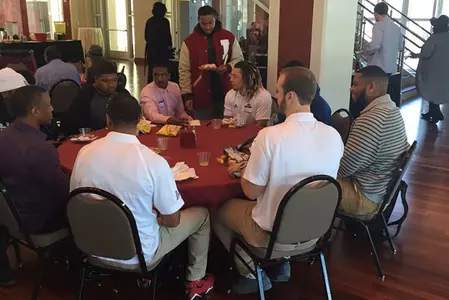
Discussion Questions Athletes’ Role In Civil Rights
1/18/2016 4:03:00 PM | General
By: Sam Beishuizen | Twitter
IUHoosiers.com
BLOOMINGTON, Ind. - Social activism has helped change the course of the United States from the day the earliest settlers arrived on the east coast.
But what does it mean exactly?
That's the question Dr. Gary Sailes of the School of Public Health rose Monday at the Henke Hall of Champions as part of a lecture titled, "The Dream and the Team: A Discussion on the Role of Sports in Civil Rights Issues."
The lecture, which was really more of an open discussion, was a result of a partnership between IU Athletics and the IU NAACP Chapter to honor the legacy of Dr. Martin Luther King Jr. Student-athletes, non-athletes, faculty and members of the general public were on hand to participate in informal discussion.
"This was a great opportunity for the university and the community as a whole to put on and talk about some issues we deal with on a daily basis but don't always take the time to dig into," Assistant Athletic Director for Administration Wesley Jones said after the event he helped organize. "I think it went well."
The lecture overlapped with a Bloomington-wide initiative to make Martin Luther King Jr. Day a "day on" rather than a day off. Events like the discussion on the role of sports in civil rights issues were being put on throughout the day in the Bloomington community.
Sailes began the event by making it clear he wasn't about to lecture for an hour. He said he'd be happy to moderate discussion, but he wanted to allow for free-flowing discussion based on what those in attendance wanted to talk about.
Sailes primed the discussion with a brief history of social activism in sports, ranging from Tommie Smith and John Carlos' "Black Power" salute at the 1968 Olympics to members of the university's own "IU 10" to current racial problems dominating the news.
Then he opened the floor.
"This is your program," Sailes said.
An hour of what Sailes called "what happens here, stays here" conversation followed. The discussion included topics such as whether or not LeBron James should be at the forefront of social activism to how student-athletes balance their course load, athletics and being active members in the community, which Sailes said was critical.
"If we're going to change things, we have to do it one person at a time," Sailes told the audience. "And that starts with us."
Sailes concluded the lecture by suggesting everyone, especially student-athletes, be "agents of change."
That doesn't necessarily mean marching in public or making dramatic stands for change, Sailes said. On the contrary, he said everyone can partake in social activism in their own way whether it be out in the public or behind closed doors.
Wherever one does it and however they do it, Sailes said the key is to be responsible.
"I'm just doing my own part," Sailes said, "and I challenge you to be socially active in your own way."
IUHoosiers.com
BLOOMINGTON, Ind. - Social activism has helped change the course of the United States from the day the earliest settlers arrived on the east coast.
But what does it mean exactly?
That's the question Dr. Gary Sailes of the School of Public Health rose Monday at the Henke Hall of Champions as part of a lecture titled, "The Dream and the Team: A Discussion on the Role of Sports in Civil Rights Issues."
The lecture, which was really more of an open discussion, was a result of a partnership between IU Athletics and the IU NAACP Chapter to honor the legacy of Dr. Martin Luther King Jr. Student-athletes, non-athletes, faculty and members of the general public were on hand to participate in informal discussion.
"This was a great opportunity for the university and the community as a whole to put on and talk about some issues we deal with on a daily basis but don't always take the time to dig into," Assistant Athletic Director for Administration Wesley Jones said after the event he helped organize. "I think it went well."
The lecture overlapped with a Bloomington-wide initiative to make Martin Luther King Jr. Day a "day on" rather than a day off. Events like the discussion on the role of sports in civil rights issues were being put on throughout the day in the Bloomington community.
Sailes began the event by making it clear he wasn't about to lecture for an hour. He said he'd be happy to moderate discussion, but he wanted to allow for free-flowing discussion based on what those in attendance wanted to talk about.
Sailes primed the discussion with a brief history of social activism in sports, ranging from Tommie Smith and John Carlos' "Black Power" salute at the 1968 Olympics to members of the university's own "IU 10" to current racial problems dominating the news.
Then he opened the floor.
"This is your program," Sailes said.
An hour of what Sailes called "what happens here, stays here" conversation followed. The discussion included topics such as whether or not LeBron James should be at the forefront of social activism to how student-athletes balance their course load, athletics and being active members in the community, which Sailes said was critical.
"If we're going to change things, we have to do it one person at a time," Sailes told the audience. "And that starts with us."
Sailes concluded the lecture by suggesting everyone, especially student-athletes, be "agents of change."
That doesn't necessarily mean marching in public or making dramatic stands for change, Sailes said. On the contrary, he said everyone can partake in social activism in their own way whether it be out in the public or behind closed doors.
Wherever one does it and however they do it, Sailes said the key is to be responsible.
"I'm just doing my own part," Sailes said, "and I challenge you to be socially active in your own way."


Wednesday, August 12
Wednesday, August 12
Tuesday, August 11
Tuesday, August 11