
Indiana University Athletics
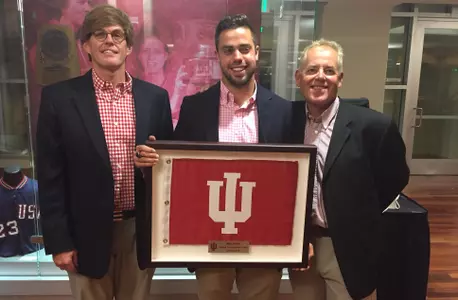
Passion, Personal Growth Define Kollin’s IU Career
4/1/2016 11:46:00 AM | Men's Golf
By: Sam Beishuizen, IUHoosiers.com
BLOOMINGTON, Indiana - The first time Max Kollin walked into an Indiana golf meeting, he was late.
And he picked the wrong person to upset.
The meeting was actually a 2012 workout being run by former IU strength and conditioning coach Je'Ney Jackson, who also worked with the men's basketball program. By the time then-freshman Kollin strolled in with a smile on his face, Jackson was midway through a conversation with the team.
"It did not go over very well, and that's probably an understatement," IU head coach Mike Mayer remembered. Kollin's casual entrance made for a first impression that grabbed Jackson's attention for all the wrong reasons.
A no-nonsense coach, Jackson made sure the grin Kollin came in with didn't stick long.
Thus began a debut season that would push Kollin to the brink of leaving the golf team. Over the ensuing nine months, he was arguably tested more off the course than on it, as he tried to adjust to the college game and demands put on student-athletes at the Division I level.
Almost four years after that initial meeting that started what he called the toughest year of his life, Kollin will compete for the Hoosiers one final time in Bloomington at this weekend's Hoosier Invitational at the IU Golf Course.
As gifted a player Mayer says he's ever seen, Kollin proved he had the game to be a longtime cornerstone in Indiana's lineup. Now, IU's lone senior, he's trying to end his career on his own terms.
All it took was Kollin getting over his biggest obstacle:
Himself.
***
It takes Kollin a few seconds to come up with a description of himself on the golf course. He hears what other people say about him, but he takes his time looking for the right words.
"Passionate," he finally said. "Definitely passionate."
That passion can be both Kollin's strength and his enemy, Mayer said.
He'll ride his emotions throughout the round, getting excited after landing an approach a few feet away from the hole and angry with himself when he can't control the ball the way he'd like. The latter sometimes ends with Kollin talking to himself or shoving his club back into the bag while chastising himself as he walks toward wherever he ball ended up.
Junior Will Seger can't help but find it a little funny. Off the course, Kollin is as laid back as anyone, he said. He's the type of person who will strike up conversations with total strangers at the airport just because and start telling jokes to pass the time.
"He's just a really easy person to talk to and get to know, and he's really like that anywhere in any setting," Seger said. "But on the golf course, you can tell that he is passionate about the game and wants to do everything possible to hit the best shot each time."
Sports have always been that way for Max, his father Jimmy Kollin said. There's something about the competition that lights a fire under his son.
Max used to be a catcher on one of the best baseball teams in Michigan before switching his focus over to golf full time. After his team's pitcher would walk a batter, Max would fire down to first base after nearly every pitch to try to get the runner out because he felt just as responsible for him being there as the pitcher did.
"He's extremely competitive and his toughest critic," Jimmy said. "He just wants to win."
When he kept himself mentally engaged, that's exactly what Max did.
He was the club champion at Twin Beach Country Club in West Bloomfield, Michigan, by the time he was 15. He owned the course record before he could legally drive a car.
The members at the club would come up to Jimmy surprised after seeing Max on the course. There would be days they'd see him out practicing alone, pumping his fists after draining putts or dropping to a knee after hitting a poor shot as if he was in contention to win The Master's on Sunday.
"It's just how he's wired," Jimmy said. "You can't stop it."
That mental edge is what helped bring Max to Indiana in the first place. It's also the same edge that had to be adjusted once he got to the college game.
***
That freshman year, it was tough.
Max arrived on campus as a consensus top-50 national recruit, ranked as high as No. 14 in his class by GolfWeek. The Farmington Hills, Michigan, native had a professional's physical build, a proven record of winning tournaments and raw talent to back it up. He was the type of recruit a school could build a program around.
Except nothing came easy. Not golf. Not school. Not time management.
Nothing.
"I don't think he was ready for how hard it was," Jimmy said. "It hit him like a train."
Max played in just three events that season, all as an individual. He struggled to manage his time in balancing the various roles of being a student-athlete away from home.
As the year went along, frustration kept mounting when the game wasn't coming as easy to him as it once did. Mayer described the shock as a classic case of watching a talented golfer not being used to regularly playing against competition that was as good or better than him.
Max became noticeably unhappy. On more than one occasion, Mayer called him into his office with transfer paperwork in hand ready for the two of them to fill out should Max decide things weren't going to work at Indiana.
"If transferring was the best option in Max's mind, we were going to be there to support him," Mayer said. "We certainly didn't want to lose Max and were going to do everything we could to keep him. But if that's what he had to do, he had to do it. The whole process was tough on him."
There were moments Max had serious thoughts about quitting, but he always managed to talk himself out of it.
"I'm not a quitter," he said. "If you quit at this thing, you're going to quit later in life. You're going to quit almost every single time. You've got to learn how to get through it."
Max didn't quit. He wouldn't allow himself to.
But he couldn't keep going without a serious overhaul, either.
***
Max started the summer between his freshman and sophomore years with a meeting. He wasn't late to this one. He called it.
After a season that was both mentally and physically draining, Max was able to take some time to relax at his parents' home. He sat down with his mother and father to discuss what would wind up being the most drastic changes he'd made in his golf career.
"We all kind of agreed, we couldn't have another year like I had," Max said.
Max made developing the mental side of his game a priority. He started meeting with a swing coach that became as much a psychological teacher as he was a golf instructor. They decided Max needed to relax more and not let his head get in the way of his game.
"I'm never going to be a calm player on the golf course. That's just not how I am," Max said. "But I developed a pre-shot routine. Before then, I was completely a feel player and just went with that. After that summer, I became organized. It helped me a lot."
The results backed it up, too.
Max started playing more complete rounds in the summer. His scores started to drop and the mistakes were less frequent. He started to learn that shooting a 75 or a 76 was going to be more helpful than blowing up and shooting a score in the 80s trying to go low.
"He spent the whole summer working his tail off," Jimmy said. "He just worked and worked."
When he returned to Bloomington the next year, he earned a starting spot in Indiana's initial qualifying rounds that he would hold onto the rest of the year and the two years since.
Max was a different version of himself on the course. He wasn't stressed out or panicking after bad shots nearly as much as he did his freshman year. When he hit a poor shot, he moved on to the next one.
Max wasn't the same player. Mayer said he could hardly recognize him.
"He kind of stumbled, but I give him credit," Mayer said. "He got back up."
Max hasn't lost that spot in the lineup since then. His sophomore year scoring average of 74.71 was the best of his career to date, but he's backed it up with a pair of averages in the low 76s having played in nearly every Indiana match since the start of 2013-14.
The passion he played with didn't go anywhere. That much was still a part of the game.
But the roller coaster was tamer. The ups weren't as high and the lows weren't as low.
"Once he figured out that mental side, he was a changed player," Mayer said. "And he's still got room to grow in that regard. He can be so much better."
This year he might finally break through.
***
Since that first run-in with Jackson in the weight room, Max hasn't missed been late to any meetings.
Once was enough.
"I have to give him credit, he really embraced everything about what couldn't have been a worse start," Mayer said. "Not only do the kids look up to him and admire what he's accomplished, but what's he's become."
Max has transitioned into a leadership position within the team. These days, IU's lone senior is the one holding teammates accountable for being at meetings, getting their work done and being responsible on and off the course.
It's a responsibility Max said he doesn't take lightly.
"I think a lot of the younger guys can look at me and see where I started and then where I finished and how much I learned from everything," he said. "I think it really helps them see that no matter where you are one day, you can change it the next and be remembered for the right things."
As for Max's own legacy, he's not entirely sure what his career will be remembered for.
But he knows what he wants it to be.
"I want to be remembered as a fiery competitor that turned it around from a rough freshman year to being a solid contributor in the lineup for the next three years," he said.
Crafting that legacy didn't come easy. All told, Max is still putting the finishing touches on it today.
But Mayer said Max should be proud of what he accomplished in Bloomington. He doesn't expect him to end his career without a little flair, either.
He doesn't know any other way.
"He came a long way," Mayer said. "And he's better for it."
BLOOMINGTON, Indiana - The first time Max Kollin walked into an Indiana golf meeting, he was late.
And he picked the wrong person to upset.
The meeting was actually a 2012 workout being run by former IU strength and conditioning coach Je'Ney Jackson, who also worked with the men's basketball program. By the time then-freshman Kollin strolled in with a smile on his face, Jackson was midway through a conversation with the team.
"It did not go over very well, and that's probably an understatement," IU head coach Mike Mayer remembered. Kollin's casual entrance made for a first impression that grabbed Jackson's attention for all the wrong reasons.
A no-nonsense coach, Jackson made sure the grin Kollin came in with didn't stick long.
Thus began a debut season that would push Kollin to the brink of leaving the golf team. Over the ensuing nine months, he was arguably tested more off the course than on it, as he tried to adjust to the college game and demands put on student-athletes at the Division I level.
Almost four years after that initial meeting that started what he called the toughest year of his life, Kollin will compete for the Hoosiers one final time in Bloomington at this weekend's Hoosier Invitational at the IU Golf Course.
As gifted a player Mayer says he's ever seen, Kollin proved he had the game to be a longtime cornerstone in Indiana's lineup. Now, IU's lone senior, he's trying to end his career on his own terms.
All it took was Kollin getting over his biggest obstacle:
Himself.
***
It takes Kollin a few seconds to come up with a description of himself on the golf course. He hears what other people say about him, but he takes his time looking for the right words.
"Passionate," he finally said. "Definitely passionate."
That passion can be both Kollin's strength and his enemy, Mayer said.
He'll ride his emotions throughout the round, getting excited after landing an approach a few feet away from the hole and angry with himself when he can't control the ball the way he'd like. The latter sometimes ends with Kollin talking to himself or shoving his club back into the bag while chastising himself as he walks toward wherever he ball ended up.
Junior Will Seger can't help but find it a little funny. Off the course, Kollin is as laid back as anyone, he said. He's the type of person who will strike up conversations with total strangers at the airport just because and start telling jokes to pass the time.
"He's just a really easy person to talk to and get to know, and he's really like that anywhere in any setting," Seger said. "But on the golf course, you can tell that he is passionate about the game and wants to do everything possible to hit the best shot each time."
Sports have always been that way for Max, his father Jimmy Kollin said. There's something about the competition that lights a fire under his son.
Max used to be a catcher on one of the best baseball teams in Michigan before switching his focus over to golf full time. After his team's pitcher would walk a batter, Max would fire down to first base after nearly every pitch to try to get the runner out because he felt just as responsible for him being there as the pitcher did.
"He's extremely competitive and his toughest critic," Jimmy said. "He just wants to win."
When he kept himself mentally engaged, that's exactly what Max did.
He was the club champion at Twin Beach Country Club in West Bloomfield, Michigan, by the time he was 15. He owned the course record before he could legally drive a car.
The members at the club would come up to Jimmy surprised after seeing Max on the course. There would be days they'd see him out practicing alone, pumping his fists after draining putts or dropping to a knee after hitting a poor shot as if he was in contention to win The Master's on Sunday.
"It's just how he's wired," Jimmy said. "You can't stop it."
That mental edge is what helped bring Max to Indiana in the first place. It's also the same edge that had to be adjusted once he got to the college game.
***
That freshman year, it was tough.
Max arrived on campus as a consensus top-50 national recruit, ranked as high as No. 14 in his class by GolfWeek. The Farmington Hills, Michigan, native had a professional's physical build, a proven record of winning tournaments and raw talent to back it up. He was the type of recruit a school could build a program around.
Except nothing came easy. Not golf. Not school. Not time management.
Nothing.
"I don't think he was ready for how hard it was," Jimmy said. "It hit him like a train."
Max played in just three events that season, all as an individual. He struggled to manage his time in balancing the various roles of being a student-athlete away from home.
As the year went along, frustration kept mounting when the game wasn't coming as easy to him as it once did. Mayer described the shock as a classic case of watching a talented golfer not being used to regularly playing against competition that was as good or better than him.
Max became noticeably unhappy. On more than one occasion, Mayer called him into his office with transfer paperwork in hand ready for the two of them to fill out should Max decide things weren't going to work at Indiana.
"If transferring was the best option in Max's mind, we were going to be there to support him," Mayer said. "We certainly didn't want to lose Max and were going to do everything we could to keep him. But if that's what he had to do, he had to do it. The whole process was tough on him."
There were moments Max had serious thoughts about quitting, but he always managed to talk himself out of it.
"I'm not a quitter," he said. "If you quit at this thing, you're going to quit later in life. You're going to quit almost every single time. You've got to learn how to get through it."
Max didn't quit. He wouldn't allow himself to.
But he couldn't keep going without a serious overhaul, either.
***
Max started the summer between his freshman and sophomore years with a meeting. He wasn't late to this one. He called it.
After a season that was both mentally and physically draining, Max was able to take some time to relax at his parents' home. He sat down with his mother and father to discuss what would wind up being the most drastic changes he'd made in his golf career.
"We all kind of agreed, we couldn't have another year like I had," Max said.
Max made developing the mental side of his game a priority. He started meeting with a swing coach that became as much a psychological teacher as he was a golf instructor. They decided Max needed to relax more and not let his head get in the way of his game.
"I'm never going to be a calm player on the golf course. That's just not how I am," Max said. "But I developed a pre-shot routine. Before then, I was completely a feel player and just went with that. After that summer, I became organized. It helped me a lot."
The results backed it up, too.
Max started playing more complete rounds in the summer. His scores started to drop and the mistakes were less frequent. He started to learn that shooting a 75 or a 76 was going to be more helpful than blowing up and shooting a score in the 80s trying to go low.
"He spent the whole summer working his tail off," Jimmy said. "He just worked and worked."
When he returned to Bloomington the next year, he earned a starting spot in Indiana's initial qualifying rounds that he would hold onto the rest of the year and the two years since.
Max was a different version of himself on the course. He wasn't stressed out or panicking after bad shots nearly as much as he did his freshman year. When he hit a poor shot, he moved on to the next one.
Max wasn't the same player. Mayer said he could hardly recognize him.
"He kind of stumbled, but I give him credit," Mayer said. "He got back up."
Max hasn't lost that spot in the lineup since then. His sophomore year scoring average of 74.71 was the best of his career to date, but he's backed it up with a pair of averages in the low 76s having played in nearly every Indiana match since the start of 2013-14.
The passion he played with didn't go anywhere. That much was still a part of the game.
But the roller coaster was tamer. The ups weren't as high and the lows weren't as low.
"Once he figured out that mental side, he was a changed player," Mayer said. "And he's still got room to grow in that regard. He can be so much better."
This year he might finally break through.
***
Since that first run-in with Jackson in the weight room, Max hasn't missed been late to any meetings.
Once was enough.
"I have to give him credit, he really embraced everything about what couldn't have been a worse start," Mayer said. "Not only do the kids look up to him and admire what he's accomplished, but what's he's become."
Max has transitioned into a leadership position within the team. These days, IU's lone senior is the one holding teammates accountable for being at meetings, getting their work done and being responsible on and off the course.
It's a responsibility Max said he doesn't take lightly.
"I think a lot of the younger guys can look at me and see where I started and then where I finished and how much I learned from everything," he said. "I think it really helps them see that no matter where you are one day, you can change it the next and be remembered for the right things."
As for Max's own legacy, he's not entirely sure what his career will be remembered for.
But he knows what he wants it to be.
"I want to be remembered as a fiery competitor that turned it around from a rough freshman year to being a solid contributor in the lineup for the next three years," he said.
Crafting that legacy didn't come easy. All told, Max is still putting the finishing touches on it today.
But Mayer said Max should be proud of what he accomplished in Bloomington. He doesn't expect him to end his career without a little flair, either.
He doesn't know any other way.
"He came a long way," Mayer said. "And he's better for it."


Players Mentioned

/ Men's Golf


/ Men's Golf
Thursday, August 13
Thursday, August 13
Wednesday, August 12
Wednesday, August 12