
Indiana University Athletics
In Depth on the Excellence Academy
9/20/2018 8:14:00 PM | Football, Student-Athlete Services
By: Pete DiPrimio
IUHoosiers.com
BLOOMINGTON, Ind. – We're talking Indiana University sports, Jesuit philosophy, legacies and a bright Cream & Crimson future with Fred Glass.
In other words, brace yourself.
Indiana's director of athletics sits in the Tobias Nutrition Center, a huge part of the Excellence Academy that once again puts the Hoosiers at the forefront of collegiate innovation and contemplates a whole new opportunity for IU athletics, and for the university as a whole.
Exciting?
You'd better believe it.
Motivating?
Darn straight.
You might think it starts with the recent dedication of the Excellence Academy, a $53-million, 66,575-square foot Memorial Stadium masterpiece that also includes the Dr. Lawrence D. Rink Center for Sports Medicine and Technology, the Irsay Family Wellness Clinic, the Center for Elite Athletic Development, the Rehabilitation and Treatment Center, the Hancock Hiltunen Caito Center for Leadership and Life Skills, and the Glass Family Leadership Suite.
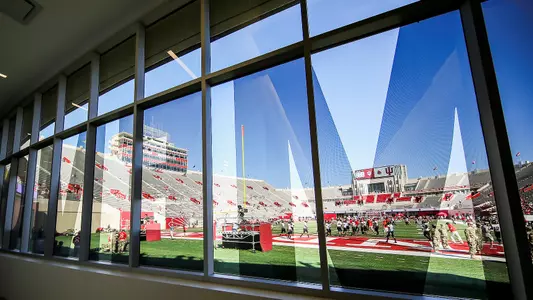
It will allow athletes to get career counseling, resume development and interview training, plus take advantage of advanced equipment to take elite athletes to an even higher level. They'll have a state-of-the-art rehabilitation center with floor-to-ceiling windows overlooking Memorial Stadium's field. There's also have a hydro-therapy center with an underwater treadmill, a lap pool and four cold/hot tubs.
Oh, there's plenty of good, nutritious food.
Beyond that, there's also a new giant videoboard, and an eye-catching landscaped plaza to provide outside confirmation of the inside excellence.
But, to really understand what it means, and where it could lead, you have to understand holistic development and even, to a certain extent, St. Ignatius. You have to recognize the state of IU's athletic department when Glass arrived in January of 2009.
You also have to understand that Glass, a lawyer by training, a get-things-done force of nature by temperament, took the job with zero experience in athletic administration, but a ton of experience in making a difference in wherever he was, especially Indianapolis.
"The reason I was here was a major infractions case that tore at the heart of everything we'd like to think about ourselves – that we didn't cheat and we cared about academics, and (Kelvin Sampson) was a cheater and didn't care about academics," he says.
"I was the fifth athletic director in eight years. I felt like, from my perspective, the department was adrift if not dysfunctional and all these people thought it was normal and it wasn't normal. They were reacting the way people might in that situation -- they kept their head down; they didn't want to be seen; they didn't want to color outside the lines; they didn't want to take any chances.
"I had to create an esprit de corps (a feeling of pride and loyalty) where this was about something bigger than yourself so people could rally around something and move on from there."
For Glass, that led to his Five Priorities (Play by the rules; Being well in mind, body and spirit; Achieving academically; Excelling athletically; Integrating with the University) which led to his 24 Sports, One Team which led to the Excellence Academy, a new gateway to the athletics campus and a first-of-its-kind concept in student-athlete development.
"I really believe we need to be developing these kids holistically, academically and athletically for sure, but also personally and everything that all that means," Glass says. "It doesn't just happen. You have to be mindful of that."
And that leads to St. Ignatius.
He was a Spanish priest and theologian who around 500 years ago founded the religious society known as the Jesuits, which promotes, among other things, developing the whole person -- heart, mind and soul.
That resonates strongly with Glass, a self-described "Jesuit-educated person," who says he's a "big fan of the Jesuits being leaders of people."
Glass wants the best for all IU student-athletes and that means a lot more than bench-press totals, 40-yard dash times and points-per-game averages.
And so, the Excellence Academy came into existence.
"My belief is this is, A) The right thing to do, and B) Helps us compete," Glass says.
Make no mistake, Glass likes to compete, while doing it the right way, against some of the nation's fiercest -- and best-funded -- sports programs.
How do you do that?
You go where no one has gone before.
"We have to find ways to differentiate ourselves, like 24 Sports, One Team, like the Five Priorities, like the Student Bill of Rights, like being progressive on combating sexual assault, like our commitment to the personal development of student-athletes," Glass says.
"It matters not only in the attraction and retention of students, but also in the attraction and retention of coaches."
Numerous interviews when he first got the job gave Glass an idea of what needed to be done, and he was in no mood to wait.
"We started the Excellence Academy with an emphasis on leadership and life skills, also health and wellness, career counseling, getting them ready for the next step. I had this distant hope that we could have an Excellence Academy building to house the program, but until then, we'd focus on the program."
That focus has drawn national attention.
"It's been well received and recognized as one of the most innovative programs around," Glass says. "In fact, I read with pleasure that Georgetown University, a Jesuit institution, started a personal development program and identified Indiana's Excellence Academy as what they wanted to be. Sort of the Gold Standard."
The gold standard came without limitless supplies of gold. Big Ten powers such as Ohio State, Michigan and Penn State will always dwarf IU in resources. Can the Excellence Academy level the playing field?
You bet, Glass says.
"We're not going to out-economically power anybody in the Big Ten. Economically we're at the lower end of the Big Ten even though we've more than doubled our budget since I've been here in the last 10 years (from around $55 million to around $110 million)."
An Excellence Academy program is one thing. A facility to fit it all is another. It takes vision, planning and money.
IU had the first two, and went into aggressive fund-raising mode for the third.
"When we started talking about a building to house it," Glass says, "it was awesome because we had spent so much time working on the program, we knew what we wanted the facility to be like. Sometimes it's inverted. People build a building and wonder what they want to do with it.
"We had this need that we think balances out the three things we're trying to do - we're trying to develop the kids athletically, academically and personally better than any school in the country. We have the Wilkinson Performance Center for the athletics, which is state of the art. We have the Shuel Center for academics, which is state of the art. Now we have the Excellence Academy, which is state of the art for personal development. It's all right here at Memorial Stadium. I think that's unique."
Did Glass always want the Excellence Academy as part of Memorial Stadium?
Not necessarily.
"Early on I didn't think much about location," he says. "But as time went on, I really liked the symmetry of having those three facilities in one place. We call that the Circle of Excellence. Our student-athletes can come to one place and do all of their business -- they can work out, do their academics, work on their resumes and video-taped interview training, see the doctor, get their treatments, and it's all in one place."
The benefits are obvious for current athletes as well as future ones.
"That's most important for our kids who are here," Glass says, "but I will allow from a recruiting perspective it's really dramatic when you walk moms and dads, aunts and uncles, and coaches through this place," Glass says. "This really says who we are."
The Excellence Academy is the culmination, but not the conclusion, of Glass's decade-long quest to position Indiana for long-term success on and off the field.
"It would be the capstone other than the fact I'm not done yet," he says.
"When I got here, we weren't that far ahead of some (high school) 6A programs in football facilities. We weren't that far ahead of many (Mid-American Conference) programs. It was a joke.
"The infrastructure hadn't changed much since I left here in 1981 as a graduate. I get all the reasons why. Through more aggressive fundraising and a little wind at our back through the TV deal, and prioritizing it, we've been able to remake the athletic campus in a way -- and I don't think it's luxurious -- that we needed to in order to compete in a really tough conference.
"Now we have a legit Big Ten football stadium. We take a backseat to no one with our facilities. I'm very proud of that.
"I think we're in touching distance of almost everybody, and leading in some other areas, after almost $300 million in investment in new facilities in the 10 years I've been here. We can compete for another generation.
"Nowhere is that more clear than Memorial Stadium, where we have the North End Zone and the Wilkinson Performance Center for Athletic Training, the Shuel Academic Center, and the Excellence Academy.
"That's right in my strike zone. I believe in leadership, and, not just as an add-on so these kids are ready to get jobs, go to interviews and be leaders. I think that personal development helps you win, and helps them with their studies. It's all very symbiotic."
The Excellence Academy facility made a recruiting impact even before it was finished in August.
"If you talk to our coaches, this is a Wow for recruits," Glass says. "In talking to the kids, they feel well cared for. I think they feel we have their backs. That's important."
IU is the only school in the country with an Excellence Academy facility. Glass says that might never change.
"People aren't champing at the bit to devote prime real estate for leadership and life skills. We might be the only school in the country that has real estate in the athletics campus dedicated to that, to career development. For a lot of people, that's not a core of what they're trying to do.
"Maybe people will follow. Maybe they won't. I think there's a good chance this will remain unusual for a long time."
How's that for motivating?
IUHoosiers.com
BLOOMINGTON, Ind. – We're talking Indiana University sports, Jesuit philosophy, legacies and a bright Cream & Crimson future with Fred Glass.
In other words, brace yourself.
Indiana's director of athletics sits in the Tobias Nutrition Center, a huge part of the Excellence Academy that once again puts the Hoosiers at the forefront of collegiate innovation and contemplates a whole new opportunity for IU athletics, and for the university as a whole.
Exciting?
You'd better believe it.
Motivating?
Darn straight.
You might think it starts with the recent dedication of the Excellence Academy, a $53-million, 66,575-square foot Memorial Stadium masterpiece that also includes the Dr. Lawrence D. Rink Center for Sports Medicine and Technology, the Irsay Family Wellness Clinic, the Center for Elite Athletic Development, the Rehabilitation and Treatment Center, the Hancock Hiltunen Caito Center for Leadership and Life Skills, and the Glass Family Leadership Suite.
It will allow athletes to get career counseling, resume development and interview training, plus take advantage of advanced equipment to take elite athletes to an even higher level. They'll have a state-of-the-art rehabilitation center with floor-to-ceiling windows overlooking Memorial Stadium's field. There's also have a hydro-therapy center with an underwater treadmill, a lap pool and four cold/hot tubs.
Oh, there's plenty of good, nutritious food.
Beyond that, there's also a new giant videoboard, and an eye-catching landscaped plaza to provide outside confirmation of the inside excellence.
But, to really understand what it means, and where it could lead, you have to understand holistic development and even, to a certain extent, St. Ignatius. You have to recognize the state of IU's athletic department when Glass arrived in January of 2009.
You also have to understand that Glass, a lawyer by training, a get-things-done force of nature by temperament, took the job with zero experience in athletic administration, but a ton of experience in making a difference in wherever he was, especially Indianapolis.
"The reason I was here was a major infractions case that tore at the heart of everything we'd like to think about ourselves – that we didn't cheat and we cared about academics, and (Kelvin Sampson) was a cheater and didn't care about academics," he says.
"I was the fifth athletic director in eight years. I felt like, from my perspective, the department was adrift if not dysfunctional and all these people thought it was normal and it wasn't normal. They were reacting the way people might in that situation -- they kept their head down; they didn't want to be seen; they didn't want to color outside the lines; they didn't want to take any chances.
"I had to create an esprit de corps (a feeling of pride and loyalty) where this was about something bigger than yourself so people could rally around something and move on from there."
For Glass, that led to his Five Priorities (Play by the rules; Being well in mind, body and spirit; Achieving academically; Excelling athletically; Integrating with the University) which led to his 24 Sports, One Team which led to the Excellence Academy, a new gateway to the athletics campus and a first-of-its-kind concept in student-athlete development.
"I really believe we need to be developing these kids holistically, academically and athletically for sure, but also personally and everything that all that means," Glass says. "It doesn't just happen. You have to be mindful of that."
And that leads to St. Ignatius.
He was a Spanish priest and theologian who around 500 years ago founded the religious society known as the Jesuits, which promotes, among other things, developing the whole person -- heart, mind and soul.
That resonates strongly with Glass, a self-described "Jesuit-educated person," who says he's a "big fan of the Jesuits being leaders of people."
Glass wants the best for all IU student-athletes and that means a lot more than bench-press totals, 40-yard dash times and points-per-game averages.
And so, the Excellence Academy came into existence.
"My belief is this is, A) The right thing to do, and B) Helps us compete," Glass says.
Make no mistake, Glass likes to compete, while doing it the right way, against some of the nation's fiercest -- and best-funded -- sports programs.
How do you do that?
You go where no one has gone before.
"We have to find ways to differentiate ourselves, like 24 Sports, One Team, like the Five Priorities, like the Student Bill of Rights, like being progressive on combating sexual assault, like our commitment to the personal development of student-athletes," Glass says.
"It matters not only in the attraction and retention of students, but also in the attraction and retention of coaches."
Numerous interviews when he first got the job gave Glass an idea of what needed to be done, and he was in no mood to wait.
"We started the Excellence Academy with an emphasis on leadership and life skills, also health and wellness, career counseling, getting them ready for the next step. I had this distant hope that we could have an Excellence Academy building to house the program, but until then, we'd focus on the program."
That focus has drawn national attention.
"It's been well received and recognized as one of the most innovative programs around," Glass says. "In fact, I read with pleasure that Georgetown University, a Jesuit institution, started a personal development program and identified Indiana's Excellence Academy as what they wanted to be. Sort of the Gold Standard."
The gold standard came without limitless supplies of gold. Big Ten powers such as Ohio State, Michigan and Penn State will always dwarf IU in resources. Can the Excellence Academy level the playing field?
You bet, Glass says.
"We're not going to out-economically power anybody in the Big Ten. Economically we're at the lower end of the Big Ten even though we've more than doubled our budget since I've been here in the last 10 years (from around $55 million to around $110 million)."
An Excellence Academy program is one thing. A facility to fit it all is another. It takes vision, planning and money.
IU had the first two, and went into aggressive fund-raising mode for the third.
"When we started talking about a building to house it," Glass says, "it was awesome because we had spent so much time working on the program, we knew what we wanted the facility to be like. Sometimes it's inverted. People build a building and wonder what they want to do with it.
"We had this need that we think balances out the three things we're trying to do - we're trying to develop the kids athletically, academically and personally better than any school in the country. We have the Wilkinson Performance Center for the athletics, which is state of the art. We have the Shuel Center for academics, which is state of the art. Now we have the Excellence Academy, which is state of the art for personal development. It's all right here at Memorial Stadium. I think that's unique."
Did Glass always want the Excellence Academy as part of Memorial Stadium?
Not necessarily.
"Early on I didn't think much about location," he says. "But as time went on, I really liked the symmetry of having those three facilities in one place. We call that the Circle of Excellence. Our student-athletes can come to one place and do all of their business -- they can work out, do their academics, work on their resumes and video-taped interview training, see the doctor, get their treatments, and it's all in one place."
The benefits are obvious for current athletes as well as future ones.
"That's most important for our kids who are here," Glass says, "but I will allow from a recruiting perspective it's really dramatic when you walk moms and dads, aunts and uncles, and coaches through this place," Glass says. "This really says who we are."
The Excellence Academy is the culmination, but not the conclusion, of Glass's decade-long quest to position Indiana for long-term success on and off the field.
"It would be the capstone other than the fact I'm not done yet," he says.
"When I got here, we weren't that far ahead of some (high school) 6A programs in football facilities. We weren't that far ahead of many (Mid-American Conference) programs. It was a joke.
"The infrastructure hadn't changed much since I left here in 1981 as a graduate. I get all the reasons why. Through more aggressive fundraising and a little wind at our back through the TV deal, and prioritizing it, we've been able to remake the athletic campus in a way -- and I don't think it's luxurious -- that we needed to in order to compete in a really tough conference.
"Now we have a legit Big Ten football stadium. We take a backseat to no one with our facilities. I'm very proud of that.
"I think we're in touching distance of almost everybody, and leading in some other areas, after almost $300 million in investment in new facilities in the 10 years I've been here. We can compete for another generation.
"Nowhere is that more clear than Memorial Stadium, where we have the North End Zone and the Wilkinson Performance Center for Athletic Training, the Shuel Academic Center, and the Excellence Academy.
"That's right in my strike zone. I believe in leadership, and, not just as an add-on so these kids are ready to get jobs, go to interviews and be leaders. I think that personal development helps you win, and helps them with their studies. It's all very symbiotic."
The Excellence Academy facility made a recruiting impact even before it was finished in August.
"If you talk to our coaches, this is a Wow for recruits," Glass says. "In talking to the kids, they feel well cared for. I think they feel we have their backs. That's important."
IU is the only school in the country with an Excellence Academy facility. Glass says that might never change.
"People aren't champing at the bit to devote prime real estate for leadership and life skills. We might be the only school in the country that has real estate in the athletics campus dedicated to that, to career development. For a lot of people, that's not a core of what they're trying to do.
"Maybe people will follow. Maybe they won't. I think there's a good chance this will remain unusual for a long time."
How's that for motivating?


Tuesday, September 08
Tuesday, September 08
Monday, September 07
Saturday, September 05