
Indiana University Athletics
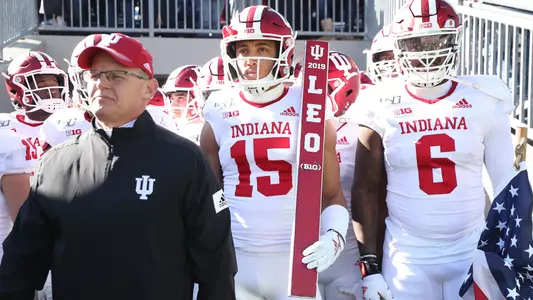
The Quest for Indiana University Football Glory - Risky Business
4/20/2020 1:00:00 PM | Football
Note: IU Athletics is partnering with IU Press to share chapters from some of their recently-published books on IU Sports. The following is a chapter from The Quest for Indiana University Football Glory, published in 2019. Additional details about this book can be found here.
Chapter 5 – Risky Business
A single guy could do something like this—a guy with no family, no wife, no kids, maybe no house. He could take a chance on college coaching, and if it didn't work out, no harm. But these stakes were far higher. At Ben Davis, Allen had a great job with a good salary, health insurance, and other benefits. Beyond that, this was one of the best coaching situations in the state, regardless of sport. Ben Davis was a big school with plenty of resources. He could do great things there. Dick Dullaghan certainly had.
But a person dreams. What did Allen really want to do? What defined him? There is the belief that a job isn't who you are but what you do, and for most that's true. But for those with a passion for what they do, a job is defining—it reflects character, belief, the ability to get the most out of yourself and those around you.
Reward comes with risk, and Allen had to ask himself, was the risk worth it? Dullaghan provided an example. After successful high school runs at Bishop Chatard and Carmel, he had coached receivers for a couple of years at Purdue in the early 1980s and then spent a season as Army's offensive coordinator before taking over at Ben Davis. He knew the challenges that college coaching presented.
"Dick Dullaghan had influence," Tom Allen Sr. says. "Dick loved the college experience. He encouraged Tommy to try it.
"Dick would tell me when recruiters from Michigan, Notre Dame, Indiana, and Purdue would come to Ben Davis, he'd tell 24 The Quest for Indiana University Football Glory them, 'I've got a coach who can coach with you in the NFL or at any level he wants.' Dick saw something in him. That was probably Tommy's greatest influence." Basically, Dullaghan encouraged Allen to follow his heart.
"He told me that, 'I want to go to college. I've reset my goals and would like to be a college coach and ultimately a defensive coordinator at the Big Ten level,'" Dullaghan says.
Allen was ready for one of the biggest decisions of his life.
"It was a big risk, but it was an easy decision," Allen says. "I knew in my heart what I wanted. I would have lived with a lot of regret if I had never taken the opportunity to try college football.
"Now I wasn't guaranteed the outcome and how long it would last. The risk involved the [high school] retirement [money]. You lose all that. You lose the guarantee of a lot of things. When you get into college, you're tied to the head coach. There are a lot of unknowns. You don't know the level you'll end up.
"I had many people who thought I was crazy, especially going to a non–head coaching position or a non-coordinator position. I was the special teams coordinator [at Wabash], but that's not the same as being the defensive coordinator. Many thought it wasn't a good move. They were like, 'What are you doing?' "The ones who were in college said, 'If you want to coach college, you've got to go do it.' Wabash was a great opportunity with a program that had been successful with a great head coach [Chris Creighton]. From my perspective, yes, risky, but I was willing to take that risk.
"It's not the normal path. Most people haven't done it that way.
It was definitely unorthodox." Then Allen did what he does best—he got everybody to buy in.
It started with Tracy, who would bear a heavy burden. Because of the workload, including recruiting, college coaches are rarely home.
In some ways, she would almost be a single mom, taking care of the kids, the house, the yard, the transportation, the extracurricular activities, and everything else.
It was even more hectic for Tracy, who worked full time as a high school math teacher.
"The beauty of all this was I was very naïve," she says. "I never anticipated living in seven states in ten years. So I was all for it.
"I remember sitting in our living room when we were at Ben Davis.
I specifically asked him what the dream was. He said, 'I want to be a Big Ten defensive coordinator.' I said, 'OK, let's go.' Over time, his dream has become our dream." The dream began at Wabash College, a successful program in the small Indiana town of Crawfordsville, about an hour west of Indianapolis. Allen would coach special teams and the secondary in the fall of 2007 for head coach Chris Creighton.
"When we made the jump to Wabash," Tracy says, "Tom drove back and forth from Indianapolis the whole spring. He kept his job at Ben Davis. It was not your typical 'you come in January and we'll hire you.' Wabash didn't have the resources to do that." That summer, the Allens sold their house and moved to Crawfordsville.
Wabash had a big year, going 11–2 and reaching the NCAA Division III quarterfinals, and, by December, Creighton had left Wabash to take over the Drake program.
Allen scrambled to find another job.
"You win eleven games, and you're out of a job," Tracy says. "It was like, 'So this is college football.'" Then it was on to Lambuth (defensive coordinator) in 2008, Drake (defensive coordinator) in 2010, Arkansas State (linebackers coach) in 2011, Mississippi (linebackers, special teams) in 2012, and South Florida (defensive coordinator) in 2015.
"Every place he went," Dullaghan says, "you could see his influence on the defense. You saw the enthusiasm and motivational skill he possesses. And he got tremendous experience." Allen also got a tough lesson in college coaching reality. Every team he coached on had success, which meant the head coach got a better job, which meant Allen had to scramble to find another job.
He went to Lambuth in Tennessee under head coach Hugh Freeze. At that time, he and Tracy had three small children and lots of uncertainty. They rented a one-bedroom apartment and made the best of it.
"I bought the kids cots," Tracy says. "I slept on a loveseat every night.
"I'll never forget that first night. I put the cots down, and the kids were like, 'This is fun.' I'm crying. They thought it was a blast.
I'm crying. It was hard. Tom's gone. I don't know who Hugh Freeze is. I don't know what Lambuth is. First time I saw the school, the facilities were worse than any high school we'd been at. I was like, 'What are we doing?'" Still, in two years, Lambuth went 8–4 and 12–1. That earned Freeze the head coaching job at Arkansas State. It got Allen another job search.
"In our first three years in college, we lost less than five games," Tracy says, "and he was without a job again.
"There were high schools wanting him back. I was like, 'Is this what it's going to be like? We win, the head coach advances, and you're without a job all the time.' "It was very frightening. We had young children. At that point, we had to decide do we keep fighting and pursuing the dream, or do we go back to high school?" One of those high school possibilities, Tracy says, was Bloomington South High School.
Then Chris Creighton called with a job opportunity at Drake.
Allen was there a year, and then Freeze called with a job offer at Arkansas State. A year after that, Freeze got the head coaching job at the SEC's Mississippi. This time, he took Allen with him.
The Allens spent three years at Mississippi. The Rebels went 24–15 and ranked among the SEC's best defenses. The year before Allen's arrival, Mississippi had been last in the SEC in total defense.
In 2015, Allen took the defensive coordinator job at South Florida.
That was another risk. Head coach Willie Taggart had gone 2–10 and 4–8 in his first two seasons. Speculation had him on the hot seat. One more losing season and he might be fired. There was the chance this could be another one-and-done move for the Allens.
Making it worse, South Florida opened 1–3, while Mississippi started 4–0 and ranked in the top twenty.
"At times you think, 'What have we done?'" Tracy says. "Tom never blinked. He said, 'God told me to take this job; we're going to be OK. If we get fired, we'll be OK. If we win, that's great.'" South Florida won seven of its next eight games to earn a bid to the Miami Beach Bowl. Allen's defense led the American Athletic Conference by allowing just 19.6 points in conference play.
"It looked like it was a risky move," Tracy says, "but he thought it was the right move. He's pretty brave, focused, and determined.
That's why I call him the Lion Chaser." As it turned out, the chasing wasn't over. Neither was the risk. In January of 2016 came Hoosier opportunity. Indiana was a defensive mess that had lasted a generation. The Hoosiers scored big and allowed bigger. Head coach Kevin Wilson had fired his two previous defensive coordinators and was scouring the country looking for the right person for the job. The name Tom Allen kept popping up.
"In January of 2016, Kevin Wilson called me," Dullaghan says. "I was in Florida on vacation. He said, 'Dick, tell me why I should not hire Tom Allen.' I said, 'I promise you, if you hire him, there will be a culture change in your program. There was in mine when he came.
He's had the same effect most every place he's been.' "If you want a guy who will scream and cuss and berate players, rip their butts and attack them personally, that's not who you want.
He is a teacher. He's a master motivator. He's a guy who knows how to get to a kid's hot button. He knows how to love them into submission, and they play unselfishly for the good of the team.
"I think Kevin had already decided he was going to hire Tom. I was pleased when he was hired. I've been in Indiana most of my life.
Even though I coached at Purdue for three years, I was tickled to death to see Tom go to Indiana." Allen's impact was dramatic in that 2016 season. Against a schedule that featured four top-ten opponents, the Hoosiers became a 28 The Quest for Indiana University Football Glory defensive force. They held teams to 380.1 total yards, an improvement of 129.4 yards from the previous season, and the best in the country. They allowed 10.4 fewer points and gave up 25 fewer touchdowns.
"It was obvious in 2016 that there was a culture change in defense," Dullaghan says. "It was there. It was obvious. Everybody in the whole country saw it." That included IU athletic director Fred Glass, who was about to make his own dramatic change in the football program.
Chapter 5 – Risky Business
A single guy could do something like this—a guy with no family, no wife, no kids, maybe no house. He could take a chance on college coaching, and if it didn't work out, no harm. But these stakes were far higher. At Ben Davis, Allen had a great job with a good salary, health insurance, and other benefits. Beyond that, this was one of the best coaching situations in the state, regardless of sport. Ben Davis was a big school with plenty of resources. He could do great things there. Dick Dullaghan certainly had.
But a person dreams. What did Allen really want to do? What defined him? There is the belief that a job isn't who you are but what you do, and for most that's true. But for those with a passion for what they do, a job is defining—it reflects character, belief, the ability to get the most out of yourself and those around you.
Reward comes with risk, and Allen had to ask himself, was the risk worth it? Dullaghan provided an example. After successful high school runs at Bishop Chatard and Carmel, he had coached receivers for a couple of years at Purdue in the early 1980s and then spent a season as Army's offensive coordinator before taking over at Ben Davis. He knew the challenges that college coaching presented.
"Dick Dullaghan had influence," Tom Allen Sr. says. "Dick loved the college experience. He encouraged Tommy to try it.
"Dick would tell me when recruiters from Michigan, Notre Dame, Indiana, and Purdue would come to Ben Davis, he'd tell 24 The Quest for Indiana University Football Glory them, 'I've got a coach who can coach with you in the NFL or at any level he wants.' Dick saw something in him. That was probably Tommy's greatest influence." Basically, Dullaghan encouraged Allen to follow his heart.
"He told me that, 'I want to go to college. I've reset my goals and would like to be a college coach and ultimately a defensive coordinator at the Big Ten level,'" Dullaghan says.
Allen was ready for one of the biggest decisions of his life.
"It was a big risk, but it was an easy decision," Allen says. "I knew in my heart what I wanted. I would have lived with a lot of regret if I had never taken the opportunity to try college football.
"Now I wasn't guaranteed the outcome and how long it would last. The risk involved the [high school] retirement [money]. You lose all that. You lose the guarantee of a lot of things. When you get into college, you're tied to the head coach. There are a lot of unknowns. You don't know the level you'll end up.
"I had many people who thought I was crazy, especially going to a non–head coaching position or a non-coordinator position. I was the special teams coordinator [at Wabash], but that's not the same as being the defensive coordinator. Many thought it wasn't a good move. They were like, 'What are you doing?' "The ones who were in college said, 'If you want to coach college, you've got to go do it.' Wabash was a great opportunity with a program that had been successful with a great head coach [Chris Creighton]. From my perspective, yes, risky, but I was willing to take that risk.
"It's not the normal path. Most people haven't done it that way.
It was definitely unorthodox." Then Allen did what he does best—he got everybody to buy in.
It started with Tracy, who would bear a heavy burden. Because of the workload, including recruiting, college coaches are rarely home.
In some ways, she would almost be a single mom, taking care of the kids, the house, the yard, the transportation, the extracurricular activities, and everything else.
It was even more hectic for Tracy, who worked full time as a high school math teacher.
"The beauty of all this was I was very naïve," she says. "I never anticipated living in seven states in ten years. So I was all for it.
"I remember sitting in our living room when we were at Ben Davis.
I specifically asked him what the dream was. He said, 'I want to be a Big Ten defensive coordinator.' I said, 'OK, let's go.' Over time, his dream has become our dream." The dream began at Wabash College, a successful program in the small Indiana town of Crawfordsville, about an hour west of Indianapolis. Allen would coach special teams and the secondary in the fall of 2007 for head coach Chris Creighton.
"When we made the jump to Wabash," Tracy says, "Tom drove back and forth from Indianapolis the whole spring. He kept his job at Ben Davis. It was not your typical 'you come in January and we'll hire you.' Wabash didn't have the resources to do that." That summer, the Allens sold their house and moved to Crawfordsville.
Wabash had a big year, going 11–2 and reaching the NCAA Division III quarterfinals, and, by December, Creighton had left Wabash to take over the Drake program.
Allen scrambled to find another job.
"You win eleven games, and you're out of a job," Tracy says. "It was like, 'So this is college football.'" Then it was on to Lambuth (defensive coordinator) in 2008, Drake (defensive coordinator) in 2010, Arkansas State (linebackers coach) in 2011, Mississippi (linebackers, special teams) in 2012, and South Florida (defensive coordinator) in 2015.
"Every place he went," Dullaghan says, "you could see his influence on the defense. You saw the enthusiasm and motivational skill he possesses. And he got tremendous experience." Allen also got a tough lesson in college coaching reality. Every team he coached on had success, which meant the head coach got a better job, which meant Allen had to scramble to find another job.
He went to Lambuth in Tennessee under head coach Hugh Freeze. At that time, he and Tracy had three small children and lots of uncertainty. They rented a one-bedroom apartment and made the best of it.
"I bought the kids cots," Tracy says. "I slept on a loveseat every night.
"I'll never forget that first night. I put the cots down, and the kids were like, 'This is fun.' I'm crying. They thought it was a blast.
I'm crying. It was hard. Tom's gone. I don't know who Hugh Freeze is. I don't know what Lambuth is. First time I saw the school, the facilities were worse than any high school we'd been at. I was like, 'What are we doing?'" Still, in two years, Lambuth went 8–4 and 12–1. That earned Freeze the head coaching job at Arkansas State. It got Allen another job search.
"In our first three years in college, we lost less than five games," Tracy says, "and he was without a job again.
"There were high schools wanting him back. I was like, 'Is this what it's going to be like? We win, the head coach advances, and you're without a job all the time.' "It was very frightening. We had young children. At that point, we had to decide do we keep fighting and pursuing the dream, or do we go back to high school?" One of those high school possibilities, Tracy says, was Bloomington South High School.
Then Chris Creighton called with a job opportunity at Drake.
Allen was there a year, and then Freeze called with a job offer at Arkansas State. A year after that, Freeze got the head coaching job at the SEC's Mississippi. This time, he took Allen with him.
The Allens spent three years at Mississippi. The Rebels went 24–15 and ranked among the SEC's best defenses. The year before Allen's arrival, Mississippi had been last in the SEC in total defense.
In 2015, Allen took the defensive coordinator job at South Florida.
That was another risk. Head coach Willie Taggart had gone 2–10 and 4–8 in his first two seasons. Speculation had him on the hot seat. One more losing season and he might be fired. There was the chance this could be another one-and-done move for the Allens.
Making it worse, South Florida opened 1–3, while Mississippi started 4–0 and ranked in the top twenty.
"At times you think, 'What have we done?'" Tracy says. "Tom never blinked. He said, 'God told me to take this job; we're going to be OK. If we get fired, we'll be OK. If we win, that's great.'" South Florida won seven of its next eight games to earn a bid to the Miami Beach Bowl. Allen's defense led the American Athletic Conference by allowing just 19.6 points in conference play.
"It looked like it was a risky move," Tracy says, "but he thought it was the right move. He's pretty brave, focused, and determined.
That's why I call him the Lion Chaser." As it turned out, the chasing wasn't over. Neither was the risk. In January of 2016 came Hoosier opportunity. Indiana was a defensive mess that had lasted a generation. The Hoosiers scored big and allowed bigger. Head coach Kevin Wilson had fired his two previous defensive coordinators and was scouring the country looking for the right person for the job. The name Tom Allen kept popping up.
"In January of 2016, Kevin Wilson called me," Dullaghan says. "I was in Florida on vacation. He said, 'Dick, tell me why I should not hire Tom Allen.' I said, 'I promise you, if you hire him, there will be a culture change in your program. There was in mine when he came.
He's had the same effect most every place he's been.' "If you want a guy who will scream and cuss and berate players, rip their butts and attack them personally, that's not who you want.
He is a teacher. He's a master motivator. He's a guy who knows how to get to a kid's hot button. He knows how to love them into submission, and they play unselfishly for the good of the team.
"I think Kevin had already decided he was going to hire Tom. I was pleased when he was hired. I've been in Indiana most of my life.
Even though I coached at Purdue for three years, I was tickled to death to see Tom go to Indiana." Allen's impact was dramatic in that 2016 season. Against a schedule that featured four top-ten opponents, the Hoosiers became a 28 The Quest for Indiana University Football Glory defensive force. They held teams to 380.1 total yards, an improvement of 129.4 yards from the previous season, and the best in the country. They allowed 10.4 fewer points and gave up 25 fewer touchdowns.
"It was obvious in 2016 that there was a culture change in defense," Dullaghan says. "It was there. It was obvious. Everybody in the whole country saw it." That included IU athletic director Fred Glass, who was about to make his own dramatic change in the football program.

Tuesday, August 11
Tuesday, August 11
Monday, August 10
Thursday, August 06