
Indiana University Athletics
Race and Football in America: The Life and Legacy of George Taliaferro - Part 3
5/15/2020 11:42:00 AM | Football, History
Note: IU Athletics is partnering with IU Press to share chapters from some of their recently-published books on IU Sports. The following is the second part of a chapter from Dawn Knight's book, Race and Football in America: The Life and Legacy of George Taliaferro, published by IU Press in 2019. The third and final part of this chapter will appear in the coming days on IUHoosiers.com. Additional details about this book can be found here.
Part 1
Part 2
Part 3-
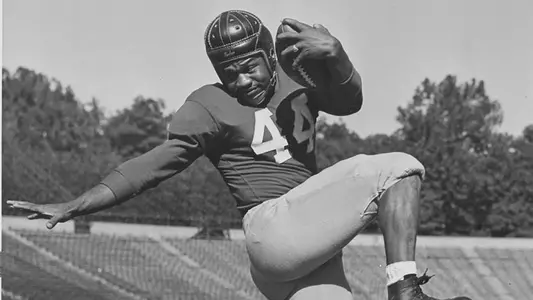
McMillin was actually one of his biggest fans, as Sam Banks, a writer for Our Sports magazine, illustrated in an article about Taliaferro. Apparently, Coach McMillin was having his usual coffee break one morning when Taliaferro and a couple of other players stopped by to see him. It wasn't out of the ordinary for them to stop in. They respected McMillin, whose conduct as both a coach and a person had encouraged and inspired them, and they considered him not only a coach but also a friend and mentor.
During the visit, however, the players had started to mess with each other. "As kids will do, they were wrestling on the stairs and George slipped and fell flat on his back," Banks wrote. McMillin rolled his eyes up as if in prayer and then ran to Taliaferro's side.
As soon as the coach got to him, Taliaferro rolled over laughing and jumped up to his feet. McMillin didn't find it quite as humorous.
"Boy, don't you ever do that to me again. Why you're my bread and butter," he told Taliaferro.
Although McMillin seemed to be joking, there was some truth to his statement. At the end of the season, Taliaferro would make All-Big Ten as a freshman at Indiana, and he would lead the Hoosiers in rushing, with 719 yards (he averaged 4.5 yards a carry and had six touchdowns). He would also lead the Hoosiers in punting, with 1,315 yards, averaging almost 33 yards a punt. He was the only Big Ten back to average more than 100 yards a game running and passing. While statistics may give some indication as to ability, however, to see him in action was more thrilling, and there were plenty of people on hand to witness his football aptitude at the memorable game against Minnesota.
 On the way to the game, Coach McMillin noticed a white horse in a field. Known for being superstitious, he immediately licked his finger and stamped it in his hand for good luck. Indiana was going to need it. The Hoosiers had only won two of its last fifty games against Minnesota, and the frigid temperature was going to make for a game the Hoosiers wouldn't soon forget. At home, Minnesota could usually count on the weather to play a factor in the game's outcome. Other teams simply were not used to playing in the extreme weather found there during football season, an obvious advantage for the Gophers. Stan Sutton wrote that the Minnesota weather "would keep a postman from finishing his route" and that "Minneapolis winters were cold enough to make penguins shiver." Although back in Indiana the weather on that November day hovered around sixty degrees, Minnesota was a different story, according to Taliaferro. A large snowstorm and freezing temperatures met the Hoosiers, whose uniforms and coats provided little relief from the bitter cold. It was exactly the kind of weather that put Minnesota at a serious advantage, earning it the title of "twelfth man." Before the game even started, Taliaferro was jumping around, trying to keep his muscles warm. It wasn't working, though, and he could feel his muscles freezing as he stood and looked out over the field. It is going to be a very long game, he thought. It may have surprised the Gophers to hear that Taliaferro was having a problem coping with the weather, though, since he started the game with a ninety-seven-yard kickoff return to the Minnesota three. His fumble on the next play, recovered by Minnesota, may have been more along the lines of what they were expecting, or at least hoping for. The play was supposed to be a snap to Taliaferro, but it went too far left, and Taliaferro lost it. Mistakes like that one were rare, though, as Taliaferro and company continued to astonish the Gopher defense despite the subzero-degree weather.
The bone-chilling temperatures didn't keep Taliaferro from scoring three touchdowns and making a ninety-yard interception return. McMillin took him out, to Taliaferro's delight, to give him a break after the third touchdown. By the time the game had ended, the Hoosiers hadn't just beaten the Golden Gophers but had handed Minnesota, a team that had won five national championships between 1934 and 1941, a 49–0 thumping, in their home stadium in weather conditions only they could truly appreciate.
The Gophers, for their part, had contributed to the Hoosier win by throwing six interceptions. A combination of coaching and playing talent had earned the Hoosiers an impressive victory.
Coach McMillin's gamble to miss the November 3 game against Cornell in order to scout the Gophers had been rewarded. Even in his absence, the Cornell game had turned out well, and he brought back a scouting report that took the Minnesota weather out of the game for the Hurryin' Hoosiers, validating McMillin's confidence in his team and his coaching staff.
The Bomen continued their season with another shutout against Pittsburgh on November 17, winning 19–0. This left the Hurryin' Hoosiers with only one more obstacle on their way to an undefeated season: archrival Purdue. The Cream and Crimson topped off the season on November 24, 1945, at the fortyeighth Old Oaken Bucket game against the Purdue Boilermakers.
On hand to watch the historic match were about twenty-seven thousand zealous fans. Unlike other Oaken Bucket games, however, this one was missing a crucial element, the Battle of the Bands. This traditional halftime feature, a battle between the rival marching bands, had to be canceled because Indiana's nationally acclaimed band, the Marching Hundred, was missing too many members because of the war. The Hoosiers had been fortunate to keep their band together as long as they had. Other universities had been forced to give up altogether on having their bands, they had such a shortage of members.
Despite the lack of halftime entertainment, at least the game was being played. In true rival fashion, the teams battled through the first half, with serious attempts to score from both sides, neither finding success. At halftime, the players went to the locker rooms evenly matched at zero. By the time the third quarter was under way, however, it was clear the Black and Gold had little left to give to the effort and were no match for the Hoosier might. The Hoosiers, on the other hand, had more fight left to exert. Their first score started when Taliaferro, Pihos, and Groomes helped get the ball to the Purdue thirty-one. Then Raimondi passed to Taliaferro, who made it to the one-yard line. Pihos finished the drive, making it into the end zone on his second attempt for the first IU touchdown of the game. A Kluszewski interception led to another Pihos score before the third quarter ended. The Hoosiers weren't finished, though. Two more Raimondi touchdown passes, to Kluszewski and Louis Mihajlovich, added another thirteen points in the fourth. The Hoosiers, as had so often been the case during that 1945 season, had dominated their opponent. The victory over rival Purdue meant that the Hoosiers had managed not just a win but an undisputed Big Ten championship, an undefeated season, and the Old Oaken Bucket trophy. The tie against Northwestern had been the only glitch in an otherwise perfect season.
An Indianapolis Star program honoring the unbeaten team described the end of the game: "As the final shot ended the game, hundreds of fans rushed onto the field, caught Bo in an avalanche, and hurried him off to the Hoosiers quarters." It went on to describe the scene in the locker room: "And the dressing room was busier than a well-stocked cigarette counter during the war shortage, all was confusion, but everyone knew that Indiana beat Purdue." Many fans remained in the locker room, still cheering their Cream and Crimson heroes. Among those, the program indicated, was McMillin's own mentor from his grammar school days in Texas, Robert Myers, McMillin's first football coach. Myers asked McMillin which underdog win had been more thrilling for him, the time he led Centre to beat Harvard or Indiana's defeat of Purdue that day. McMillin's reply, that the Indiana game was the more thrilling, came without hesitation. To sweeten the victory, President Wells, also in the locker room, canceled classes the following Monday and scheduled a convocation for later in the week for a student-body celebration.
In a ceremony after the game, another I was added to the Oaken Bucket to celebrate Indiana's 26–0 shutout victory over Purdue.
A poem written by Carl Lewis explains the bucket's glory: "I'm called the 'old' oaken bucket, but I can never be old. I live with youth and will as long as there are young men to vie for my favor one November day each year." The Hoosiers could not have scripted a better ending to their perfect season than earning the coveted trophy. After the game, Russell "Mutt" Deal's Indiana teammates voted the decorated World War II veteran the permanent captain of the team. It was Deal's fourth game against Purdue and fourth victory over this rival.
So, under the leadership of Coach McMillin and Russell Deal, in 1945, Indiana University, with a record of 9–0–1, had an undefeated football season for the first and only time in the school's history. The football team also won an undisputed Big Ten championship for the first time, though this powerful conference was actually called the Western Conference or "Big Nine" at the time.
The University of Chicago had been part of the conference but had dropped out, thus earning the conference its new nickname.
Although it remained the Big Nine the entire time Taliaferro played for Indiana, many people still referred to the conference as the "Big Ten." Later, when Michigan State joined the conference, it became the Big Ten again anyway. So Indiana had won an undisputed Big Ten championship. Today, there are fourteen teams in the Big Ten Conference.
"It can happen. A football team wallowing in the muck of mediocrity suddenly takes off and soars, higher than it has ever flown before. And then almost as abruptly it descends, never to repeat its journey," Mark Montieth wrote in a 1995 Indianapolis Star article about that 1945 football season. "Call it kismet, karma, destiny, or anything you like. It's what happens when talent, effort and good fortune merge for one brief shining moment to produce something that borders on perfection," he continued.
Yet some critics, who apparently did not believe in kismet, karma, or destiny, credited World War II with Indiana's perfect season.
Coach McMillin did not take kindly to such suggestions. He was rather insulted at the idea, believing his "po li'l boys" simply had the determination and the talent to make it happen. The fact that five of his starters had earned postseason honors supported McMillin's position. Bob Ravensberg was named All-American first team, second team, and All-Big Ten second team. Pete Pihos was named All-American second team and All-Big Ten first team. Ted Kluszewski was named All-Big Ten first team, and John Goldsberry was named All-Big Ten second team. Freshman George Taliaferro also racked up the honors. On top of this, the Indiana University football program earned, along with a conference championship, a fourth-place ranking in the Associated Press football poll. In first, second, and third place were Army, Navy, and Alabama's Crimson Tide. The Hoosiers were in good company. Adding to the accolades was Bo McMillin, who was named Coach of the Year.
McMillin would have liked IU to get a chance to play number one-ranked Army, and there had actually been talk of a postseason game between the two greats. Hammel and Klingelhoffer explained that Big Ten rules prohibited postseason play for its teams but that there was a movement for a bowl matchup between Army and Indiana at Soldier Field for war relief. As many as 125,000 people were expected to attend what was sure to be a battle. Apparently General Eisenhower denied permission, citing that the cadets had to study for their midterm exams. However, McMillin was confident his Hoosiers could have taken the popular Army team. According to Hammel and Klingelhoffer, McMillin said in a speech at his Coach of the Year dinner, "I haven't seen Blanchard but until I do, I'll settle for Pete Pihos any time. . . . I've heard a lot about DeWitt Coulter, Army's wonderful left tackle. I never saw Coulter play, but until I have, I'll take John Goldsberry, our 230-pound left tackle and the fastest man on our line." He continued, "Maybe you've never heard of Ted Kluszewski and Bob Ravensberg, our ends. They were the best ends Fritz Crisler of Michigan saw all season, by his own quotes. . . . Our line was probably the best in the Big Ten in ten years, the real secret of our unbeaten season and Big Ten Championship. That line allowed only one touchdown all season, and that was by Michigan in the first game, before Brown, Cannady and Pihos were in the lineup." McMillin didn't stop there. "It was a hell of a line. . . . It's too bad Army had a full schedule. We'd have loved to meet them," he said.
Although the two teams never got a chance to play, that didn't keep people from debating who would have won. Hammel and Klingelhoffer pointed to the Michigan games, which were the only true comparisons that could be made of the two football teams. Indiana had beaten the Wolverines 13–7, while Army had beaten the Wolverines by a slightly larger margin, 28–7. Still, that wasn't a true comparison because the Indiana-Michigan game, the first of the season, was before the return of two of Indiana's key players, Pete Pihos and Howard Brown. Who would have won a contest between the two is anybody's guess. Hoosier fans, no doubt, believed the Bomen could have taken a tough Army team. The only thing that wasn't up for debate was that it would have been a hell of a game to watch.
The end of the 1945 college football season signaled a new beginning for professional football. At the same time that IU was winning the Big Ten championship, the National Football League was emerging as a force in professional sports. Robert Peterson, author of Pigskin: The Early Years of Pro Football, wrote that by the end of the 1945 season, pro players, like their college counterparts, were starting to return to their teams after having served in World War II. NFL fans were also beginning to return.
In 1942, attendance had dropped to about 900,000. In 1945, however, an attendance record was set with 1,918,631 fans enjoying professional football, an average of 28,636 for the season's sixty eight games and a big boost from 1942. Things were beginning to look up for the war-scarred league.
The league was evolving because of the war, and it was bringing with it a new tradition for the same reason. A pregame event that had started as a show of patriotism during the war became a permanent part of NFL and athletic competition tradition.
Peterson wrote, "During the war, playing the national anthem had become a ceremonial prelude to NFL games." Even though the war was over, the commissioner felt that the anthem should continue to be played before each game. Peterson quoted Commissioner Elmer Layden's announcement: "It should be as much a part of every game as the kickoff. We must not drop it simply because the war is over. We should never forget what it stands for." The NFL, responsible for starting the tradition, would be the source of a controversy surrounding it more than seventy years later, when dozens of its players would kneel and link arms during the playing of the national anthem to protest racial inequality.
However, the anthem protests, as they came to be known, were not the first time football was used as a platform through which to promote social change.
Peterson wrote that a 1945 Newsweek article also predicted positive changes for professional football. He quoted Newsweek columnist John Lardner, who wrote, "The end of the war may be the event which will build the sport into national proportions both geographically and commercially, just as the end of the last war gave pro players their original impetus and made them begin to think of organization and responsibility." The war was over, bringing changes to the world and to professional football. Lardner was right. There were big changes in store for professional football, and George Taliaferro would eventually be a significant part of those changes.
Taliaferro was a varsity letter recipient his freshman year. He was a major contributor to Indiana's football glory, and he was named the league's best all-around offensive player, Associated Press first team Big Ten, and second team All-American by the Sporting News. He was also the only Big Ten back to average more than a hundred yards a game, running and passing. His role as a star player at a major university widened his influence on African American boys, moving it beyond the confines of Gary, Indiana. Later, William Wiggins, as an IU professor, would describe Taliaferro's influence on writer Ryan Whirty: "Whenever guys played football in the backyard, everybody wanted to be George Taliaferro." Professional football, which would further Taliaferro's influence, was in his future, but he still had a couple of years before it would significantly change his life. Although 1945 was a good football year for both Taliaferro and the NFL, each still had obstacles to overcome before their destinies would become intertwined. Taliaferro had color barriers to fight, and a new professional football league, the All-America Football Conference, was about to challenge the dominance of the National Football League.
During the 1945 season, Taliaferro had encountered some racism on the football field and in Bloomington. But the racism that hit Taliaferro the hardest occurred right after the Big Ten championship. A wall-sized picture of the 1945 championship team, which ran as an ad in the Indiana University football game programs, was hung on a wall at the Gables restaurant, a restaurant on the gown side, the campus side, of Bloomington. The restaurant "was just down the street from where Hoagy Carmichael wrote 'Stardust,'" Taliaferro said. Segregation prevented Taliaferro and the other black members of the football team from entering the popular restaurant, thus also preventing them from seeing the hand-tinted photograph that featured the eleven starters.
Taliaferro was in the second row, just to the right of center.
Occasionally, he would try to see the picture, managing to get just a glimpse. Since the picture hung on the far-left wall, he would go to the far-right window of the Gables, cup his hands around his face, and press his forehead against the glass. After several attempts turning his head this way and that, he discovered just the right angle to see some of the championship picture. He couldn't see the left side of the picture at all, no matter how he turned his head, but he "could see the most important person on that picture, which was me," he joked. It would be another two years before Taliaferro actually had the opportunity to see the picture in its entirety.
In November, the Nuremberg trials began. Twenty-two German officers were put on trial in Nuremberg, Germany, for war crimes. The judges were from France, Great Britain, Russia, and the United States. When the trials were over, twelve men were sentenced to death by hanging, seven were given jail terms, and three were set free. While the trials signaled that the war was ostensibly over, the draft was not. Before he had a chance to finish his freshman year, Taliaferro received a letter from Uncle Sam demanding that he serve his country. He wouldn't be back at Indiana University in the fall to play for McMillin. Instead, like so many black servicemen, he would spend his time in the army fighting racism, a more visible enemy than any others he would encounter as an American soldier.
Part 1
Part 2
Part 3-
McMillin was actually one of his biggest fans, as Sam Banks, a writer for Our Sports magazine, illustrated in an article about Taliaferro. Apparently, Coach McMillin was having his usual coffee break one morning when Taliaferro and a couple of other players stopped by to see him. It wasn't out of the ordinary for them to stop in. They respected McMillin, whose conduct as both a coach and a person had encouraged and inspired them, and they considered him not only a coach but also a friend and mentor.
During the visit, however, the players had started to mess with each other. "As kids will do, they were wrestling on the stairs and George slipped and fell flat on his back," Banks wrote. McMillin rolled his eyes up as if in prayer and then ran to Taliaferro's side.
As soon as the coach got to him, Taliaferro rolled over laughing and jumped up to his feet. McMillin didn't find it quite as humorous.
"Boy, don't you ever do that to me again. Why you're my bread and butter," he told Taliaferro.
Although McMillin seemed to be joking, there was some truth to his statement. At the end of the season, Taliaferro would make All-Big Ten as a freshman at Indiana, and he would lead the Hoosiers in rushing, with 719 yards (he averaged 4.5 yards a carry and had six touchdowns). He would also lead the Hoosiers in punting, with 1,315 yards, averaging almost 33 yards a punt. He was the only Big Ten back to average more than 100 yards a game running and passing. While statistics may give some indication as to ability, however, to see him in action was more thrilling, and there were plenty of people on hand to witness his football aptitude at the memorable game against Minnesota.
On the way to the game, Coach McMillin noticed a white horse in a field. Known for being superstitious, he immediately licked his finger and stamped it in his hand for good luck. Indiana was going to need it. The Hoosiers had only won two of its last fifty games against Minnesota, and the frigid temperature was going to make for a game the Hoosiers wouldn't soon forget. At home, Minnesota could usually count on the weather to play a factor in the game's outcome. Other teams simply were not used to playing in the extreme weather found there during football season, an obvious advantage for the Gophers. Stan Sutton wrote that the Minnesota weather "would keep a postman from finishing his route" and that "Minneapolis winters were cold enough to make penguins shiver." Although back in Indiana the weather on that November day hovered around sixty degrees, Minnesota was a different story, according to Taliaferro. A large snowstorm and freezing temperatures met the Hoosiers, whose uniforms and coats provided little relief from the bitter cold. It was exactly the kind of weather that put Minnesota at a serious advantage, earning it the title of "twelfth man." Before the game even started, Taliaferro was jumping around, trying to keep his muscles warm. It wasn't working, though, and he could feel his muscles freezing as he stood and looked out over the field. It is going to be a very long game, he thought. It may have surprised the Gophers to hear that Taliaferro was having a problem coping with the weather, though, since he started the game with a ninety-seven-yard kickoff return to the Minnesota three. His fumble on the next play, recovered by Minnesota, may have been more along the lines of what they were expecting, or at least hoping for. The play was supposed to be a snap to Taliaferro, but it went too far left, and Taliaferro lost it. Mistakes like that one were rare, though, as Taliaferro and company continued to astonish the Gopher defense despite the subzero-degree weather.The bone-chilling temperatures didn't keep Taliaferro from scoring three touchdowns and making a ninety-yard interception return. McMillin took him out, to Taliaferro's delight, to give him a break after the third touchdown. By the time the game had ended, the Hoosiers hadn't just beaten the Golden Gophers but had handed Minnesota, a team that had won five national championships between 1934 and 1941, a 49–0 thumping, in their home stadium in weather conditions only they could truly appreciate.
The Gophers, for their part, had contributed to the Hoosier win by throwing six interceptions. A combination of coaching and playing talent had earned the Hoosiers an impressive victory.
Coach McMillin's gamble to miss the November 3 game against Cornell in order to scout the Gophers had been rewarded. Even in his absence, the Cornell game had turned out well, and he brought back a scouting report that took the Minnesota weather out of the game for the Hurryin' Hoosiers, validating McMillin's confidence in his team and his coaching staff.
The Bomen continued their season with another shutout against Pittsburgh on November 17, winning 19–0. This left the Hurryin' Hoosiers with only one more obstacle on their way to an undefeated season: archrival Purdue. The Cream and Crimson topped off the season on November 24, 1945, at the fortyeighth Old Oaken Bucket game against the Purdue Boilermakers.
On hand to watch the historic match were about twenty-seven thousand zealous fans. Unlike other Oaken Bucket games, however, this one was missing a crucial element, the Battle of the Bands. This traditional halftime feature, a battle between the rival marching bands, had to be canceled because Indiana's nationally acclaimed band, the Marching Hundred, was missing too many members because of the war. The Hoosiers had been fortunate to keep their band together as long as they had. Other universities had been forced to give up altogether on having their bands, they had such a shortage of members.
Despite the lack of halftime entertainment, at least the game was being played. In true rival fashion, the teams battled through the first half, with serious attempts to score from both sides, neither finding success. At halftime, the players went to the locker rooms evenly matched at zero. By the time the third quarter was under way, however, it was clear the Black and Gold had little left to give to the effort and were no match for the Hoosier might. The Hoosiers, on the other hand, had more fight left to exert. Their first score started when Taliaferro, Pihos, and Groomes helped get the ball to the Purdue thirty-one. Then Raimondi passed to Taliaferro, who made it to the one-yard line. Pihos finished the drive, making it into the end zone on his second attempt for the first IU touchdown of the game. A Kluszewski interception led to another Pihos score before the third quarter ended. The Hoosiers weren't finished, though. Two more Raimondi touchdown passes, to Kluszewski and Louis Mihajlovich, added another thirteen points in the fourth. The Hoosiers, as had so often been the case during that 1945 season, had dominated their opponent. The victory over rival Purdue meant that the Hoosiers had managed not just a win but an undisputed Big Ten championship, an undefeated season, and the Old Oaken Bucket trophy. The tie against Northwestern had been the only glitch in an otherwise perfect season.
An Indianapolis Star program honoring the unbeaten team described the end of the game: "As the final shot ended the game, hundreds of fans rushed onto the field, caught Bo in an avalanche, and hurried him off to the Hoosiers quarters." It went on to describe the scene in the locker room: "And the dressing room was busier than a well-stocked cigarette counter during the war shortage, all was confusion, but everyone knew that Indiana beat Purdue." Many fans remained in the locker room, still cheering their Cream and Crimson heroes. Among those, the program indicated, was McMillin's own mentor from his grammar school days in Texas, Robert Myers, McMillin's first football coach. Myers asked McMillin which underdog win had been more thrilling for him, the time he led Centre to beat Harvard or Indiana's defeat of Purdue that day. McMillin's reply, that the Indiana game was the more thrilling, came without hesitation. To sweeten the victory, President Wells, also in the locker room, canceled classes the following Monday and scheduled a convocation for later in the week for a student-body celebration.
In a ceremony after the game, another I was added to the Oaken Bucket to celebrate Indiana's 26–0 shutout victory over Purdue.
A poem written by Carl Lewis explains the bucket's glory: "I'm called the 'old' oaken bucket, but I can never be old. I live with youth and will as long as there are young men to vie for my favor one November day each year." The Hoosiers could not have scripted a better ending to their perfect season than earning the coveted trophy. After the game, Russell "Mutt" Deal's Indiana teammates voted the decorated World War II veteran the permanent captain of the team. It was Deal's fourth game against Purdue and fourth victory over this rival.
So, under the leadership of Coach McMillin and Russell Deal, in 1945, Indiana University, with a record of 9–0–1, had an undefeated football season for the first and only time in the school's history. The football team also won an undisputed Big Ten championship for the first time, though this powerful conference was actually called the Western Conference or "Big Nine" at the time.
The University of Chicago had been part of the conference but had dropped out, thus earning the conference its new nickname.
Although it remained the Big Nine the entire time Taliaferro played for Indiana, many people still referred to the conference as the "Big Ten." Later, when Michigan State joined the conference, it became the Big Ten again anyway. So Indiana had won an undisputed Big Ten championship. Today, there are fourteen teams in the Big Ten Conference.
"It can happen. A football team wallowing in the muck of mediocrity suddenly takes off and soars, higher than it has ever flown before. And then almost as abruptly it descends, never to repeat its journey," Mark Montieth wrote in a 1995 Indianapolis Star article about that 1945 football season. "Call it kismet, karma, destiny, or anything you like. It's what happens when talent, effort and good fortune merge for one brief shining moment to produce something that borders on perfection," he continued.
Yet some critics, who apparently did not believe in kismet, karma, or destiny, credited World War II with Indiana's perfect season.
Coach McMillin did not take kindly to such suggestions. He was rather insulted at the idea, believing his "po li'l boys" simply had the determination and the talent to make it happen. The fact that five of his starters had earned postseason honors supported McMillin's position. Bob Ravensberg was named All-American first team, second team, and All-Big Ten second team. Pete Pihos was named All-American second team and All-Big Ten first team. Ted Kluszewski was named All-Big Ten first team, and John Goldsberry was named All-Big Ten second team. Freshman George Taliaferro also racked up the honors. On top of this, the Indiana University football program earned, along with a conference championship, a fourth-place ranking in the Associated Press football poll. In first, second, and third place were Army, Navy, and Alabama's Crimson Tide. The Hoosiers were in good company. Adding to the accolades was Bo McMillin, who was named Coach of the Year.
McMillin would have liked IU to get a chance to play number one-ranked Army, and there had actually been talk of a postseason game between the two greats. Hammel and Klingelhoffer explained that Big Ten rules prohibited postseason play for its teams but that there was a movement for a bowl matchup between Army and Indiana at Soldier Field for war relief. As many as 125,000 people were expected to attend what was sure to be a battle. Apparently General Eisenhower denied permission, citing that the cadets had to study for their midterm exams. However, McMillin was confident his Hoosiers could have taken the popular Army team. According to Hammel and Klingelhoffer, McMillin said in a speech at his Coach of the Year dinner, "I haven't seen Blanchard but until I do, I'll settle for Pete Pihos any time. . . . I've heard a lot about DeWitt Coulter, Army's wonderful left tackle. I never saw Coulter play, but until I have, I'll take John Goldsberry, our 230-pound left tackle and the fastest man on our line." He continued, "Maybe you've never heard of Ted Kluszewski and Bob Ravensberg, our ends. They were the best ends Fritz Crisler of Michigan saw all season, by his own quotes. . . . Our line was probably the best in the Big Ten in ten years, the real secret of our unbeaten season and Big Ten Championship. That line allowed only one touchdown all season, and that was by Michigan in the first game, before Brown, Cannady and Pihos were in the lineup." McMillin didn't stop there. "It was a hell of a line. . . . It's too bad Army had a full schedule. We'd have loved to meet them," he said.
Although the two teams never got a chance to play, that didn't keep people from debating who would have won. Hammel and Klingelhoffer pointed to the Michigan games, which were the only true comparisons that could be made of the two football teams. Indiana had beaten the Wolverines 13–7, while Army had beaten the Wolverines by a slightly larger margin, 28–7. Still, that wasn't a true comparison because the Indiana-Michigan game, the first of the season, was before the return of two of Indiana's key players, Pete Pihos and Howard Brown. Who would have won a contest between the two is anybody's guess. Hoosier fans, no doubt, believed the Bomen could have taken a tough Army team. The only thing that wasn't up for debate was that it would have been a hell of a game to watch.
The end of the 1945 college football season signaled a new beginning for professional football. At the same time that IU was winning the Big Ten championship, the National Football League was emerging as a force in professional sports. Robert Peterson, author of Pigskin: The Early Years of Pro Football, wrote that by the end of the 1945 season, pro players, like their college counterparts, were starting to return to their teams after having served in World War II. NFL fans were also beginning to return.
In 1942, attendance had dropped to about 900,000. In 1945, however, an attendance record was set with 1,918,631 fans enjoying professional football, an average of 28,636 for the season's sixty eight games and a big boost from 1942. Things were beginning to look up for the war-scarred league.
The league was evolving because of the war, and it was bringing with it a new tradition for the same reason. A pregame event that had started as a show of patriotism during the war became a permanent part of NFL and athletic competition tradition.
Peterson wrote, "During the war, playing the national anthem had become a ceremonial prelude to NFL games." Even though the war was over, the commissioner felt that the anthem should continue to be played before each game. Peterson quoted Commissioner Elmer Layden's announcement: "It should be as much a part of every game as the kickoff. We must not drop it simply because the war is over. We should never forget what it stands for." The NFL, responsible for starting the tradition, would be the source of a controversy surrounding it more than seventy years later, when dozens of its players would kneel and link arms during the playing of the national anthem to protest racial inequality.
However, the anthem protests, as they came to be known, were not the first time football was used as a platform through which to promote social change.
Peterson wrote that a 1945 Newsweek article also predicted positive changes for professional football. He quoted Newsweek columnist John Lardner, who wrote, "The end of the war may be the event which will build the sport into national proportions both geographically and commercially, just as the end of the last war gave pro players their original impetus and made them begin to think of organization and responsibility." The war was over, bringing changes to the world and to professional football. Lardner was right. There were big changes in store for professional football, and George Taliaferro would eventually be a significant part of those changes.
Taliaferro was a varsity letter recipient his freshman year. He was a major contributor to Indiana's football glory, and he was named the league's best all-around offensive player, Associated Press first team Big Ten, and second team All-American by the Sporting News. He was also the only Big Ten back to average more than a hundred yards a game, running and passing. His role as a star player at a major university widened his influence on African American boys, moving it beyond the confines of Gary, Indiana. Later, William Wiggins, as an IU professor, would describe Taliaferro's influence on writer Ryan Whirty: "Whenever guys played football in the backyard, everybody wanted to be George Taliaferro." Professional football, which would further Taliaferro's influence, was in his future, but he still had a couple of years before it would significantly change his life. Although 1945 was a good football year for both Taliaferro and the NFL, each still had obstacles to overcome before their destinies would become intertwined. Taliaferro had color barriers to fight, and a new professional football league, the All-America Football Conference, was about to challenge the dominance of the National Football League.
During the 1945 season, Taliaferro had encountered some racism on the football field and in Bloomington. But the racism that hit Taliaferro the hardest occurred right after the Big Ten championship. A wall-sized picture of the 1945 championship team, which ran as an ad in the Indiana University football game programs, was hung on a wall at the Gables restaurant, a restaurant on the gown side, the campus side, of Bloomington. The restaurant "was just down the street from where Hoagy Carmichael wrote 'Stardust,'" Taliaferro said. Segregation prevented Taliaferro and the other black members of the football team from entering the popular restaurant, thus also preventing them from seeing the hand-tinted photograph that featured the eleven starters.
Taliaferro was in the second row, just to the right of center.
Occasionally, he would try to see the picture, managing to get just a glimpse. Since the picture hung on the far-left wall, he would go to the far-right window of the Gables, cup his hands around his face, and press his forehead against the glass. After several attempts turning his head this way and that, he discovered just the right angle to see some of the championship picture. He couldn't see the left side of the picture at all, no matter how he turned his head, but he "could see the most important person on that picture, which was me," he joked. It would be another two years before Taliaferro actually had the opportunity to see the picture in its entirety.
In November, the Nuremberg trials began. Twenty-two German officers were put on trial in Nuremberg, Germany, for war crimes. The judges were from France, Great Britain, Russia, and the United States. When the trials were over, twelve men were sentenced to death by hanging, seven were given jail terms, and three were set free. While the trials signaled that the war was ostensibly over, the draft was not. Before he had a chance to finish his freshman year, Taliaferro received a letter from Uncle Sam demanding that he serve his country. He wouldn't be back at Indiana University in the fall to play for McMillin. Instead, like so many black servicemen, he would spend his time in the army fighting racism, a more visible enemy than any others he would encounter as an American soldier.

Tuesday, September 15
Tuesday, September 15
Tuesday, September 15
Monday, September 14