
Indiana University Athletics
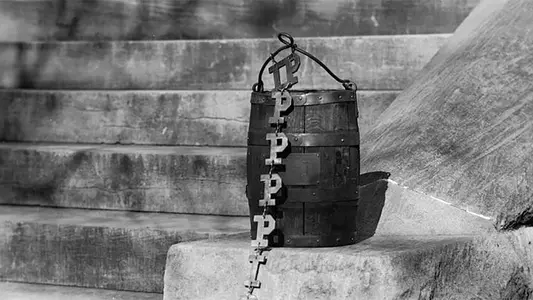
Hoosier Beginnings: The Old Stolen Bucket
9/9/2020 10:27:00 AM | Football, History
Note: IU Athletics is partnering with IU Press to share chapters from some of their recently-published books on IU Sports. The following is a chapter from the recently released Hoosier Beginnings: The Birth of Indiana University Athletics, published by IU Press in 2020. Additional details about this book can be found here.
It happens every time Indiana wins back the Old Oaken Bucket.
The Hoosiers roar across the field in search of their prize, a reward for all its hard work and determination, tangible proof that IU will own bragging rights on one of the oldest rivalry trophies in college sports for the next twelve months.
 When Purdue wins the Bucket back, the process is reversed. And whichever team owns the trophy for a given year, it makes sure the trophy leaves the stadium with them.
After all, that hasn't always happened.
The Old Oaken Bucket made its first appearance in 1925 during IU's first season in the original Memorial Stadium. The Chicago chapters of the Purdue and Indiana alumni organizations got together to discuss a suitable trophy for the rivalry game, and it was resolved that an old oaken bucket would be found to serve the purpose.
Legend has it the trophy was found on the Bruner family farm between Kent and Hanover in southern Indiana. The bucket may have been used in a well, but the family history claimed it was used by General John Hunt Morgan and his "Raiders" during the Civil War. There's no way to prove that, but it makes for a good story. The two alumni organizations decided the winner of each game would get either a bronze I or P attached to the bucket in remembrance of that year's winner. As luck would have it, the first link on the Old Oaken Bucket is a combined "I-P" link to commemorate the 0–0 tie, topping off a gorgeous trophy with an appropriate link.
That first tie game was followed by four straight Purdue wins. In fact, the series wasn't even close. The Boilermakers outscored IU 91–20 in the first four Bucket games, and in the 1930 season, Purdue looked like it was in good shape to hold onto the Bucket for a fifth year. The Boilers headed into the 1930 game with a 6–1 record and had won fourteen of their last fifteen games dating back to the previous season.
Indiana, meanwhile, was, well, Indiana. The Hoosiers struggled mightily on the gridiron in 1930 and had won just one game, a season-opening 14–0 win over Miami (Ohio). Since that victory, IU had scored exactly one touchdown all season, and that came in a 7–7 tie with Oklahoma A&M (later to become Oklahoma State). Indiana hadn't managed to score a point since that October 11 battle and had been outscored 115–21 on the season. With a road trip to Purdue looming to mercifully close the season, IU looked like it was in trouble.
Purdue was all but assured a victory, but Indiana had other plans.
Then, as now, records for both teams could be thrown out when the two ball clubs battled. It didn't matter to IU fans that the Hoosiers were so bad. A win over Purdue would make the season worthwhile, and students gathered Thursday, November 21, in Bloomington for a pep rally that would set the campus on fire—quite literally. A torchlight procession brought students and fans to the annual burial of Ole Jawn Purdue in front of the Men's Gymnasium for a yell session and a bonfire.
"The greatest pep session ever held on the Indiana campus took place last night amid bursting bombs and glaring lights to convince [head coach] Pat Page and his Scrappin' Hoosiers that the Indiana student body is back of them to the last man," the Indiana Daily Student wrote the next day. "It was not the winning of a conference championship, nor the conquering of a great foe that was necessary to goad the student body to action. They assembled because they knew that Page and his men needed their help."
Fireworks were sent into the night air. Chants of "Beat Purdue" were heard. The band played. It was, according to the Indiana Daily Student, the largest gathering of students for a pep rally in years.
It may have been the largest gathering in years, but it didn't necessarily draw attention from the bulk of the students. The Bloomington Telephone's report on the pep rally was impressed by a crowd of roughly five hundred people, but it wondered where the other three thousand students who were on campus were that evening.
"Spirit, it seems, has been so long dormant on the IU campus that an attempt to revive it for even so important a battle as the clash with Purdue meets with only mediocre success," the Telephone wrote.
On the morning of game day, some five hundred fans, students, and alumni loaded onto a special train at the Bloomington Monon Railroad station for the trip to West Lafayette at 8:00 a.m., six hours prior to kickoff. The train was festooned with decorations, and a steamboat whistle was installed to loudly announce IU's presence when the train passed through towns and arrived at Purdue. "Scrappin' Hoosiers" was written in crimson on the side of the coal car, and it was outlined in cream-colored paint. The Old Oaken Bucket was painted on the side of the engine cab, and the interlocking IU logo was on the front.
It was quite the sight.
The train rolled into West Lafayette on time, and more than fifteen hundred Hoosier fans packed IU's section at Ross-Ade Stadium to cheer on their heroes.
For once, they had something to cheer about. Purdue got on the board early, scoring a touchdown in the first three minutes of the game, and the Hoosiers looked like they were en route to another beating. The Boilermakers missed the extra point, however, and Indiana managed to turn up the defense. Both teams were held scoreless until early in the fourth quarter. At the Purdue thirty-five-yard line, Indiana threw a short pass to Vic Dauer, and he weaved through the Purdue defense to score IU's first touchdown in six weeks. The score tied the game and sent the IU faithful into a frenzy. On the sideline, senior kicker Ed Hughes pulled off his sweatshirt and trotted onto the field to attempt the extra point. The ball was snapped, and Dauer—IU's holder—had to stretch to nab the pigskin, but he got it down just in time for Hughes's toe to rip through the ball and send it end over end through the middle of the goalposts. IU led 7–6, but it had to hold on for another ten minutes.
Purdue's passing attack was feared, but the Hoosiers held, and they had a shot at icing the game with just minutes left after driving to the Purdue fifteen-yard line. A run up the middle gained five yards, but on second down, a short pass was intercepted at the Boilermakers' five-yard line, giving Purdue life.
The Boilermakers, however, didn't have a comeback in them. IU continued to shut down the passing game, and the clock expired without a Purdue score, giving the Hoosiers their first Old Oaken Bucket win.
Too bad the actual trophy wasn't on hand.
Purdue couldn't imagine actually losing to Indiana, and it hadn't bothered to bring the Old Oaken Bucket to Ross-Ade Stadium. It did already have a bronze "P" ready to put on the Bucket, and both the letter and the trophy were at the Purdue Union awaiting that night's celebratory mixer dance.
Indiana decided to turn its attention elsewhere. The freshman football team, some team reserves, and some fans headed across the field and tried to ring Purdue's "Victory Bell," which was being protected by the Boilermakers' Gimlet Booster Club.
Naturally, that didn't go over well with the Purdue faithful, and a brawl broke out. Punches flew, some noses were broken, and blood was spilled, but the bell went untouched.
Coach Page and his Scrappin' Hoosiers were scheduled to be on the 7:00 p.m. train back to Bloomington, where the celebration was already raging— bonfires had been started in the town square, and President William Lowe Bryan dispatched guards to Assembly Hall to ensure no one would set it on fire—and the team didn't have time to head over to the mixer dance to pick up the Bucket. That job would fall to an IU student by the name of Charley Hoover, who was in West Lafayette as a representative of the Indiana Student Union. The head of the Purdue Student Union, Lloyd Vallely, stood on the stage at the mixer dance, tasked with giving the Old Oaken Bucket to Indiana for the first time ever. The Purdue students at the dance were silent as Vallely handed the trophy to Hoover, and they glared at Hoover as he held the Bucket up and thanked the Purdue students.
Already feeling nervous over the notion of being one of the only IU people at the dance and the person who would take off with the trophy, Hoover looked at the Purdue students and decided he didn't want to walk out of the hall with the trophy in his hands. Hoover worried for his safety. He handed it back to Vallely and said it might be best for the Bucket to change hands another day. Hoover returned to Bloomington without the Bucket, and the following Monday, he called Vallely to arrange for the transfer of the trophy. A celebratory dance was scheduled at IU for Monday night, and Hoover knew he needed to get the Bucket to Bloomington.
Vallely was understanding, and he promised to send it by express train to Indianapolis, where it could be picked up by Hoover or some other IU representative. Hoover agreed and hung up, thinking everything would be all right.
The weather that Monday was ugly, as it often is in Bloomington in late November. It was cold, windy, and rainy, and Hoover wasn't excited about driving to and from Indianapolis in the nasty conditions.
Maybe, just maybe, Hoover could draft someone who was already planning to come to Bloomington that night to pick up the Old Oaken Bucket.
Enter John Bookwalter, an owner of the Bookwalter-Ball-Greathouse printing company of Indianapolis. Hoover called Bookwalter and told him of his predicament, and Bookwalter gave him the bad news that he wasn't coming to Bloomington that night. The good news was that Bookwalter was willing to go to the express station and pick up the Old Oaken Bucket and then put it on a bus bound for Bloomington. The bus would arrive in town at 9:00 p.m., just in time for the dance to begin.
All of this seems a little spineless and lazy on Hoover's part, but the bottom line is he had a plan to get the Bucket to Bloomington. Everything was arranged, and Hoover relaxed.
When the dance began, a band called Bud Dent and his Collegians played a song called "The Old Oaken Bucket" at full volume. The bus arrived in Bloomington on schedule but with one hiccup.
The Old Oaken Bucket wasn't on the bus. In fact, nobody knew where the Bucket was or who had it. It was missing.
Early the next morning, Hoover called Bookwalter to find out where it was. Bookwalter was a little confused. After all, he had already given it to IU's representatives. See, Bookwalter went down to the express station and picked up the Bucket from the train. There he was met by . . . well, we'll let the Indiana Daily Student explain.
"A delegation of Indiana students with IU stickers and pennants adorning their suitcases, coats and laundry bags had met him at the station and told him that they had been sent from Bloomington to get the Bucket," the Indiana Daily Student wrote. "Naturally, Mr. Bookwalter, having been convinced by the victory-flushed faces and shining Cream and Crimson stickers that this certainly was a representative group from the IU campus, surrendered the prized trophy." The group, dressed up as IU representatives, took the Old Oaken Bucket and walked off into the night, never to be seen or heard from again.
The situation had advanced beyond Hoover's head—in all honesty, it seems like he was in over his head to begin with—and Bookwalter called James Fesler, president of the IU board of trustees. Bookwalter explained the situation, and Fesler quickly decided to call in the big guns.
His first move was to involve Harry G. Leslie, a former Purdue player who just so happened to be the governor of Indiana at the time. The athletics directors from both schools—Nelson Kellogg for Purdue and Zora Clevenger for Indiana—were contacted, and a conference was set up in Lafayette with Leslie, Kellogg, Clevenger, Fesler, Bookwalter, and poor Charley Hoover to discuss what would come next. Meanwhile, some other key information emerged.
It seems that Purdue's sacred "Victory Bell" had been stolen in the early morning hours of Sunday, November 24, just after the end of the mixer dance. The bell had been mounted on a cart, and it seems someone had hitched the cart to their car and headed south.
Naturally, Purdue students immediately suspected Indiana students, and no fewer than five freight cars were chartered for the next train headed toward Bloomington. The idea was that Purdue fans could fill the train cars and go get the bell back.
That posse never had a chance to explode in violence. Sometime Monday morning, the bell was found in a roadside ditch near Wingate, Indiana, about twenty-five miles south of West Lafayette. The cart, it seems, had crashed and headed off the road, leaving the bell a bit beat up. Still, it was found. One item, however, was missing. The clapper, that piece of metal that hangs inside the bell, was nowhere to be found.
The mystery stretched on for days and became national news. Amateur sleuths suggested all kinds of theories, but it was clear that this was a case of theft. Setting up a time for the governor and all the other luminaries to gather for a conference took time, and by early December, the Bucket was still missing, the passage of time only adding to the story. The involvement of the governor showed that the theft of the Bucket wasn't being taken as a happy college prank. This was a serious matter, and there was going to be a legal price to pay when the mystery was solved.
Then, in the early morning hours of December 4, an elderly man quietly walked to the loading platform of the Lafayette Journal and Courier and deposited a crate on the dock. Employees of the newspaper saw him from a distance, but they made no effort to stop him. When they went to the dock to inspect the crate, they found the Old Oaken Bucket inside, completely undamaged. Nothing was missing, the links were still in the chain, and the trophy was none the worse for wear.
There also was no note, no explanation for where the Bucket had been. There was nothing—just an old man, a crate, and a mystery.
Indiana didn't care. The Bucket had been found, and headlines screamed the news.
"OLD OAKEN BUCKET IS DISCOVERED," blared the Indiana Daily Student. The Bucket had been recovered, but it would still take a few days for it to get to Bloomington. Clevenger was headed to a meeting with the Big Ten in Chicago over the weekend, and he told Purdue he would personally pick up the trophy on his way back to Bloomington to ensure nothing else happened to it. Finally, on Monday, December 8, the Old Oaken Bucket, which Indiana had won from Purdue sixteen days earlier, arrived on the IU campus. Precautions were taken to make sure nobody would steal the bucket anytime soon.
"The real Indiana-Purdue trophy, representative of supremacy on the gridiron, will be placed on display in a special-constructed glass 'cage' in the catalog room of the University library," the Indiana Daily Student reported. "It is temporarily on display in the library. When queried as to what would be done with the bucket the remainder of the year, Mr. Clevenger stated that it probably would be placed in some strong vault but that it may be taken out for any occasions that call for its display."
Nobody tried to steal the Old Oaken Bucket over the next year, but the Boilermakers earned it back in 1931, scoring a 19–0 win in Bloomington. Purdue would go on to win the Bucket in five of the next eight meetings, but Indiana dominated the 1940s by winning seven of ten games. The Boilers would dominate the series from 1948 to 1975, with IU winning just three games and tying once, but the series has remained relatively competitive ever since.
The Bucket, by the way, was stolen on at least three other occasions, including in 1958 and the late 1960s and early 1970s, and it has been the target of failed attempts at other times. But in this day and age, stealing the Old Oaken Bucket has fallen out of favor. The trophy has remained safe for decades, and the only way for someone to own it is to earn a victory on the field.
Two questions still remain: Why was the Old Oaken Bucket stolen? And who stole it?
Let's answer the second question first. Nobody knows who actually stole the Old Oaken Bucket, and that secret likely lies in the grave of the person or people involved in the theft. As for the elderly man who is said to have returned it, he could have been someone involved in the theft or, more likely, the father of someone involved in the situation who wanted to return the Bucket before anybody could get into real trouble over it. After all, the theft rose to the level of the governor, and someone was going to be arrested if the culprits were found.
Exactly who stole the Bucket, and the identity of those people dressed in IU shirts and stickers and pennants, remains a mystery that might stay that way forever.
As to why the Bucket was stolen, it has been suggested that the trophy was kidnapped in response to the theft of the Victory Bell and, maybe more importantly, the clapper in the bell. The theory goes that the Bucket was going to be held hostage until the clapper was returned.
That theory sounds plausible, and it's plausible that once the heat was turned up by the coverage of the theft, and it became clear that hiding a bell clapper is a heck of a lot easier than hiding the distinctive Old Oaken Bucket, robbers could get cold feet. After all, what were they going to do with the Bucket? Put it on their mantle? Not a good idea if you're trying not to get caught for a theft that has caught the governor's attention.
Ultimately, it doesn't matter who stole the Bucket or why they did it. The Old Oaken Bucket was returned intact, and the theft only added to the lore surrounding one of college football's most famous trophies.
It happens every time Indiana wins back the Old Oaken Bucket.
The Hoosiers roar across the field in search of their prize, a reward for all its hard work and determination, tangible proof that IU will own bragging rights on one of the oldest rivalry trophies in college sports for the next twelve months.
When Purdue wins the Bucket back, the process is reversed. And whichever team owns the trophy for a given year, it makes sure the trophy leaves the stadium with them.After all, that hasn't always happened.
The Old Oaken Bucket made its first appearance in 1925 during IU's first season in the original Memorial Stadium. The Chicago chapters of the Purdue and Indiana alumni organizations got together to discuss a suitable trophy for the rivalry game, and it was resolved that an old oaken bucket would be found to serve the purpose.
Legend has it the trophy was found on the Bruner family farm between Kent and Hanover in southern Indiana. The bucket may have been used in a well, but the family history claimed it was used by General John Hunt Morgan and his "Raiders" during the Civil War. There's no way to prove that, but it makes for a good story. The two alumni organizations decided the winner of each game would get either a bronze I or P attached to the bucket in remembrance of that year's winner. As luck would have it, the first link on the Old Oaken Bucket is a combined "I-P" link to commemorate the 0–0 tie, topping off a gorgeous trophy with an appropriate link.
That first tie game was followed by four straight Purdue wins. In fact, the series wasn't even close. The Boilermakers outscored IU 91–20 in the first four Bucket games, and in the 1930 season, Purdue looked like it was in good shape to hold onto the Bucket for a fifth year. The Boilers headed into the 1930 game with a 6–1 record and had won fourteen of their last fifteen games dating back to the previous season.
Indiana, meanwhile, was, well, Indiana. The Hoosiers struggled mightily on the gridiron in 1930 and had won just one game, a season-opening 14–0 win over Miami (Ohio). Since that victory, IU had scored exactly one touchdown all season, and that came in a 7–7 tie with Oklahoma A&M (later to become Oklahoma State). Indiana hadn't managed to score a point since that October 11 battle and had been outscored 115–21 on the season. With a road trip to Purdue looming to mercifully close the season, IU looked like it was in trouble.
Purdue was all but assured a victory, but Indiana had other plans.
Then, as now, records for both teams could be thrown out when the two ball clubs battled. It didn't matter to IU fans that the Hoosiers were so bad. A win over Purdue would make the season worthwhile, and students gathered Thursday, November 21, in Bloomington for a pep rally that would set the campus on fire—quite literally. A torchlight procession brought students and fans to the annual burial of Ole Jawn Purdue in front of the Men's Gymnasium for a yell session and a bonfire.
"The greatest pep session ever held on the Indiana campus took place last night amid bursting bombs and glaring lights to convince [head coach] Pat Page and his Scrappin' Hoosiers that the Indiana student body is back of them to the last man," the Indiana Daily Student wrote the next day. "It was not the winning of a conference championship, nor the conquering of a great foe that was necessary to goad the student body to action. They assembled because they knew that Page and his men needed their help."
Fireworks were sent into the night air. Chants of "Beat Purdue" were heard. The band played. It was, according to the Indiana Daily Student, the largest gathering of students for a pep rally in years.
It may have been the largest gathering in years, but it didn't necessarily draw attention from the bulk of the students. The Bloomington Telephone's report on the pep rally was impressed by a crowd of roughly five hundred people, but it wondered where the other three thousand students who were on campus were that evening.
"Spirit, it seems, has been so long dormant on the IU campus that an attempt to revive it for even so important a battle as the clash with Purdue meets with only mediocre success," the Telephone wrote.
On the morning of game day, some five hundred fans, students, and alumni loaded onto a special train at the Bloomington Monon Railroad station for the trip to West Lafayette at 8:00 a.m., six hours prior to kickoff. The train was festooned with decorations, and a steamboat whistle was installed to loudly announce IU's presence when the train passed through towns and arrived at Purdue. "Scrappin' Hoosiers" was written in crimson on the side of the coal car, and it was outlined in cream-colored paint. The Old Oaken Bucket was painted on the side of the engine cab, and the interlocking IU logo was on the front.
It was quite the sight.
The train rolled into West Lafayette on time, and more than fifteen hundred Hoosier fans packed IU's section at Ross-Ade Stadium to cheer on their heroes.
For once, they had something to cheer about. Purdue got on the board early, scoring a touchdown in the first three minutes of the game, and the Hoosiers looked like they were en route to another beating. The Boilermakers missed the extra point, however, and Indiana managed to turn up the defense. Both teams were held scoreless until early in the fourth quarter. At the Purdue thirty-five-yard line, Indiana threw a short pass to Vic Dauer, and he weaved through the Purdue defense to score IU's first touchdown in six weeks. The score tied the game and sent the IU faithful into a frenzy. On the sideline, senior kicker Ed Hughes pulled off his sweatshirt and trotted onto the field to attempt the extra point. The ball was snapped, and Dauer—IU's holder—had to stretch to nab the pigskin, but he got it down just in time for Hughes's toe to rip through the ball and send it end over end through the middle of the goalposts. IU led 7–6, but it had to hold on for another ten minutes.
Purdue's passing attack was feared, but the Hoosiers held, and they had a shot at icing the game with just minutes left after driving to the Purdue fifteen-yard line. A run up the middle gained five yards, but on second down, a short pass was intercepted at the Boilermakers' five-yard line, giving Purdue life.
The Boilermakers, however, didn't have a comeback in them. IU continued to shut down the passing game, and the clock expired without a Purdue score, giving the Hoosiers their first Old Oaken Bucket win.
Too bad the actual trophy wasn't on hand.
Purdue couldn't imagine actually losing to Indiana, and it hadn't bothered to bring the Old Oaken Bucket to Ross-Ade Stadium. It did already have a bronze "P" ready to put on the Bucket, and both the letter and the trophy were at the Purdue Union awaiting that night's celebratory mixer dance.
Indiana decided to turn its attention elsewhere. The freshman football team, some team reserves, and some fans headed across the field and tried to ring Purdue's "Victory Bell," which was being protected by the Boilermakers' Gimlet Booster Club.
Naturally, that didn't go over well with the Purdue faithful, and a brawl broke out. Punches flew, some noses were broken, and blood was spilled, but the bell went untouched.
Coach Page and his Scrappin' Hoosiers were scheduled to be on the 7:00 p.m. train back to Bloomington, where the celebration was already raging— bonfires had been started in the town square, and President William Lowe Bryan dispatched guards to Assembly Hall to ensure no one would set it on fire—and the team didn't have time to head over to the mixer dance to pick up the Bucket. That job would fall to an IU student by the name of Charley Hoover, who was in West Lafayette as a representative of the Indiana Student Union. The head of the Purdue Student Union, Lloyd Vallely, stood on the stage at the mixer dance, tasked with giving the Old Oaken Bucket to Indiana for the first time ever. The Purdue students at the dance were silent as Vallely handed the trophy to Hoover, and they glared at Hoover as he held the Bucket up and thanked the Purdue students.
Already feeling nervous over the notion of being one of the only IU people at the dance and the person who would take off with the trophy, Hoover looked at the Purdue students and decided he didn't want to walk out of the hall with the trophy in his hands. Hoover worried for his safety. He handed it back to Vallely and said it might be best for the Bucket to change hands another day. Hoover returned to Bloomington without the Bucket, and the following Monday, he called Vallely to arrange for the transfer of the trophy. A celebratory dance was scheduled at IU for Monday night, and Hoover knew he needed to get the Bucket to Bloomington.
Vallely was understanding, and he promised to send it by express train to Indianapolis, where it could be picked up by Hoover or some other IU representative. Hoover agreed and hung up, thinking everything would be all right.
The weather that Monday was ugly, as it often is in Bloomington in late November. It was cold, windy, and rainy, and Hoover wasn't excited about driving to and from Indianapolis in the nasty conditions.
Maybe, just maybe, Hoover could draft someone who was already planning to come to Bloomington that night to pick up the Old Oaken Bucket.
Enter John Bookwalter, an owner of the Bookwalter-Ball-Greathouse printing company of Indianapolis. Hoover called Bookwalter and told him of his predicament, and Bookwalter gave him the bad news that he wasn't coming to Bloomington that night. The good news was that Bookwalter was willing to go to the express station and pick up the Old Oaken Bucket and then put it on a bus bound for Bloomington. The bus would arrive in town at 9:00 p.m., just in time for the dance to begin.
All of this seems a little spineless and lazy on Hoover's part, but the bottom line is he had a plan to get the Bucket to Bloomington. Everything was arranged, and Hoover relaxed.
When the dance began, a band called Bud Dent and his Collegians played a song called "The Old Oaken Bucket" at full volume. The bus arrived in Bloomington on schedule but with one hiccup.
The Old Oaken Bucket wasn't on the bus. In fact, nobody knew where the Bucket was or who had it. It was missing.
Early the next morning, Hoover called Bookwalter to find out where it was. Bookwalter was a little confused. After all, he had already given it to IU's representatives. See, Bookwalter went down to the express station and picked up the Bucket from the train. There he was met by . . . well, we'll let the Indiana Daily Student explain.
"A delegation of Indiana students with IU stickers and pennants adorning their suitcases, coats and laundry bags had met him at the station and told him that they had been sent from Bloomington to get the Bucket," the Indiana Daily Student wrote. "Naturally, Mr. Bookwalter, having been convinced by the victory-flushed faces and shining Cream and Crimson stickers that this certainly was a representative group from the IU campus, surrendered the prized trophy." The group, dressed up as IU representatives, took the Old Oaken Bucket and walked off into the night, never to be seen or heard from again.
The situation had advanced beyond Hoover's head—in all honesty, it seems like he was in over his head to begin with—and Bookwalter called James Fesler, president of the IU board of trustees. Bookwalter explained the situation, and Fesler quickly decided to call in the big guns.
His first move was to involve Harry G. Leslie, a former Purdue player who just so happened to be the governor of Indiana at the time. The athletics directors from both schools—Nelson Kellogg for Purdue and Zora Clevenger for Indiana—were contacted, and a conference was set up in Lafayette with Leslie, Kellogg, Clevenger, Fesler, Bookwalter, and poor Charley Hoover to discuss what would come next. Meanwhile, some other key information emerged.
It seems that Purdue's sacred "Victory Bell" had been stolen in the early morning hours of Sunday, November 24, just after the end of the mixer dance. The bell had been mounted on a cart, and it seems someone had hitched the cart to their car and headed south.
Naturally, Purdue students immediately suspected Indiana students, and no fewer than five freight cars were chartered for the next train headed toward Bloomington. The idea was that Purdue fans could fill the train cars and go get the bell back.
That posse never had a chance to explode in violence. Sometime Monday morning, the bell was found in a roadside ditch near Wingate, Indiana, about twenty-five miles south of West Lafayette. The cart, it seems, had crashed and headed off the road, leaving the bell a bit beat up. Still, it was found. One item, however, was missing. The clapper, that piece of metal that hangs inside the bell, was nowhere to be found.
The mystery stretched on for days and became national news. Amateur sleuths suggested all kinds of theories, but it was clear that this was a case of theft. Setting up a time for the governor and all the other luminaries to gather for a conference took time, and by early December, the Bucket was still missing, the passage of time only adding to the story. The involvement of the governor showed that the theft of the Bucket wasn't being taken as a happy college prank. This was a serious matter, and there was going to be a legal price to pay when the mystery was solved.
Then, in the early morning hours of December 4, an elderly man quietly walked to the loading platform of the Lafayette Journal and Courier and deposited a crate on the dock. Employees of the newspaper saw him from a distance, but they made no effort to stop him. When they went to the dock to inspect the crate, they found the Old Oaken Bucket inside, completely undamaged. Nothing was missing, the links were still in the chain, and the trophy was none the worse for wear.
There also was no note, no explanation for where the Bucket had been. There was nothing—just an old man, a crate, and a mystery.
Indiana didn't care. The Bucket had been found, and headlines screamed the news.
"OLD OAKEN BUCKET IS DISCOVERED," blared the Indiana Daily Student. The Bucket had been recovered, but it would still take a few days for it to get to Bloomington. Clevenger was headed to a meeting with the Big Ten in Chicago over the weekend, and he told Purdue he would personally pick up the trophy on his way back to Bloomington to ensure nothing else happened to it. Finally, on Monday, December 8, the Old Oaken Bucket, which Indiana had won from Purdue sixteen days earlier, arrived on the IU campus. Precautions were taken to make sure nobody would steal the bucket anytime soon.
"The real Indiana-Purdue trophy, representative of supremacy on the gridiron, will be placed on display in a special-constructed glass 'cage' in the catalog room of the University library," the Indiana Daily Student reported. "It is temporarily on display in the library. When queried as to what would be done with the bucket the remainder of the year, Mr. Clevenger stated that it probably would be placed in some strong vault but that it may be taken out for any occasions that call for its display."
Nobody tried to steal the Old Oaken Bucket over the next year, but the Boilermakers earned it back in 1931, scoring a 19–0 win in Bloomington. Purdue would go on to win the Bucket in five of the next eight meetings, but Indiana dominated the 1940s by winning seven of ten games. The Boilers would dominate the series from 1948 to 1975, with IU winning just three games and tying once, but the series has remained relatively competitive ever since.
The Bucket, by the way, was stolen on at least three other occasions, including in 1958 and the late 1960s and early 1970s, and it has been the target of failed attempts at other times. But in this day and age, stealing the Old Oaken Bucket has fallen out of favor. The trophy has remained safe for decades, and the only way for someone to own it is to earn a victory on the field.
Two questions still remain: Why was the Old Oaken Bucket stolen? And who stole it?
Let's answer the second question first. Nobody knows who actually stole the Old Oaken Bucket, and that secret likely lies in the grave of the person or people involved in the theft. As for the elderly man who is said to have returned it, he could have been someone involved in the theft or, more likely, the father of someone involved in the situation who wanted to return the Bucket before anybody could get into real trouble over it. After all, the theft rose to the level of the governor, and someone was going to be arrested if the culprits were found.
Exactly who stole the Bucket, and the identity of those people dressed in IU shirts and stickers and pennants, remains a mystery that might stay that way forever.
As to why the Bucket was stolen, it has been suggested that the trophy was kidnapped in response to the theft of the Victory Bell and, maybe more importantly, the clapper in the bell. The theory goes that the Bucket was going to be held hostage until the clapper was returned.
That theory sounds plausible, and it's plausible that once the heat was turned up by the coverage of the theft, and it became clear that hiding a bell clapper is a heck of a lot easier than hiding the distinctive Old Oaken Bucket, robbers could get cold feet. After all, what were they going to do with the Bucket? Put it on their mantle? Not a good idea if you're trying not to get caught for a theft that has caught the governor's attention.
Ultimately, it doesn't matter who stole the Bucket or why they did it. The Old Oaken Bucket was returned intact, and the theft only added to the lore surrounding one of college football's most famous trophies.



Wednesday, June 03
Wednesday, May 27
Wednesday, May 20
Tuesday, May 05