
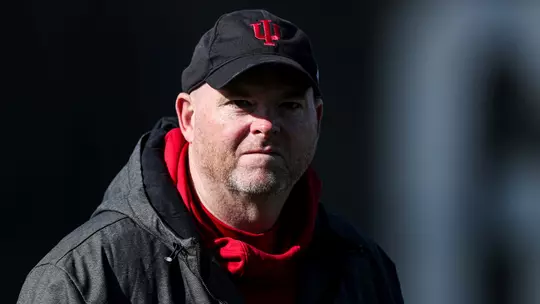
Carey’s Offensive Challenge is Clear: Make It Better
Pete DiPrimio | IUHoosiers.com
BLOOMINGTON, Ind. - Rod Carey once again comes to Indiana’s football rescue.
Would you expect anything less from a Mallory man?
This time the quality control coach is the midseason choice to become offensive coordinator and spark an attack that ranks next to last in the Big Ten in scoring.
The good news, he says, is potential and talent are there to do it.
“We haven’t been good enough on offense. It’s my charge to get us better. I wouldn’t have taken it if I didn’t think I could to it. That will be the mindset.
“I think we can make a difference. Those differences are coming together.”
What does making a difference mean?
For one thing, it doesn’t mean radical change. Even with a bye week, there’s not enough time for that with a trip to No. 2 Michigan looming on Oct. 14, and then six-straight Big Ten games after that.
“There’s nothing you can do midseason,” Carey says. “The setup is the setup. The offense is the offense. What we’re trying to do is get us to run those plays better and maybe do it with a little different flair. That’s all you can do.”
For another thing, it comes down to this -- move the ball, score touchdowns.
“We’ve got to get the ball across the goal line,” Carey says. “That’s as easy as you can put it. That’s everybody’s execution. It starts with me, then the position coaches, then the players, the quarterbacks. We all carry that responsibility. We have to get the ball across the goal line, by hook or crook. That’s what we have to do.”
IU’s 20.8-point scoring average ranks only ahead of Nebraska in the Big Ten. Against FBS teams, Indiana's scoring average is 15.75 points.
That was enough for head coach Tom Allen to replace offensive coordinator Walt Bell with Carey, a former IU football player under Bill Mallory, a former head coach and offensive coordinator at Northern Illinois (the 2012 Huskies averaged 38.6 points and played in the Orange Bowl), as well as an ex-head coach at Temple.
“In four FBS games, we’ve only scored three touchdowns in meaningful minutes,” Allen says. “That’s not good enough. We need to be better. We have to be better.”
The result -- for the second-straight season, Carey faces a formidable challenge -- fix what has been, in so many ways, unfixable. Last year, he came in at midseason to take over as offensive line coach.
“I’m excited about the time we’ve spent together the last two years,” Allen says. “It’s a chance to help us with his vast experience as a head coach and as an offensive coordinator.
“He played here. He loves Indiana. He’s passionate about Indiana Football and wants to help us get where we need to be.”
Carey’s strategy comes down to this:
“Do what works.”
“I hate to be simple,” he adds, “but we have to be. If we make it too complicated, no one will be any good. It’s modern offense. It’s not like we’ll line up in the I-formation. We’re not doing that.”
Good offense demands strong execution and deception. IU’s attack has lacked both. Bell’s offense had a run-first emphasis. Carey won’t label his approach that way.
“I have a real easy philosophy on offense. If you ask me, ‘What do you like on offense? I say, ‘What works.’ That’s what it comes down to. What works. Misdirection, running, throwing, controlling the ball. Controlling the game.
“I believe that offense is about controlling games. Defenses play really well when the offense controls the game.
“If we can control the game, and obviously score points, the defense will play great. You will get a lot of opportunities on offense.
“I like what works. That’s what we’re in the middle of figuring out.”
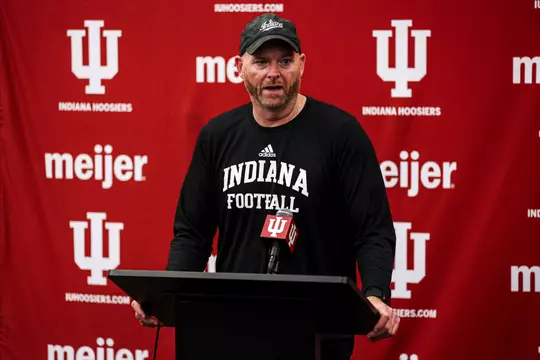
Last year, Allen asked Carey to take over a struggling offensive line, a move Carey made from a defensive quality control role. This time he comes from an offensive quality control job during which he attended all offensive meetings, but only in a non-speaking, note-taking way. Still, he’s worked with the offensive players and coaches. He understands that, despite the struggles, the offense showed flashes of strong productivity, highlighted by the two second-half touchdown drives against Louisville.
Carey’s extensive offensive coaching background includes play calling that should allow him to maximize opportunities.
“The players are excited,” Carey says. “They see the flashes. They know. They have the confidence. They want to be good. They have a lot of energy to do that.
“My job is to prod that excitement a lot more.”
Carey will also coach the quarterbacks. Tayven Jackson and Brendan Sorsby have started this season. They’ve combined to complete 60.4 percent of their passes for 1,120 yards, four touchdowns, and three interceptions. Last year’s starter, Dexter Williams II, is pushing to return after major knee surgery.
Neither Carey nor Allen has addressed possible personnel changes. Carey does say Jackson and Sorsby are fundamentally sound.
“I have familiarity of what the quarterbacks have been taught. Coach Bell is a good fundamental teacher. That part is in place.”
IU has offensive talent with running backs Jaylin Lucas, Josh Henderson, and Christian Turner, with receivers Cam Camper, Donaven McCulley, and DeQuece Carter, and an improved offensive line under coach Bob Bostad.
“I’m excited about it,” Carey says. “I think the guys are, too. We’ve had those flashes. We need to make them more permanent.”
Carey says small improvements will make a difference. He aims to facilitate that.
“If I didn’t believe that,” he says, “I would not be standing here. I told Coach Allen that, too. I believe we will make a difference.”
For Carey, better offense comes from a simple approach -- do what you do well, stay away from what you don’t.
“That’s what we’ve spent time as a staff trying to identify.”
For the quarterbacks, he adds, “their reads won’t change, but maybe we do more of the plays they read better, and less of the ones they don’t read as well.”
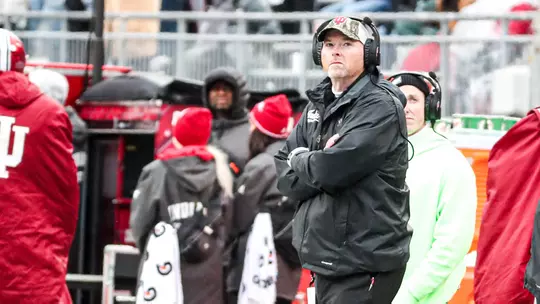
Coaching is a high-risk, high-reward profession. Getting fired and having to fire someone are equally difficult.
Allen let Bell go last Sunday morning, then offered Carey the job.
“The way it happened, you’re never excited about,” Carey says. “I’ve been in Tom’s shoes before. Those are hard choices. I have a lot of sympathy for the choice he had to make and for Coach Bell. I think the world of Coach Bell.
“It’s a double-edged sword. Tom was very heavy hearted. He knows the personal cost. It wasn’t like I was jumping for joy. I had a heavy heart, too.
“At the same time, there was excitement, but tempered. It was good and bad at the same time.”
Then he and Allen met with the players.
“We were honest with them,” Carey says. “Why are we in this situation? Why did Coach Allen make this decision? We haven’t been good enough. We had that conversation. They got that.”
IU’s offense will have to be very good when it faces a Michigan defense that leads the Big Ten in points allowed per game (6.0), ranks second in rushing yards allowed per game (85.6), and third in passing yards allowed per game (160.6). It also has 12 sacks.
Adding to the difficulty will be a Michigan Stadium crowd in excess of 100,000.
Carey and the offensive staff will counter with imagination masked by simplicity.
“The thought process is do what we can to simplify,” he says. “Accentuate some things we can do, and do those more.
“It’s the little things, the details, the setup of the staff and how we approach things. Those little things tend to make a big difference.”
A big difference is needed if IU (2-3) is to regain its winning ways. Carey, who played in two bowls as a standout Hoosier center (including Indiana’s last bowl victory in the 1991 Copper Bowl), and in seven more as a coach, embraces the challenge.
“The personal side of this is horrible. The business side is real.
“I’m not gonna take a snap. I did that before here. I can’t do it anymore.
“You take what’s existing, and do it better.”