Indiana University Athletics
Critical Summer -- Building Toughness the Tom Allen Way
5/25/2023 10:00:00 AM | Football
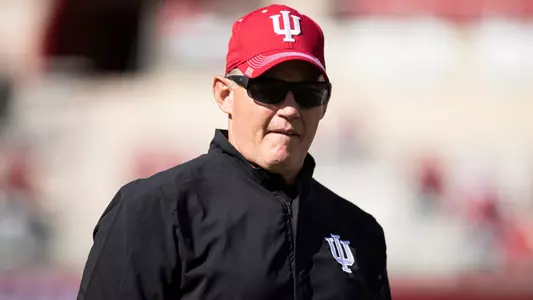
BLOOMINGTON, Ind. - Tom Allen hits his stride. He hits it well -- passionate, caring, determined. It’s no surprise.
For now, Allen strives to return Indiana to its winning ways. He and his staff have recruited well, tapped into the transfer portal well, pushed to develop players well.
Now, it comes down to this -- let the other teams wear down, break down, stumble amid pressure. Allen expects bigger things from his seventh IU team, and if he gets it, well ...
“You have to have an expectation that I don’t get tired,” he says. “The other team gets tired.
“That has to be built. That’s over the summer. That’s maximizing our conditioning. It’s team building and toughness building. It’s sharing adversity. It’s done through our strength staff.”
In the end, it’s mindset. It’s the old Bob Knight belief that mental is to physical as four is to one.
When you open the season with powerhouse Ohio State, as the Hoosiers do on Sept. 2 at Memorial Stadium, when you face other Big Ten challenges, as the Hoosiers do, plus add Louisville (with former Purdue coach Jeff Brohm now in charge) in Indianapolis for some extra non-conference juice, you’d better be ready to rock until the other guy breaks.
“We want to have a fourth-quarter mindset,” Allen says. “We want to build the toughness to finish. That’s part of that mental-toughness piece.”
The summer is critical for that. Program priorities are focus, preparation and, yes, toughness.
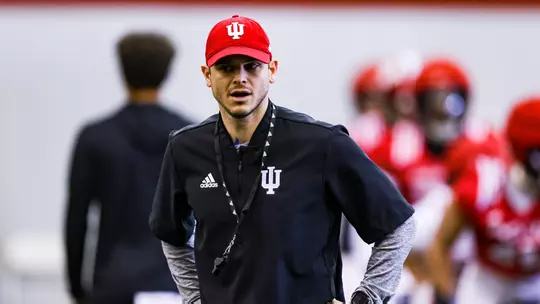
Focus is on things such as pre-snap keys, post-snap technique and execution.
Preparation starts with trust. Players must trust they’ve done what needs to be done, and more. They need to get in elite shape so that the last quarter is their best quarter.
“It’s all fourth-quarter driven,” Allen says. “It’s all about how will we finish from a physical perspective. We want to dominate our opponent in those situations. Win those third downs; win those critical downs.”
How do you get there over the summer?
It starts with NCAA-sanctioned change.
In theory, player-led summer practices are difference makers if done well. Everyone holds each other accountable, veterans lead the way, and a winning team is built.
In reality, things get complicated.
Players lack the experience to teach the details and ensure everything is done correctly with the appropriate intensity.
With NCAA rules now allowing coaches to work with players in June as never before (although without footballs), development should accelerate.
“Before, we had player-led practices, and you know how that goes,” Allen says. “Sometimes, you get bad habits. Then you have to undo all that when you get to fall camp. That’s not the case anymore. We can do things without a ball.
“We’re not throwing the football, but it’s technique and fundamentals. That’s a big difference.”
The goal is game-changing productivity and growth without burnout. Players already train year-round. Breaks are crucial given the intensity that runs from the start of fall camp (Aug. 2 is the first day of practice) until the end of the regular season (the final game is Nov. 25 at Purdue).
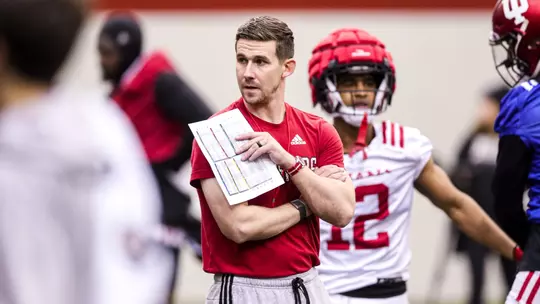
“You try not to make it burdensome so when you get to fall camp, you feel burned out, and aren’t excited about the start of the season,” Allen says. “We don’t want to do that. It’s important that they get away.”
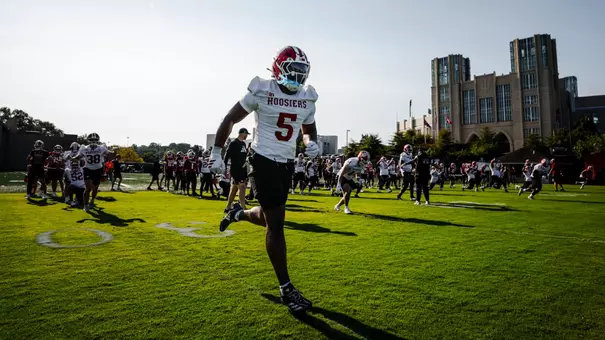
IU will hit it hard in June with Organized Team Activities sessions. Coaches also are heavy into camps and recruiting.
“(The NCAA) has given us six OTAs in June with our full staff,” Allen says. “That’s unprecedented. We can prepare them in June more than we ever have in the past. That’s a big deal.”
Allen adds that coaches will take a break in July, “so they can come back refreshed.”
While there weren’t any team sessions in May, players were still expected to work out.
“We talk about May mattering,” Allen says. “They have to work like a professional. That’s what the pros have to do. Follow the plan and be ready to work on June 1.”
The changes in the summer calendar allowed coaches to have more productive spring sessions. Previously they used late spring practice time in part to show players what they wanted done over the summer when coaches couldn’t be around. Now, coaches do that themselves.
“We were able to do more individuals and fundamentals in the spring,” Allen says. “We got more from that. We could be more aggressive with installs.”
In the end, Allen says, it comes down to this:
“We need to have the best summer since I’ve been here.”