

‘All World’ – Kern Continues Record Softball Pace
By Pete DiPrimio | IUHoosiers.com
BLOOMINGTON, Ind. – Michigan State pitcher Ashley Miller is about to make a big mistake -- she’s going to throw a pitch Indiana freshman second-base standout Taryn Kern can reach.
Flashback to last Saturday. Indiana is in a tight late-inning game with the Spartans. Kern, in the midst of a record-setting debut season, digs in on the right side of the plate, her feet on the batter’s box line so that a pitch a little too far inside might hit her. A team-leading 20 times this season, it has.
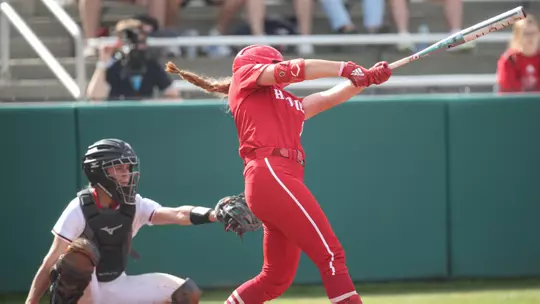
The pitch comes and Kern connects, sending the ball high into a cloudless blue sky. It lands 250-plus feet away, well beyond the Andy Mohr Field left-field fence. It’s her national-leading and school-record-extending 22nd home run, and it helps clinch a 9-5 victory and, ultimately, a series sweep that secures a Big Ten runner-up finish, Indiana’s best showing in a generation.
A few days later, Kern wins her sixth Big Ten freshman-of-the-week award, adding to a list of accolades that also includes being a top-25 finalist for national freshman of the year and making the top-25 national player of the year award list.
“Taryn has been all-world,” IU coach Shonda Stanton says.
Consider Hoosier Hall of Famer and former Olympian Michelle Venturella had the school single-season home run record of 17 for 29 years until Kern broke it with a three-run shot at Minnesota last month. That was one of two home-run moments that stand out.
“That one went pretty far,” she says. “The pitcher threw hard. That helped. Getting the lead against a good pitcher, that was a fun one.
“Then there was the weekend in Memphis when I hit four home runs. That was a ‘Woo!’ moment for me.”
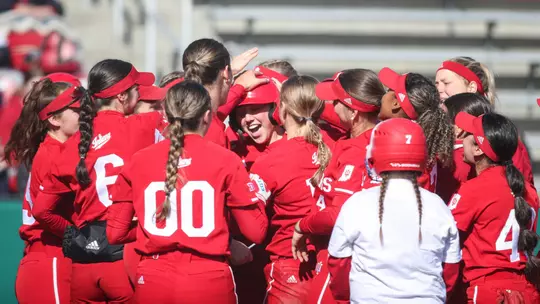
“Woo” goes beyond homers. Add a team-leading .438 batting average, and a school-record 67 runs batted in, and you have perhaps the greatest offensive season in IU history.
Did you see this coming from a freshman?
Did anyone?
“I definitely did not,” says Kern, who had set a preseason home-run goal of eight.
“To see how far I’ve come is a funny thing. I’m grateful for the success I’ve had, but I have to keep working hard and keep chasing my dreams.”
Kern’s youthful dreams meant growing up with the goal of being a power hitting without the results.
“In my first three years of high school, I had three home runs total. My senior year, I had 13.”
What changed?
“I started working on my strength and mechanics. I focused on that aspect. That was the one piece I knew I was missing.”
Kern says she doesn’t try to hit home runs, but does challenge pitchers.
“I make the pitcher come to me because I’m in charge at the plate.”
That’s why she crowds the plate.
“I get my toes all the way up, even almost over the line. I think pitchers do feel intimidated. I get hit a lot, so I have no problem taking the walk or getting hit by a pitch. I’ll take the base for the team.”
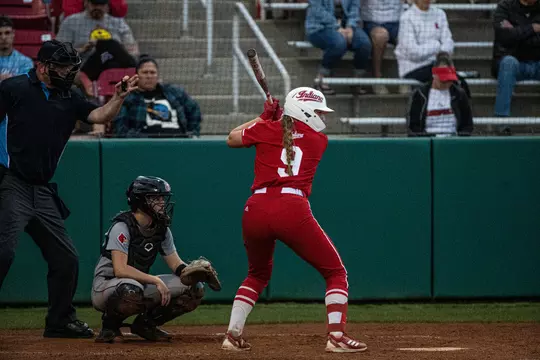
Stanton expected Kern to make instant impact, but not of the lead-the-nation-in-homers-as-a-freshman variety.
“You don’t project she’s going to be a NCAA home run leader as a freshman,” Stanton says, “but you know this kid has tools. She had the hit-power tool, the average tool, the defense tool. She had three of the five tools. We look for one elite tool. Her hit tool was enough to build around.”
Countless hours at the family’s backyard batting cage -- including plenty of work with her father, Chris, a former Gonzaga baseball player, and her hitting coach, Danielle Peterson, a former UCLA softball player -- honed Kern’s swing into something Da Vinci might have designed if baseball existed during his Renaissance-dominating days. It’s smooth and fundamentally sound, and produces enough power to drive balls out of any park to all fields.
“We’d go to the batting cage multiple times a week hitting, sometimes late at night,” Kern says. “My dad has played a huge role in my success.”
For this, Stanton gives thanks.
“We couldn’t project this kind of power,” she says, “but what we could project was she had a clean (swing) arc. She has one of the cleanest arcs I’ve ever seen. She stays in the zone so long. That gives you a margin of error when you swing. So, we knew she could be successful.”
And so she is.
How does a California girl become a Hoosier?
“Zoom,” Stanton says with a laugh. “How crazy is that?”
The pandemic altered everything back in the spring of 2020, including recruiting. Recruits couldn’t visit schools in person, and coaches couldn’t go out to see athletes. Zoom was a way to meet and observe.
“Zoom is not a good look,” Stanton says, “but Taryn kept getting results. The results were always there.”
For Kern, the Big Ten, IU’s passionate sports culture and program-on-the-rise prospects intrigued her.
“What the coaches do here drew me,” she says. “The way they’re transforming the program. Then it’s the sports culture of IU, and being in a college town. You don’t get that in California. I thought that would be really cool to experience.”
There was a personal connection. IU associate head coach Chanda Bell was a former teammate of Kern’s high school coach. They talked about Kern. A lot.
“We could say, ‘This is what we’re seeing. Does it add up?’” Stanton says.
It did. Kern committed in December of 2020 without visiting IU, although virtual tours and power-point presentations filled that void.
“I talked with the coaches for a few months,” Kern says. “I knew everything about the school and the program. The only piece missing was me coming here.”
Kern and her father finally made an unofficial visit during the 2021 college basketball Final Four in Indianapolis. Gonzaga finished as national runner-up, and the Kerns were there to watch. They drove to Bloomington with the understanding that if the younger Kern hated the visit, they’d re-think the commitment.
“But I loved it,” Kern says.
IU coaches finally saw Kern play, and knew they’d struck softball gold.
“We took one look and said, this kid is legit,” Stanton says.
That extended beyond her softball ability.
“When we talked to her,” Stanton says, “she was amazing. She brings her own sunshine. She’s a joy to be around. She has a likeability factor. A maturity factor. She’s well supported by her family. She has the mindset and methods. You knew that going in.”
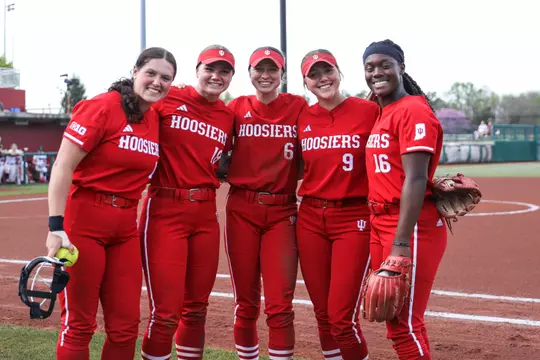
With Kern in the lineup, all things are possible, and it shows. IU (40-15 overall, 18-5 in the Big Ten) finished second in the conference standings behind No. 16 Northwestern (35-11, 20-3). It leads the Big Ten in hitting (.319), home runs (72), runs scored (378) and runs batted in (354). It’s second in stolen bases, with 98.
Third baseman Cora Bassett (.331 average) leads off, followed by Kern, designated player Taylor Minnick (.413, 11 homers, 52 runs batted in), first baseman Sarah Stone (.273, 7, 59), third baseman/pitcher Brianna Copeland (.333, 11, 44), right fielder Avery Parker (.326, 9, 36), left fielder Cassidy Kettleman (.275), center fielder Kinsey Mitchell (.362) and shortstop Brooke Benson (.228).
“Taryn elevates those around her, and her teammates help her shine,” Stanton say. “Taylor Minnick has the hardest job in hitting behind her. Teams are nervous to pitch to Taylor, too. Then we have Sarah Stone and Brianna Copeland and the others.
“We don’t have a gap trap. That helps Taryn elevate. She helps her teammates elevate and it all helps Team 50 rise.”
Could that rise lead to a Big Ten tourney title, and then the program’s first NCAA tourney bid since 2011?
The Hoosiers enter the 12-team, four-day, single-elimination event on a nine-game winning streak. They open Thursday against the winner between Penn State (30-15) and Michigan (26-24).
The tourney winner gets an automatic NCAA Tournament bid. IU needs to win three games to earn that bid.
Kern can’t wait for the opportunity.
“I don’t think we have a ceiling. Having our strength be our offense solidifies that. No matter how many runs the other team scores, we’re going to punch back. We’ll keep scoring.
“We have five hitters with seven or more home runs. That’s awesome. It’s awesome to see our hard work pay off.
“I think the sky is the limit for us.”