
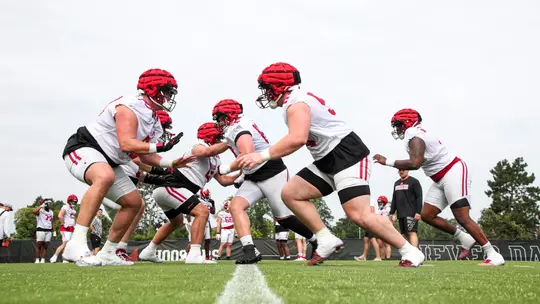
Mission Focus – Offensive Line Building for Success
Pete DiPrimio | IUHoosiers.com
BLOOMINGTON, Ind. - Practice No. 1 is over.
Then it’s not.
A cool by August standards late morning arrives at Indiana’s football practice fields and a final conditioning session is added at the end of this two-hour camp-opening practice.
Fitness and toughness are crucial under head coach Tom Allen’s win-the-fourth-quarter mandate.
Players line up for short sprints. The focus is not on distance and speed as much as attention to detail. A good stance. Hands on the ground. Stay low. Little things matter, especially when mental and physical fatigue kick in and victory is at stake.
Allen paces through the midst of his players, bullhorn in hand, voice raspy, eyes alert, pushing a stay-strong message.
“Hands down!” he shouts through the bullhorn. “Stay down! Finish strong!”
Players sprint. Allen watches.
“Keep going, men!”
Players sprint. Allen paces.
“Hold your stance! Stay in your stance! Finish strong!”
Also watching is Bob Bostad, the new offensive line coach tasked with building a group capable of winning against the defensive likes of Ohio State in the Sept. 2 season opener, and all the other elite defenses on a schedule that, as usual, rates among the nation’s toughest.
Twenty-five years of offensive line coaching at the college and NFL levels, including two stints at Wisconsin and four NFL seasons with the Tampa Bay Buccaneers and Tennessee Titans, have steeled Bostad for this. He sees the potential and the challenges. His job -- maximize the first to overcome the second.
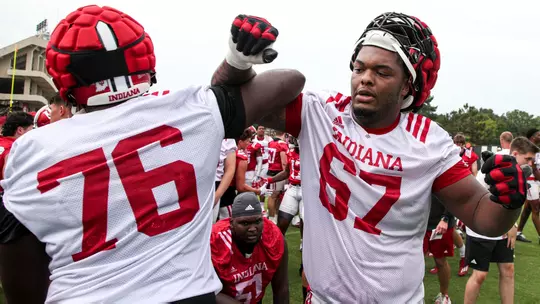
“We have a lot of things to do,” he says. “Let’s slowly build this together and get it done. I like the approach. I like the attitude. I like the willingness. Those things are all there.”
Facts back him up. In its final two games last season against Michigan State and Purdue, IU rushed for 257 and 215 yards.
“It’s about building confidence and having success,” Bostad says. “We’re trying to get to that. We’ve got some guys who have played a lot of football. We have a quiet, confident group that has done some good things. It’s there. We have to put it all together.”
Linemen such as Matthew Bedford, Mike Katic, Kahlil Benson and Max Longman are all in.
“Any time you get a coach who has been in the NFL, who has coached the offensive line, he knows what he’s talking about,” says Longman, a University of Massachusetts transfer. “He’s a voice you can trust.”
Trust is big for Katic, who has 25 career starts.
“It’s the way he explains it,” he says. “He knows it’s worked for him in the past, and it will work for us. He’s so smart about offensive line play. Everything he says, we listen to and follow.”
Following means focus.
“He’s really focused on the details and how to get things done,” Bedford says. “That’s what he’s implemented since he’s been here. He comes from the league and understands what it means to make good O-linemen into great O-linemen. That’s what he’s focused on -- the mission and how we get it done.”
A couple of years of sub-par offensive line play leaves outside-the-program doubt and inside resolve. The running game must improve. Pass protection must improve. Communication and chemistry must improve.
In so many ways, season success depends on it.
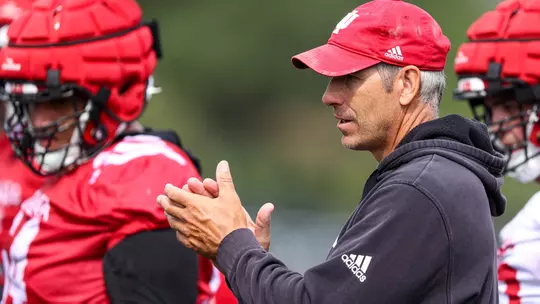
“We understand to the outside eye and in the past, we’ve been the weak link,” Bedford says. “We’re working on changing that. We’re not just working on it, we’re changing it now, through actions, through habits.
“We built a lot of bad habits in the last couple of years and we’re breaking them.”
Habit breaking starts with this -- each player must focus on his actions and how they impact what’s happening around him.
“Coach Bostad enforces it,” Benson says. “If you’re not on board, you’re going to fall behind. It pushes us to want to be great.
“Details matter. Small things matter. Small things lead to big things.”
Excellence often comes down to doing simple things well all the time. If the quarterback gets knocked down, pick him up. Run to the ball every play, all the time, no exceptions.
“Once you engage the man and do your job, get to the ball,” Bedford says. “We run a fast-paced offense. We need to understand how to move quickly and transition to the next play.”
Accountability starts with the players. As a redshirt senior with All-Big Ten honors and 28 career starts at four positions on his resume, Bedford is at the top of the offensive line leadership list.
“It’s player led,” he says. “It’s 100 percent leadership. That falls on me. How habits are made goes through us -- me, Katic, Kahlil. We’re taking a big role in making sure we’re changing things.”
Here’s an example. If a player doesn’t run to the ball, it’s addressed immediately on the field, and then on the sidelines. Players address it first, then Bostad.
“You have 10 pushups,” Bedford says. “You have something physically to remind you that you need to get to the ball.
“This is the assignment. You’re not meeting it, so we’re going to call you up to the challenge. Pull you up to the standard.
“At the minimum, we’re going to run to the ball. At the minimum, we’re going to do that. If you don’t do it, we’re going to call you up to the standard. Every time.”
The best teams, regardless of sport, are player led. That extends to each position. For the offensive line, when something needs fixed, players take charge.
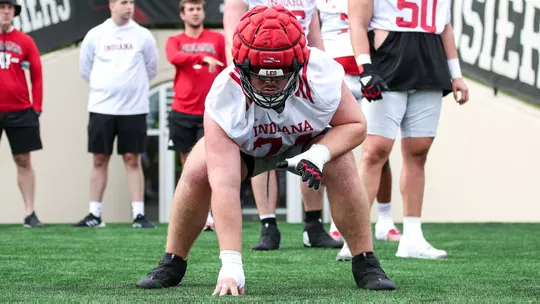
“Coach Bostad lets us take a big player role,” Bedford says. “We’re a player-led group. We direct that situation.”
Consecutive losing records after consecutive bowl seasons fuel a program-wide urgency. As running game coordinator as well as offensive line coach, Bostad is at the forefront given the youth at quarterback. He pushes to restore the confidence and execution of an offensive line in need of both.
“I’m a big believer that you build confidence by a lot of reps,” he says. “It’s like anything else, it takes 3,000 reps to master a skill. That’s a lot of reps. We probably won’t get to that, but we’ll get as many as we can.”
Practices drills and film watching of those drills are part of a process that started last spring. So is a constant evaluation of how players respond to coaching.
“Did we do a good job of teaching in the spring?” Bostad asks. “Are we talking about the same things? Being a good coach means being a good teacher. We might have good lesson plans. Do they make sense? Are we all over the board so our kids are all over the board? Are we staying with the same things? Are they hearing the same things over and over?
“If we’re doing that and we’re sound, then we go on the field and work with them. That’s how you build the confidence.”
Bostad’s no-nonsense coaching style resonates with players.
“He has a subtle intensity that I appreciate,” Bedford says with a smile.
“His style is not flamboyant. It’s not a bunch of rah-rah. He’s straight to the point. He knows exactly what he wants. He knows exactly how to relay it to you clearly so you can understand what you need to do.”
Another smile.
“There are repercussions when those things don’t get done.”
Repercussions work when strong relationships are built. In this case, that includes fishing and boating.
“There’s not a lot of jokes,” Bedford says with a smile, “but he likes to fish. When he’s out of the office, we talk about fishing; we talk about boats. He’s building that connection with us outside of football, but when he’s in the office, we’re in the office.”
In the end for the offensive line, it comes down to five guys functioning as one, every time.
“It’s about focusing on the mission, the objective, the play,” Bedford says. “Focus on the details of how you get that done. Focus on the play, focus on the details of the play.”
And then block the defender into tomorrow.