Indiana University Athletics
DiPrimio: Building Block – NCAA Titles Fuel Tyler’s Olympic Aspirations
4/9/2024 12:41:00 PM | Men's Swimming and Diving
By Pete DiPrimio
IUHoosiers.com
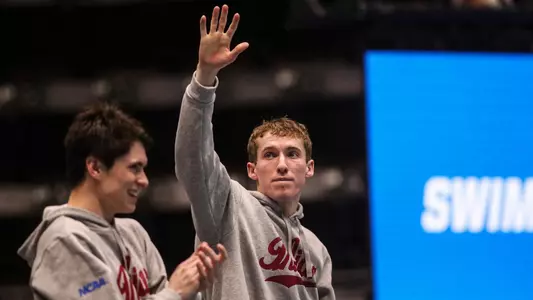
BLOOMINGTON, Ind. – Take a break? There's no time for that. Not now. Not for Indiana junior Carson Tyler, who at age 19 is atop the U.S. college diving world with bigger things in mind.
"We're only days from the NCAA meet," diving coach Drew Johansen says from his Counsilman-Billingsley Aquatic Center office, "and he's in here working out because he loves it."
Love has Olympic motivation. July's Paris Games is the goal, the culmination of a multi-year quest that requires a top-two finish (individually) in June's Olympic Trials in Knoxville, Tenn.
"There's a process it takes to get there," Tyler says. "Focus on what we have to do every day to get there. It won't happen overnight. It takes time. Keep working."
Tyler has worked to reap the benefits. He's coming off one of the most dominating diving performances in NCAA history in last month's championships in Indianapolis. He won a second-straight national platform title as well as a 3-meter springboard championship. He also took third on the 1-meter springboard, an event he didn't focus on because the other two are Olympic dives.
On one platform dive, a reverse 3 ½ somersault, Tyler got a perfect 10 score from one judge and earned 91.80 points. Another dive got him a 95.40. His 515.75 total – an IU record in NCAA competition – was 65 points ahead of runner-up Maxwell Weinrich, also a Hoosier.
Tyler's 56 team points were more than any other diving team. Ohio State, the second-best diving squad, had 55.
"I wasn't aware of it at the time," he says. "I was focusing on the job I had to do. After the fact, I was super proud. It's a really good achievement, but it wasn't the goal. I focused on execution and the outcome worked itself out."
It's this outcome-oriented approach, combined with exceptional physical skills, that has Johansen so optimistic about what's ahead.
"We knew before Carson came through the door that he had the potential to be one of the greats. We're in the process of that."
Greatness has cream and crimson company. Add teammate Quinn Henninger's All-America finishes in the 1-meter, 3-meter and platform events, and Weinrich's additional All-America effort on 3-meter, and IU divers scored 121 points, which would have placed them 11th in the NCAA team standings.
Combined with swimming, the Hoosiers finished fourth as a team to go along with the women's seventh-place team finish a week earlier. It's yet another example of cream and crimson excellence, and this much is certain in this Olympic year:
More is coming.
*****
Legends loom larger-than-life at Counsilman-Billingsley Aquatic Center through black-and-white photographs – frozen moments of athletic achievement and celebration – that showcase possibilities.
Here's a huge photos of Olympic medal winning divers Cynthia Potter and Jim Henry; and more of swimming gold medalists Lilly King and Cody Miller, and one of arguably the greatest swimming and diving coaches in U.S. history, Doc Counsilman and Hobie Billingsley.
Tyler taps into all of it, especially Indiana's rich diving legacy that includes Potter (a three-time Olympian and the 1976 bronze medalist), Henry (a 1968 bronze medalist), 1964 Olympic gold medalists Ken Sitzberger and Lesley Bush, 1968 bronze medalist Win Young, 1992 gold medalist Mark Lenzi (who added a bronze medal in '96) and, most recently, 2020 silver medalists Andrew Capobianco, Michael Hixon and Jessica Parratto.
They are among the reasons why Tyler, who is from Georgia, is a Hoosier.
"I came because of the long history of excellent divers," he says. "You see all the photos along the pool – people winning NCAA championships, winning the Olympics, winning Olympic medals. To be a part of that was a big goal for me."
Tyler nods at the man sitting next to him.
"And the coach is pretty good, too," he says with a smile about Johansen. "That all played a part in my decision to come here.
Like Billingsley before him, Johansen has an elite coaching background that includes seven NCAA individual champions in the last six seasons. He has been the U.S. Olympic diving head coach for each of the last three games.
Johansen recruits for more than just physical skills. He targets relationships as well as rankings, believes in culture over numbers. His mantra is passion, personality and physique.
"If they have those three things," he says, "they will succeed here."
Tyler personifies that.
"You need a passion for the sport and Carson has it," Johansen says. "The personality has to be a fit for me and my coaching style. Not everybody is going to take the way I teach. Personality also has to fit with the team culture. The physique is having the body to do the diving. Carsen has the right physique to be on the platform, but he's also very successful on the springboard, which isn't always the case. He had the three P's."
As a result, potential has become reality.
"It was a fit right away," Johansen says. "We're working hard together. We are able to struggle together and still share our experiences in a positive way that allows us to grow."
*****
Tyler's diving passion comes from the child in all of us.
"I like to do flips and I like the freedom of jumping around and going through the water," he says. "It's a very freeing sport. Ever since I was a kid, I've loved to do flips."
Flipping came without a gymnastic background typical of many divers.
"I was never a gymnast. There was a diving program where I grew up, and I got into that."
Doing a dive that involves multiple twists, turns and somersaults one time is challenging. Doing it on command, amid enormous pressure, and doing it better than anyone in the country requires elite mental and physical toughness, along with exceptional body awareness to know where you are at all times as you twist and fall.
"You have to use your eyes," Tyler says. "I try to pick up on visual cues. I use the water as a visual cue. In each flip as it's coming around, I try to find the water and use that information."
Information involves ever-increasing complexity in these go-bigger scoring times.
"Diving has evolved tremendously, especially on the springboard," Johansen says. "They are doing an entire other flip and entire other twist in every direction than they did 15 years ago.
"We've learned new techniques on how to use the springboard. The platform hasn't changed in 100 years. It's still 10 meters high and a piece of concrete, and yet they are doing more twists and flips. That's just getting better techniques on how to spin, how to control your somersault and the fitness level of the athletes."
Harnessing it all requires cutting-edge training that borrows from golf.
Yes, golf.
Think the powerful swings of Bryson DeChambeau, one of the world's longest drivers.
"Our sport is very much like golf physically and mentally," Johnansen says. "I can swing a club, but I don't generate the club-head speed that DeChambeau does. If I did, I wouldn't be able to walk the next day.
"He uses his technique to launch the ball. That's very much like our sport. The better your fitness and quickness, the more power and load you have in your legs, combined with technique, you can produce those amazing forces to do all those flips and twists that happen in a split second."
Tyler's diving evolution would add another twist to the gainer three-and-half twist, a daring reverse dive that starts by facing forward.
"That would be a crazy dive," he says. "People have done it. I haven't seen it done well."
*****
For Tyler, the NCAA Championships were a means to – if things work out – an Olympic end. The top two U.S. Trials finishers in diving events earn a trip to Paris.
"This was a good part of our process to reach the Olympics," he says. "It was a building block. It gives me confidence moving forward."
Tyler is unsure if he will compete in both the platform and springboard, or just one. Much will depend on his training, the results of a pair of upcoming competitions and overall stamina.
"The physical load of the Trials is really challenging," Johansen says. "What Carson did in the Big Ten and NCAA championships is similar. If we stay healthy and fit, with the potential to make both events, we might take on that challenge."
How physically demanding is diving? On the platform, divers plunge into the water from 10 meters. That's punishing on the best of dives, more so on ones that aren't.
"On the platform, it's mainly your upper body," Tyler says. "Your shoulders and (trapezius muscles) feel it, especially when do 20 reps on a single day. It also takes a toll on your legs.
"On the springboard, your legs will be sore the next day. Your shins and calves also might feel it."
Tyler's Olympic preparation began when he arrived at IU in 2021 as a two-time junior national champ. Johansen says the first two years were focused on learning the harder platform dives as well as strength training.
"He needed to work in the weight room," Johansen says. "He needed some body weight to be able to bend the springboard to get to that Olympic caliber dives, and we've done those.
"On platform, he added four new dives to his list that equal the standard to make the Olympic podium. Those are the dives he used at the NCAA championships."
Moving forward, Tyler won't change his preparation plan.
"We'll keep doing what we've been doing because it's seemed to have worked. Keep showing up every day, keep the same amount of effort and the outcome will be there."
The diving team is selected based on the scores of 12 dives per event. Does Tyler's 515-points six-dive total from the NCAA victory project to make the U.S. platform team?
Probably.
"Any time you score over 500 points in an event like that with that type of judging, you're in rare air," Johansen says. "That's Olympic caliber."
Tyler's NCAA success was boosted by that of the Hoosiers' overall performance, including swimmer Brendan Burns' dramatic 100-meter backstroke victory from the outside lane.
"When that happened," Johansen says, "I knew that Carson and Quinn would dive great. The power of team was taking us all. It was no longer about an individual, but the team.
"That's how that whole season unfolded for us, and we're going to carry that into the Olympic Trials. We will probably be the largest team there. We will keep that energy going."
A break, you see, is nowhere in sight.