
‘More Than a Coach’ -- The Evolution of Offensive Coordinator Mike Shanahan
Pete DiPrimio | IUHoosiers.com
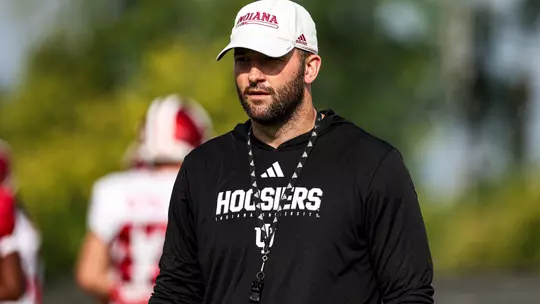
LOS ANGELES - They call him “Shanny” and it fits. Mike Shanahan is more than Indiana’s offensive coordinator, more than a receivers coach, more than the guiding force behind one of the nation’s most dominating offenses on a 13-0 top-seeded college football playoff team.
Shanahan is, standout receiver Elijah Sarratt says, a man who cares, and that makes all the difference.
“I love him more than just a coach. He's someone I can talk to about anything. He's someone I want to invite to maybe my wedding years from now. I appreciate Coach Shanny a lot. Just seeing him evolve every single day makes me want to get better as well.”
IU’s prolific offense -- Big Ten-leading averages of 41.9 points, 472.8 total yards and 221.2 rushing yards, all directed by Heisman Trophy-winning quarterback Fernando Mendoza, entering the Jan. 1 Rose Bowl showdown with ninth-seeded Alabama (11-3) -- doesn't just reflect Shanahan's offensive prowess as a play caller and game-plan innovator. It's a collaborative effort with head coach Curt Cignetti, offensive line coach Bob Bostad, tight ends coach Grant Cain, running backs coach John Miller, and quarterbacks coach Chandler Whitmer.
“He makes sure that he gets the opinions of every coach, whether it's scheme or a certain play or the way he wants to run the offense,” standout offensive lineman Carter Smith says. “Coach Cignetti is also very involved in that. It’s iron sharpening iron.”
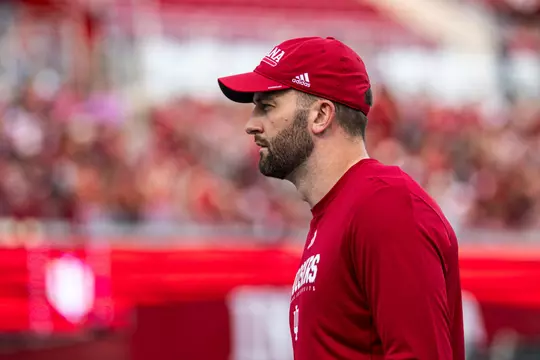
Defensive coordinator Bryant Haines has experienced that sharpening first hand. He and Shanahan have worked together for more than a decade, and spent countless practices disrupting each other.
“I have always respected him as a co-worker and a receivers coach who was always extremely organized and very efficient with his coaching,” Haines says.
“He was a no-brainer hire here as the OC. Anyone that's been around Shanny knows how capable he is. I knew he was going to make it because he is phenomenal. He's a great coach, very smart and his organizational discipline is one of his elite qualities.”
Shanahan’s coaching evolution spans nearly 20 years, from his days as a wide receiver at Pitt to his graduate assistant role at Pitt followed by working for Cignetti as a receivers coach at Indiana University Pennsylvania to receivers coach and recruiting coordinator at Elon to the same position at James Madison before taking over offensive coordinator duties there and now at IU.
Joining Cignetti at Indiana was an easy choice, Shanahan says, despite the program’s 9-27 record over the previous three seasons.
“There wasn’t a doubt in my mind I would come with him if he asked and gave me the opportunity. I saw IU was in a lot of close games the year prior to us being here even though the record wasn’t great. They were very competitive. That was a positive.”
Shanahan has always thrived under Cignetti, who brings decades of impressive offensive insight.
“I’ve learned a lot from Coach Cig,” Shanahan says. “He has a lot on his plate as the head coach, but one thing I admire about him is his work ethic and his preparation throughout the week. He sees the game while being on the field, which is maybe slightly different than what I can see in the press box. When he makes a suggestion or Coach Bostad or Coach Whitmer or Coach Miller make one, I feel confident in those guys, if they recommend it.
“Our dynamic is that as we get more familiar with each other, we’re pushing each other to come up with the best plans and then on game day executing it the best we can to put the players in the best position to be successful. At the end of the day, that’s all we’re trying to do.”
It’s worked at unprecedented program levels. IU has scored 55-or-more points six times this season. Last year, it scored 41-or-more points eight times.
“A lot of credit goes to the players for making it happen regardless of the defense or down and distance,” Shanahan says. “It’s been a lot of fun every week going through the process with Coach Cig and the other guys on the offensive staff.”
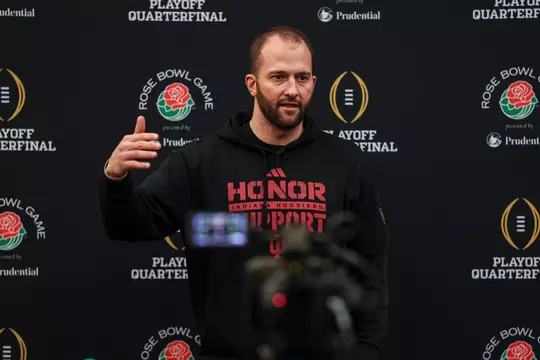
Cignetti says he first hired Shanahan in 2016 because he needed a receiver coach at IUP. The problem -- the part-time position paid just $10,000 a year. The fact they both were from Western Pennsylvania brought familiarity.
For perspective, Shanahan recently signed a three-year contract extension that puts him among the nation’s highest-paid assistant coaches.
“He came in for the interview and he was nervous,” Cignetti says. “His father had played basketball at IUP. A lot of people thought highly of him in the western Pennsylvania area, so we hired him.”
Shanahan quickly made an impact. “He did a good job, a really good job,” Cignetti said. “I was working closely with the offense as well that year.”
When Cignetti took the Elon job, he said the first coach he took was Shanahan. The second was Haines.
“Mike just progressed every single year.”
At Elon, Drew Folmar was the offensive coordinator. At James Madison, it was Shane Montgomery, but after three years, Cignetti made a change.
“Mike wanted to be the coordinator. He had been with me, by that time, maybe six years. Normally, I had gone outside and hired a quarterback guy to be my coordinator. That was my intention when the job was open.”
Shanahan had a friend, Tino Sunseri, who worked closely with then Alabama offensive coordinator Steve Sarkisian, now the Texas head coach. Cignetti liked the Crimson Tide’s passing game and wanted to incorporate elements into his offense.
So, Cignetti hired Sunseri as the quarterbacks coach and Shanahan as the offensive coordinator.
“We had some new ideas and Mike could put it all together,” Cignetti says. Mike's just gotten better every year, where he's very capable of taking and running with it at any level, anywhere. I feel very fortunate to have him.”
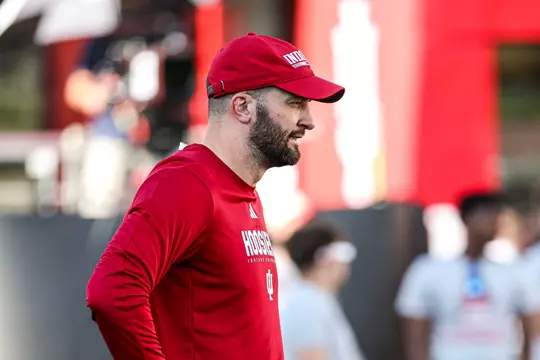
Quarterback continuity is a cornerstone for most strong offensive systems.
Then there’s the way IU does it.
Elite offensive success comes despite an ever-changing starting quarterback. Last year, Kurtis Rourke, a transfer from Ohio, directed the Big Ten’s best offense. This season, it’s Mendoza, a transfer from the University of California who completes 71.5 percent of his passes for 2,980 yards, a nation’s best 33 touchdown passes against just six interceptions.
“I can’ remember when we had the same quarterback starter back to back,” Shanahan says. “Since I became offensive coordinator with Coach Cignetti, we’ve had a new quarterback every year.”
What’s the secret to the Hoosiers’ quarterback success?
“It all starts with the offensive line,” Shanahan says. “We’re very fortunate to have seven good players up front, a lot of experience, starting with Pat Coogan, Carter Smith, Drew Evans, Bray Lynch, Kahlil Benson, and Adedamola Ajani. All those guys doing their jobs allow the quarterback to do his job.
“We always strive to be balanced. Part of that is our (run-pass-option) system. Keeping the defense off balance with the play calling and schematics from week to week with what we see on film.
“A lot of it is a combination of pre-snap and post-snap indicators. Nowadays, it’s hard to cut the field in half and say, ‘Do this vs. this coverage and that vs. that, because of all the defensive disguises and the things defenses have evolved in to.
“We have a little bit of everything in the pass game -- progressions to quick-game concepts, play action, pushing the ball down the field. We try to have a lot of multiples and do what Fernando does best.”
Mendoza, Shanahan adds, has talent the other quarterbacks did not. It’s among the reasons why he has led dramatic, fourth-quarter, game-winning drives at Iowa, at Oregon and at Penn State, and against Ohio State.
“Fernando can touch areas around the field some of the others couldn’t,” Shanahan says. “That’s opened another aspect of our offense we’ve been able to take advantage of his year.”
It starts, Shanahan says, with Mendoza’s work ethic.
“He’s very serious about his craft. It all starts with his prep. He has a lot physical attributes you can’t coach -- a strong arm, a quick release. He sees the game well, sees the field well. He understands situations.
“He can do it all. He can get the ball out quick to our playmakers on the perimeter. He makes good decisions on when to throw and when to hand it off. He does a good job in the drop back, the quick game, play actions, getting out of the pocket and using his legs to his advantage. There are a lot of things schematically we can do to take advantage of his skill set.”
Beyond that, Shanahan says, “Coach Whitmer does a great job of getting him prepared each week to anticipate what the defense is doing and get the ball to the right guy, to hand it off when he needs to.”
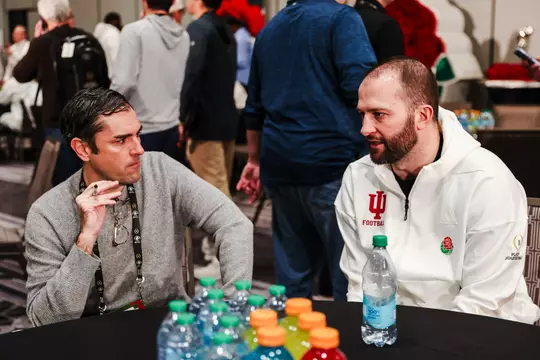
What’s the secret to Shanahan’s success? Sarratt offers insight from working with him at James Madison as well as IU.
“One of the biggest things I don't think people talk about enough with him is the amount of work and time he puts in,” Sarratt says. “It amazes me the time he puts in. There are days when I'm like 'Hey coach, you might want to go home a little early tonight, man, just kick your feet up,' but he's always putting in the work since I've known him. He demands excellence out of me and everyone around him.”
Shanahan has become better at engaging with every offensive group, Sarratt adds.
“He picks us up. If practice is going slow maybe saying, 'O-line come on; quarterbacks come on; running backs come on.' I've seen that more this year. He's been offensive coordinator for not too long, only a couple years now, so he's learning as we're learning. The future is bright for Coach Shanny.”
Coogan says Shanahan’s success starts from his belief in his playmakers.
“He does a great job of putting his playmakers in a position to succeed. He lets his ego go at the door and just cares about the overall success of the unit, and that is getting the ball in the hands of people we all know can make plays, explosive plays.
“He does a great job of making sure we're all on the same page.”
Beyond that, Coogan says, “He trusts us. He gives us the power to make plays for him and for the team. Whether it is a run heavy call or those (run-pass-option plays).
“We've had games where the RPOs have been there and other games where we've had to rely on more of the run and more of the drop back passing. He does a great job of adjusting. He does a great job of putting us in positions to have success. It's been great working with him and getting to know him.”
Greatness includes one other element, Smith adds. Watching Shanahan work his offensive magic, is “fun.”
Fun has resulted in a massive turnaround. IU is 24-2 over the last two seasons. That’s generated overwhelming fan support and excitement.
“I have had some people in the community thank me and the team,” Shanahan says. “That’s been one of the coolest parts of being here, just the support we’ve gotten from the community -- students, alumni, former players, people in general. They’re taking a lot of pride in what we’ve been able to do.”