
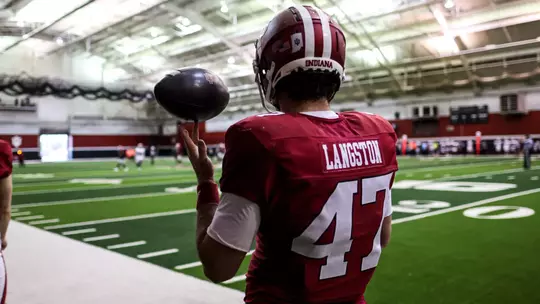
‘Data Nerd’ – Regression, P Value and Langston’s Long-Snapping Success
Pete DiPrimio | IUHoosiers.com
BLOOMINGTON, Ind. -- Anonymity rules when you’re a long snapper, as Mark Langston is for Indiana; when your job demands precise ball placement every time on extra point attempts, field goal attempts and punts, all while blocking someone who seeks to steam roll you.
If you do it right.
Mess up on kicks and the Hoosiers don’t score. Blow the snap on a punt and it’s likely a field position disaster -- or worse.
Then you generate headlines for all the wrong reasons.
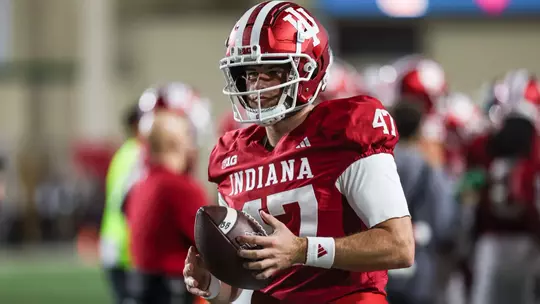
The 6-foot, 225-pound Langston, an honorable mention All-Big Ten selection last season in his Hoosier debut, is well aware. He knows how to do it right, and the answer, he says, in so many words, is to turn into a scientist.
“As far as how many reps I do in practice, I’m kind of like a data nerd,” he says. “I’ve recorded all my reps since 2022 when I tore my ACL. Fifty reps was my number.”
So far, that’s straight forward enough. Fifty reps per practice delivers maximum performance.
Then it gets complicated.
“I ran the regression on Excel,” he says. “I did my P value for how many reps I took. The number of reps I took was the least impactful co-efficient. Having that approach per each rep is what I’m focused on.”
Like we said -- it’s complicated.
Inspiration came from former Alabama long snapper Thomas Fletcher, who played on a pair of Crimson Tide national title teams before being drafted by the NFL’s Carolina Panthers. A hip injury ended his career. He’s now the special teams coordinator and tight ends coach at West Alabama.
During training, Langston said Fletcher would snap the ball, take off his helmet and walk around for a while, then run back onto the field, put on his helmet and snap a few more balls, then repeat. The goal -- maximize each rep and don’t overdo it.
“I try to stay around 50 snaps,” Langston says, “so I can come back every day and stay fresh every day.”
If that seems overly analytical, Langston doesn’t care. Last season, his first as a Hoosier after transferring from Georgia Southern, he played a big role in kicker Nico Radicic making all 69 of his extra point attempts, and 10 of his 11 field goal attempts. He delivered on-time snaps to punter James Evans.
“On Day One of fall camp last year,” Langston says, “I sat down with the players’ manual and had every stat you could think of.”
Last year, the Hoosiers went 11-2, with the losses coming at Ohio State and at Notre Dame, the national champ and national runner-up. Punting issues contributed to both defeats. Head coach Curt Cignetti noticed. Langston noticed.
“Our two losses were directly correlated to how the punt team performed,” Langston says. “I established why that was and how to make it better.”
The nerd in Langston is reflected in the chemistry he has with Radicic and new punter Mitch McCarthy, a transfer from UCF.
“We’re trying to get us to all think alike,” Langston says. “That goes beyond just doing drill work. It’s about, why are we doing this drill?”
He says during training sessions, their social media hashtag is T for P -- Training for a Purpose.
“For each drill and rep, it’s like, why are we doing this? That makes it easier to translate onto the field instead of just going out there kicking a thousand balls because you just want to check a box. It’s more than that.
“It’s better to have a direction. Like Coach Cig says, 90 percent is in between your ears. Having that approach that he has is something that’s intangible and un-coachable. You either have it or you don’t. That’s really impressive.”
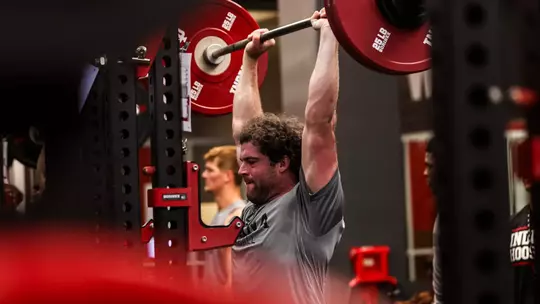
The spring was the first chance Langston, McCarthy and Radicic had to work together in a football setting. That’s continued over the summer.
“The objective is to get us all thinking alike, and knowing where our problems are, knowing where to step, knowing where to line up,” Langston says. “We’ve done a good job with that and want to keep building off of that.”
Langston’s long-snapping days began at Georgia’s Savannah Christian Preparatory School. As a senior, he earned all-state honors as a long snapper and a defensive player when he totaled 86 tackles while helping Savannah Christian reach the Class 3A state playoffs final four. He also played baseball and helped his school finish as the state runner-up.
How did he become a long snapper?
“In high school, I was heavy into defense,” he says. “One day in practice, I just went off to the side and started snapping to a field goal post. I eventually got really good at it.”
He got good enough to earn a scholarship opportunity at Kennesaw State, where he worked with a veteran long snapper. He also spent time training with current Los Angeles Chargers long snapper Josh Harris.
“It just took off from there,” Langston says. “I had a really good guy ahead of me who took me under his wing and taught me everything. Along with (Harris), they molded me into who I am.”
Refinement came by watching lots of YouTube videos.
“You try to mimic what they’re doing on the videos,” he says. “It’s watch and repeat. Keep practicing. That’s all it is -- reps on reps on reps on reps.”
At Kennesaw State, Langston redshirted his first season, didn’t play at all in his second. Then, he transferred to Georgia Southern and started 22 games over the next two years before missing all of 2023 with that torn ACL. He then transferred to IU and had a career year.
He wants another one, understanding that during games, defenses will come after him while seeking to block kicks and punts. His counter is to attack them.
“I try to be the one to deliver the blow. For most of the time, it's kind of inevitable to get caught up like a pinball going through coverage. When that happens, you just keep moving forward.”
Long-snapper challenges, he adds, are “multi-faceted.”
“A lot of people would say the snap is the biggest challenge. I wouldn’t say that. For me, it’s probably slowing down the game, being where your feet are and taking the right steps. Being really measured with your footwork. Getting to the point where you can deliver the blow, and not take it, and not get run over.”
Last year, IU thrived on special teams (its PFF grade ranked third nationally), which is something Langston says that as a special teams leader, he takes “immense pride in.” The Hoosiers seek to do it better this coming season, and the key, he adds, starts with “thinking alike.”
“For so much of it, the margin of who’s better is so small. Everybody can snap and kick and punt relatively the same. What are you doing outside that gives you an edge to stay ahead? That’s what gives us an advantage.”