
Indiana University Athletics
1/12/2026 3:30:00 PM | Football
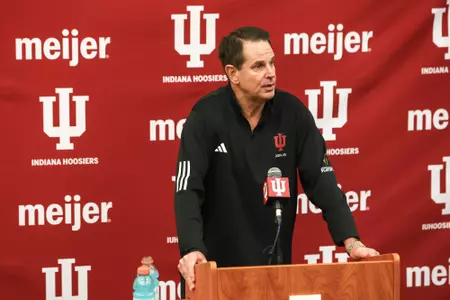
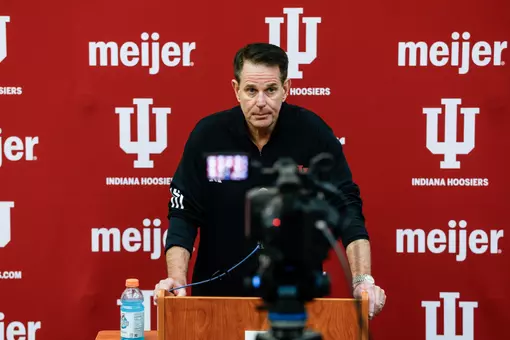
BLOOMINGTON, Ind. –––– Indiana football coach Curt Cignetti addressed the media on a teleconference ahead of the College Football Playoff National Championship Game at Hard Rock Stadium on Monday (Jan. 19) in Miami, Florida.
Below is a full transcript of the press conference, while video of the media session can be found on the right sidebar at IUHoosiers.com.
Curt Cignetti | Indiana Head Coach
Opening Statement
CC: Excited to start our prep as a team. We staffed yesterday, but we're with our players today. A huge challenge against a great Miami team. Very impressive, really in all three phases. A lot of twitched-up athletes playing fast, playing with a nasty edge. Coach Cristobal has done a great job. Offensively, the quarterback, Carson Beck, really playing well; receiving corps, impressive; offensive line, veteran, impressive; running back, over 1100 yards.
Defensively really shutting people down, creating havoc up front. The two ends are a big challenge. Corey has them flying around. And their teams are good. It's going to be a great challenge.
On retaining Bob Bostad from the previous regime…
CC: I think Bob Bostad was a key addition to the staff. I'd known of his name for about 10, 12 years and his reputation. When I looked at who was on the roster in terms of the coaching staff last year, and I saw he had been the line coach, that excited me. And I offered him the opportunity to stay right away. I don't think it took him real long to make a decision. In terms of the transition with the offensive staff, Mike Shanahan -- at the time, Tino Sunseri, quarterback coach; John Miller, the running back coach; Grant Cain, the tight ends coach -- had been involved with me at JMU and I'm involved in the meetings. I think putting it all together was real easy because Bob's a vet. And his philosophy in terms of the run game was aligned with mine and Mike's. And then it was just a matter of, okay, pass pro, what would our calls be, how are we going to do it? What five-man, six-man, seven-man protections are we going to carry? He's done a tremendous job. He's a great developer. He gets a ton out of his guys. The whole becomes greater than the sum of its parts. And we've been very consistent and very balanced between the run and the pass.
On the difference in a player's ability and development throughout the different years in college…
CC: I think when you're talking about the high school signees, they change a lot between their freshman year and their senior year. Their developmental curve is different. Every guy is a little bit different. Some come in more ready to play than others. Some, it takes a while to mature physically. Some, it's mental. But there's no question about it that a 22-year-old is a little wiser, older, bigger, stronger. He's had four years in the offense, defense or special teams. And he's a more productive player.
On how having experienced players has translated to early success…
CC: No, I think it helps us a ton, but that's what we look for, too. When I came, you know, it was a quick process, a three-day hiring process. When I got here, we had 10 offensive starters in the transfer portal, and we had one returner on defense. So we were down to 40 scholarships by day three. So we needed to hit the portal hard. And we signed 22 guys that all have been two- or three-year starters with consistent production. I knew we had flipped the roster. And then every year, as your high school recruiting builds up, you kind of start to wean down a bit from the portal. You'll never be at a point where you don't engage with the portal. And this year we'll take a few less than we took last year and we took a few less last year than we took the year before. But I think getting older, mature guys that played a lot of football, if they've got the right stuff, which I'm not bringing them in if they don't, it's an asset.
On trying to find the right balance of high school and portal talent to develop over the years…
CC: I don't look at it that way. I think in college football, nowadays, you've got to win every year. With social media the way it is, the pressure to be successful, you've got to put together a team that's ready to compete for championships every single year. Now, the more success you have, the better you're going to recruit from the high school ranks. And those guys will develop, and most of them will redshirt, but some of them will play as a freshman. We're always going to bring in 20, give or take one or two, high school guys. I think we brought in 23 this year. Some of those guys are ready to help us right away in some capacity. But the portal guys, you're bringing them in because you have a critical need, where have you to fill a hole on your football team. So we've been successful doing it. College football's changed a lot, obviously, still changing. You've got to adapt, improvise, be light on your feet if you're going to survive. And that's where I think all that recruiting coordinator experience I had in the past, too, as well as coaching probably benefited me.
On what he would say to people who call Indiana a 'Cinderella Story'…
CC: Well, define "Cinderella story" in the context of Indiana. I'm not quite sure what you mean by that.
Reporter: A team that has risen up despite the past that shows there has not been a lot of winning tradition.
CC: Well, I think that's a fact. If you look at the record since Indiana started playing football and relative to the success we've had the last two years, we've broken a lot of records here in terms of wins, championships, postseason games, top-10 wins on the road, et cetera, top-10 wins, period. So it's been kind of surreal, but you get it done with the right people, properly led. You've got to have a blueprint, plan in process. You've got to have the right people on your staff and the right people in the locker room. We've been fortunate to have great staff continuity, with Bryant and Mike have been with me 11, 12 years, and a lot of other guys on staff, five, six, seven years. And then down in the locker room, we've got a lot of older guys that have high character, great leadership traits. They can buy into the team vision. They're very consistent, day in and day out, in terms of being committed and disciplined and working hard toward improvement, staying focused on the goal, keeping the eye on the bull's-eye, so to speak. And being able to sort of enter every Saturday prepared with the right mindset and then putting it on the field. It's all about people. And then you've got to have a blueprint and a plan. And I think there's no question about it, that's what's gotten us to this point.
On being in championship game settings…
CC: We've got to prepare for this game no different than we've prepared for Ohio State and Alabama. The biggest mistake our guys can make -- and I'll talk to them tonight in the team meeting about this -- is making this game bigger than it is and going down that road. Then that would be detrimental to our preparation and our performance. This week is no different than any other week. We have to be on point. We have to stack meetings, practices and go in totally prepared. But then you've got to put on it the field against a great opponent.
On his high-level defense…
CC: Well, we were excellent against Ohio State, Alabama. Against Oregon, we created three turnovers and blocked a punt, which was four, led to 21 points. It starts with Bryant Haines. He's the leader of the defense. And he goes in with a good plan and puts our guys in position to attack and make plays. But then the credit goes to the guys on the field. The leader of the defense is Aiden Fisher, but every unit has its leaders. And it all starts up front with stopping the run and affecting the quarterback. And turnover ratio is huge, getting the takeaways, and limiting the explosive plays and good in critical situations. We're playing a little shorthanded. We've lost some guys that were valuable contributors. But it's been the next-man-up mentality, like Daniel Ndukwe, who made a couple of big plays in that game, blocked a punt also. We haven't skipped a beat, so to speak. Now, there were a few more cleanup plays coming out of the Oregon game than the other games, partly because of the conflict Oregon can put you in offensively with tight ends that run like receivers and spread you out and create some throwing lanes. But you've got to be really consistent in all three phases to be successful, and I think that's what this team has been. We've been pretty consistent on offense, defense and special teams. And for the most part, you know, we've played at a high level from play 1 to 150, regardless of the competitive circumstances.
On game planning against a former staffer in Corey Hetherman…
CC: I think we've evolved offensively. He was my defensive coordinator the first three years at JMU. We've evolved offensively. Terminology has changed. We do things differently. But his scheme has, too. Now, philosophically, you know, in terms of what we think is important, him and I, that hasn't changed. He's going to create havoc up front, stop the run, TFLs, sacks. They got 47 sacks on the year. He's going to attack. The way he goes about it is a little different than the way he went about it at JMU. But the way we go about it offensively is a little different, too. So I've got a lot of respect for Corey. He did a tremendous job. I hated to see him go. I hold him in very high regard.
He's one of the best football coaches I've ever been around. His day-in-and-day-out intensity and his commitment to the game is unparalleled. But I was fortunate to have Bryant Haines on my staff who was ready to step into that role. And they're a little different because they're different people. And Bryant likes to do a lot of the different things, but we do them well. But the philosophy is still the same in terms of, it all starts up front. Statistically, since Bryant's taken over, it's about like it was when Corey was the coordinator. We're always in the top five in total defense, one or two against the run, very high in TFLs and sacks. But in terms of the schematics -- you know, man, zone, the kind of blitzes, the fronts -- we've changed a little bit. And I've seen Corey change based on what I'm seeing on tape.
On using D'Angelo Ponds on the pass play in the Peach Bowl…
CC: That was specific to a certain situation and down and distance in this game against Oregon, this past game. He's a tremendous athlete. He's got great stop/start, speed and quickness. He's a baller. He went in and executed the play perfectly. And they gave us the look or we would throw the ball and not hand it off. He outran him to the perimeter and got the first down. He was a high school quarterback also, and there's a lot of things he could probably do. We'll see how much we use him over there this week.
On being shorthanded defensively with injuries…
CC: We came out really good, and everybody that played in the last game will play in this game.
On the legacy of his James Madison guys who transferred over with him to Indiana…
CC: Well, I think they've been a big part of what's transpired here, especially year one in the transition. We had a lot of guys decide to stay. They had to write stuff. A lot of new guys, the JMU guys, probably represented about half of the transfers we brought in in December. They were probably able to answer some questions for the new guys, the returners, too, in terms of how we do things and about me and the other coaches. So, in terms of their legacy, I don't think that book's final chapter has been written yet. And when it has been written, then I think we'll all have a clearer idea.
On Pat Coogan and his fumble recovery in the Peach Bowl…
CC: He's a winner. Pat Coogan is a winner. And we've got a lot of guys like Pat Coogan. But he's been a great addition. Played a lot of football at Notre Dame. We needed a center. He saw the opportunity. He's been key to the development of the offensive line, one of the leaders on our football team. And this team has really grown closer as the season's gone on. It's a very tight group. And this team has probably taken the message of how we want to play and put it on the field to a greater extent than any of the other teams we've had. Pat's a key part of that. He's very highly respected by his teammates. He prepares great. I mean, you're on the plane, traveling. You'll see Pat back there. He's reading his notes, writing things down. The game means a lot to him. And the fact that he was 20 yards down the field and recovered that fumble, it didn't surprise me a bit that it was Pat Coogan. We just gotta teach him now, once he recovers it, to roll over it properly.
On Fernando Mendoza's communication…
CC: Chandler Whitmer, probably, and Derek Owings, our strength and conditioning coach, have more day-in-and-day-out involvement with Fernando than I do. I can tell you this, the best way to lead a team is to perform well, especially at the quarterback position. I've never tried to, like, make that guy the leader in spring ball because his performance will speak for itself. And he is highly, highly respected in the locker room. And the way he's played speaks for itself. I thought he was excellent against Oregon. Even since the Heisman Trophy, he's upped his level of play. He's a special guy. I mean, he's extremely intelligent, and people recognize that. And he says the right things, and he'll be really successful one day when football ends, whatever he chooses to do. He's got a great relationship with the guys, and it's mainly the older guys, obviously. Those guys hang together. But I think what he's done behind the scenes to bring the offensive unit even closer together -- and those are a lot of things that I'm not aware of at the time, find out later. He's just done a tremendous job. In every single area where you could impact team success, he's been front and center.
On if he comes away impressed with Mendoza's maturity…
CC: You know, when I talk to him, the conversations are usually pretty short. He doesn't say a lot in the building or on the practice field. He's not a vocal guy. Where you, I think, get a full taste of Fernando Mendoza is during the interview process, whether it's during the week or after the game. And it's always an A-plus interview.
FastScripts Transcript by ASAP Sports
Below is a full transcript of the press conference, while video of the media session can be found on the right sidebar at IUHoosiers.com.
Curt Cignetti | Indiana Head Coach
Opening Statement
CC: Excited to start our prep as a team. We staffed yesterday, but we're with our players today. A huge challenge against a great Miami team. Very impressive, really in all three phases. A lot of twitched-up athletes playing fast, playing with a nasty edge. Coach Cristobal has done a great job. Offensively, the quarterback, Carson Beck, really playing well; receiving corps, impressive; offensive line, veteran, impressive; running back, over 1100 yards.
Defensively really shutting people down, creating havoc up front. The two ends are a big challenge. Corey has them flying around. And their teams are good. It's going to be a great challenge.
On retaining Bob Bostad from the previous regime…
CC: I think Bob Bostad was a key addition to the staff. I'd known of his name for about 10, 12 years and his reputation. When I looked at who was on the roster in terms of the coaching staff last year, and I saw he had been the line coach, that excited me. And I offered him the opportunity to stay right away. I don't think it took him real long to make a decision. In terms of the transition with the offensive staff, Mike Shanahan -- at the time, Tino Sunseri, quarterback coach; John Miller, the running back coach; Grant Cain, the tight ends coach -- had been involved with me at JMU and I'm involved in the meetings. I think putting it all together was real easy because Bob's a vet. And his philosophy in terms of the run game was aligned with mine and Mike's. And then it was just a matter of, okay, pass pro, what would our calls be, how are we going to do it? What five-man, six-man, seven-man protections are we going to carry? He's done a tremendous job. He's a great developer. He gets a ton out of his guys. The whole becomes greater than the sum of its parts. And we've been very consistent and very balanced between the run and the pass.
On the difference in a player's ability and development throughout the different years in college…
CC: I think when you're talking about the high school signees, they change a lot between their freshman year and their senior year. Their developmental curve is different. Every guy is a little bit different. Some come in more ready to play than others. Some, it takes a while to mature physically. Some, it's mental. But there's no question about it that a 22-year-old is a little wiser, older, bigger, stronger. He's had four years in the offense, defense or special teams. And he's a more productive player.
On how having experienced players has translated to early success…
CC: No, I think it helps us a ton, but that's what we look for, too. When I came, you know, it was a quick process, a three-day hiring process. When I got here, we had 10 offensive starters in the transfer portal, and we had one returner on defense. So we were down to 40 scholarships by day three. So we needed to hit the portal hard. And we signed 22 guys that all have been two- or three-year starters with consistent production. I knew we had flipped the roster. And then every year, as your high school recruiting builds up, you kind of start to wean down a bit from the portal. You'll never be at a point where you don't engage with the portal. And this year we'll take a few less than we took last year and we took a few less last year than we took the year before. But I think getting older, mature guys that played a lot of football, if they've got the right stuff, which I'm not bringing them in if they don't, it's an asset.
On trying to find the right balance of high school and portal talent to develop over the years…
CC: I don't look at it that way. I think in college football, nowadays, you've got to win every year. With social media the way it is, the pressure to be successful, you've got to put together a team that's ready to compete for championships every single year. Now, the more success you have, the better you're going to recruit from the high school ranks. And those guys will develop, and most of them will redshirt, but some of them will play as a freshman. We're always going to bring in 20, give or take one or two, high school guys. I think we brought in 23 this year. Some of those guys are ready to help us right away in some capacity. But the portal guys, you're bringing them in because you have a critical need, where have you to fill a hole on your football team. So we've been successful doing it. College football's changed a lot, obviously, still changing. You've got to adapt, improvise, be light on your feet if you're going to survive. And that's where I think all that recruiting coordinator experience I had in the past, too, as well as coaching probably benefited me.
On what he would say to people who call Indiana a 'Cinderella Story'…
CC: Well, define "Cinderella story" in the context of Indiana. I'm not quite sure what you mean by that.
Reporter: A team that has risen up despite the past that shows there has not been a lot of winning tradition.
CC: Well, I think that's a fact. If you look at the record since Indiana started playing football and relative to the success we've had the last two years, we've broken a lot of records here in terms of wins, championships, postseason games, top-10 wins on the road, et cetera, top-10 wins, period. So it's been kind of surreal, but you get it done with the right people, properly led. You've got to have a blueprint, plan in process. You've got to have the right people on your staff and the right people in the locker room. We've been fortunate to have great staff continuity, with Bryant and Mike have been with me 11, 12 years, and a lot of other guys on staff, five, six, seven years. And then down in the locker room, we've got a lot of older guys that have high character, great leadership traits. They can buy into the team vision. They're very consistent, day in and day out, in terms of being committed and disciplined and working hard toward improvement, staying focused on the goal, keeping the eye on the bull's-eye, so to speak. And being able to sort of enter every Saturday prepared with the right mindset and then putting it on the field. It's all about people. And then you've got to have a blueprint and a plan. And I think there's no question about it, that's what's gotten us to this point.
On being in championship game settings…
CC: We've got to prepare for this game no different than we've prepared for Ohio State and Alabama. The biggest mistake our guys can make -- and I'll talk to them tonight in the team meeting about this -- is making this game bigger than it is and going down that road. Then that would be detrimental to our preparation and our performance. This week is no different than any other week. We have to be on point. We have to stack meetings, practices and go in totally prepared. But then you've got to put on it the field against a great opponent.
On his high-level defense…
CC: Well, we were excellent against Ohio State, Alabama. Against Oregon, we created three turnovers and blocked a punt, which was four, led to 21 points. It starts with Bryant Haines. He's the leader of the defense. And he goes in with a good plan and puts our guys in position to attack and make plays. But then the credit goes to the guys on the field. The leader of the defense is Aiden Fisher, but every unit has its leaders. And it all starts up front with stopping the run and affecting the quarterback. And turnover ratio is huge, getting the takeaways, and limiting the explosive plays and good in critical situations. We're playing a little shorthanded. We've lost some guys that were valuable contributors. But it's been the next-man-up mentality, like Daniel Ndukwe, who made a couple of big plays in that game, blocked a punt also. We haven't skipped a beat, so to speak. Now, there were a few more cleanup plays coming out of the Oregon game than the other games, partly because of the conflict Oregon can put you in offensively with tight ends that run like receivers and spread you out and create some throwing lanes. But you've got to be really consistent in all three phases to be successful, and I think that's what this team has been. We've been pretty consistent on offense, defense and special teams. And for the most part, you know, we've played at a high level from play 1 to 150, regardless of the competitive circumstances.
On game planning against a former staffer in Corey Hetherman…
CC: I think we've evolved offensively. He was my defensive coordinator the first three years at JMU. We've evolved offensively. Terminology has changed. We do things differently. But his scheme has, too. Now, philosophically, you know, in terms of what we think is important, him and I, that hasn't changed. He's going to create havoc up front, stop the run, TFLs, sacks. They got 47 sacks on the year. He's going to attack. The way he goes about it is a little different than the way he went about it at JMU. But the way we go about it offensively is a little different, too. So I've got a lot of respect for Corey. He did a tremendous job. I hated to see him go. I hold him in very high regard.
He's one of the best football coaches I've ever been around. His day-in-and-day-out intensity and his commitment to the game is unparalleled. But I was fortunate to have Bryant Haines on my staff who was ready to step into that role. And they're a little different because they're different people. And Bryant likes to do a lot of the different things, but we do them well. But the philosophy is still the same in terms of, it all starts up front. Statistically, since Bryant's taken over, it's about like it was when Corey was the coordinator. We're always in the top five in total defense, one or two against the run, very high in TFLs and sacks. But in terms of the schematics -- you know, man, zone, the kind of blitzes, the fronts -- we've changed a little bit. And I've seen Corey change based on what I'm seeing on tape.
On using D'Angelo Ponds on the pass play in the Peach Bowl…
CC: That was specific to a certain situation and down and distance in this game against Oregon, this past game. He's a tremendous athlete. He's got great stop/start, speed and quickness. He's a baller. He went in and executed the play perfectly. And they gave us the look or we would throw the ball and not hand it off. He outran him to the perimeter and got the first down. He was a high school quarterback also, and there's a lot of things he could probably do. We'll see how much we use him over there this week.
On being shorthanded defensively with injuries…
CC: We came out really good, and everybody that played in the last game will play in this game.
On the legacy of his James Madison guys who transferred over with him to Indiana…
CC: Well, I think they've been a big part of what's transpired here, especially year one in the transition. We had a lot of guys decide to stay. They had to write stuff. A lot of new guys, the JMU guys, probably represented about half of the transfers we brought in in December. They were probably able to answer some questions for the new guys, the returners, too, in terms of how we do things and about me and the other coaches. So, in terms of their legacy, I don't think that book's final chapter has been written yet. And when it has been written, then I think we'll all have a clearer idea.
On Pat Coogan and his fumble recovery in the Peach Bowl…
CC: He's a winner. Pat Coogan is a winner. And we've got a lot of guys like Pat Coogan. But he's been a great addition. Played a lot of football at Notre Dame. We needed a center. He saw the opportunity. He's been key to the development of the offensive line, one of the leaders on our football team. And this team has really grown closer as the season's gone on. It's a very tight group. And this team has probably taken the message of how we want to play and put it on the field to a greater extent than any of the other teams we've had. Pat's a key part of that. He's very highly respected by his teammates. He prepares great. I mean, you're on the plane, traveling. You'll see Pat back there. He's reading his notes, writing things down. The game means a lot to him. And the fact that he was 20 yards down the field and recovered that fumble, it didn't surprise me a bit that it was Pat Coogan. We just gotta teach him now, once he recovers it, to roll over it properly.
On Fernando Mendoza's communication…
CC: Chandler Whitmer, probably, and Derek Owings, our strength and conditioning coach, have more day-in-and-day-out involvement with Fernando than I do. I can tell you this, the best way to lead a team is to perform well, especially at the quarterback position. I've never tried to, like, make that guy the leader in spring ball because his performance will speak for itself. And he is highly, highly respected in the locker room. And the way he's played speaks for itself. I thought he was excellent against Oregon. Even since the Heisman Trophy, he's upped his level of play. He's a special guy. I mean, he's extremely intelligent, and people recognize that. And he says the right things, and he'll be really successful one day when football ends, whatever he chooses to do. He's got a great relationship with the guys, and it's mainly the older guys, obviously. Those guys hang together. But I think what he's done behind the scenes to bring the offensive unit even closer together -- and those are a lot of things that I'm not aware of at the time, find out later. He's just done a tremendous job. In every single area where you could impact team success, he's been front and center.
On if he comes away impressed with Mendoza's maturity…
CC: You know, when I talk to him, the conversations are usually pretty short. He doesn't say a lot in the building or on the practice field. He's not a vocal guy. Where you, I think, get a full taste of Fernando Mendoza is during the interview process, whether it's during the week or after the game. And it's always an A-plus interview.
FastScripts Transcript by ASAP Sports



Players Mentioned
OL
/ Football
LB
/ Football
QB
/ Football
DL
/ Football
DB
/ FootballWednesday, October 21
Tuesday, October 20
Tuesday, October 20
Monday, October 19