
Indiana University Athletics
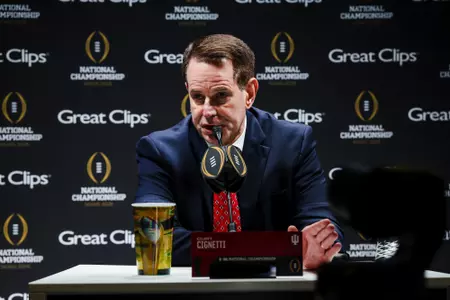
Quoted: National Championship Game Media Day
1/17/2026 1:00:00 PM | Football
MIAMI, Fla. –––– Indiana football coach Curt Cignetti addressed the media at the Miami Beach Convention Center on Saturday (January 17) ahead of the College Football Playoff National Championship Game on Monday (January 19).
Below is a partial transcript of the press conference, while video of the media sessions can be found on the right sidebar at IUHoosiers.com.
Q. What is it about this collection of coaches and players that made this week possible?
CC: Well, we're here because we prepared the right way and we have the right people in the staff and in the locker room, and we have tremendous support from our president and athletic director and we have a great fan base.
We have a plan and a process, and we have great leadership and good players, and we've been very consistent in terms of our play in all three phases, so we've met every challenge.
So the novelty of being here, to us, isn't there. We're here. We've got a job to do and a challenge to meet, and we've got two more days of prep.
On the fan base always showing up…
CC: If you're not sure you can make it down, find a ride. Yeah, the Big Ten Championship, last week against Oregon and the Rose Bowl. Indiana fans, largest alumni base in America. A lot of people didn't know that. It's been huge for us.
On there not being any novelty to being here and that there is a job to be done…
CC: Yeah, you know, we're still in our process, our preparation process. We all understand that.
Obviously, the last two years, it's been a great story. It's been fast progress, kind of surreal to some degree. It's a big story nationally. I get that.
But that's separate, sort of, from our team mindset right now, in terms of us physically being here and what our intentions are today, what we've got to get done today.
It's been great. We've got a lot of momentum. But we're playing a great football team in Miami. Tenacious up front on the defensive line, really physical on the offensive line, big running back, athletes everywhere, playmakers at wide receiver. Special teams are very good. They're playing on their home field. They didn't have to travel.
It's a big mountain we have to climb.
On making the right pieces on the roster fit…
CC: Yeah, when I was with Nick (Saban), there was an evaluation sheet, and supposedly when he was with Belichick at the Browns, he had sort of come up with a sheet, or had a large impact on that, ankle, knee, hip flexibility, toughness at every position. Ankle stiffness, hip stiffness, knee stiffness, fatal flaws, start-stop game, generate explosion from those three facets of your lower body. That would be the biggest things.
From a personal standpoint, I learn from my mistakes, and I think most of us that aspire to achieve at a high level either learn from our mistakes or we don't progress.
When I was young, we took some potential guys. We had to. When I was with Coach Majors at Pitt, we didn't have much, didn't have facilities, didn't have money. We weren't very attractive to recruits. We took a lot of guys that had certain qualities but hadn't quite put it all together. So I learned from that.
To me, there's a lot to be said about what the guy is made of, his intangibles and his moldability or coachability, what kind of teammate he's going to be. You still have to have a certain level, obviously, of athleticism to be successful at the P4 level and the Big Ten.
But you get the right group of guys together that combine as a team and they're good decision-makers, they're good people, because you've got to make decisions on the football field, too, and you've got to play with discipline and you've got to play with poise and you've got to play with confidence and consistency and have day-in/day-out consistency to a high standard and expectation.
That's what this group of guys have done to this point. But there's a lot to be done yet, and they understand that.
On what made it seem like a good fit with Fernando Mendoza last year in the portal…
CC: I was aware of Fernando because we had Alberto, the younger brother. He signed with us at JMU, Tino Sunseri signed him. He had won two state championships. Was a special family. They were all high achievers. The mom had gotten sick. I knew the dad a little bit.
I'm a tape junkie, and I would see Fernando on tape maybe from two years ago when I'm watching red area pass or something. And then when he went in the portal, I mean, he was a talented guy. Didn't take many plays. Had a lot of physical attributes. Knew what kind of family he came from. We had Alberto in the program.
So he got here, and he's done a great job of developing. Tremendous job. He's probably played better after he won the Heisman, which is a real credit to him. But we've got one more to go.
That was an easy decision.
On handling the pressure of the high stakes games…
CC: To me it's noise and clutter. You stay focused on the here and now, control the controllables, be detailed in your preparation. That gives you the most confidence going in, gives you the best chance. Because we have so many guys on this team that are older and have started so many games, the moment has never been too big. We have not always been perfect, but we've been very consistent in all three phases.
I think as we went on the road and won tight ballgames, especially at the end of the game, like Iowa being the first one, that just gave us more and more belief and confidence and put us in a better position down the road for the same type games.
On if he cracked open a beer after the Peach Bowl…
CC: It was Hoosier beer. You ever hear of Hoosier beer? Yeah, it was shortly thereafter. Just one. At my age when you drink two you fall asleep.
On his thoughts of what could be achieved when he said his famous "Google Me" quote…
CC: I don't think I ever thought that far away, honestly. It was such a quick hiring process, and then when I got here, I found out so many things I didn't know, 10 offensive starters in the transfer portal and some other things that -- like two universes colliding.
We had pretty much won championships year in and year out, and doom and gloom on the Indiana side, and that's kind of why I got out there a little bit the way I did. I knew I was out on a limb. I had to find out if the fan base was dead or on life support. The basketball game was the first thing, and then Google me was our press conference, signing day press conference when I was asked the same question for about the 14th time.
I had a lot of confidence in myself and the staff because we had had success. That's why I took the job. But I can't say I ever thought this far ahead.
On developing the talent he gets and making the most of it…
CC: This game is all about recruiting, development, retention. The development piece is huge. Derek Owings, our strength and conditioning coach, has been with me for six or seven years. He's always in high demand, does a tremendous job. And then the way you coach them in the meeting room, the way you practice, the things you put in their head.
There's a lot of guys out there that can play, and development and consistency are the two key factors.
I really honestly have never looked at a star in my life. I understand they're out there, four-stars, five-stars and all that good stuff. If a guy can play and he's got the right stuff in terms of intangibles and he's a worker and he loves the game, he loves football and the process and he's got enough physical ability, he'll develop.
On if he sees similarities between Indiana and Miami between the programs' rise to the top…
CC: In terms of the result, probably. In terms of the product and what you're getting, probably not.
On his sense of humor…
CC: Absolutely. It would be hard for me to describe my sense of humor. I see it all and I hear it all.
I make my points, and I have a way of getting it across to the kids in as few words as possible. I think Bryant Haines said it best. I read something two weeks ago, he had said: Get it across in as few words as possible with the most amount of impact.
That's been my philosophy for a long time. If I've got something, a point I need to make, I'm going to hit them right between the eyes.
On being disappointed with the team's performance before the Rose Bowl and today's practice expectation…
CC: No, I would not say that. We'll find out because I have a press conference tomorrow, and we'll see how today goes because first practice on-site is a challenge.
On his sideline disposition…
CC: I'm always just trying to anticipate, think ahead, because there's a lot of critical decisions you've got to make that can affect the game. Trying to take emotion out of the equation.
I see it, yeah. Everybody sees it, right?
On playing Miami at their home stadium and if he thinks IU fans will show out…
CC: Yeah, I think we'll have a great showing. It probably won't be like the Peach Bowl, but we'll have a great showing. I have not been surprised the way they've traveled because once we got rolling year one, we were selling it out and they couldn't get in, and it's only grown and grown.
On knowing what you got out of the transfer portal will translate…
CC: You mean in terms of developmental curve?
Reporter: Yeah, you have Fernando on campus, and you haven't seen him play for you for a while --
CC: Yeah, but that's what recruiting is. Recruiting is evaluation. If you trust your evaluation and your history of evaluation has been successful and you have a lot of confidence in yourself and your process for evaluation, then you feel strong about a guy.
I felt extremely strong about Fernando. Extremely. Like I knew we had something.
On doing what he did at James Madison and taking that to Indiana…
CC: Yeah. We kind of create those categories artificially, right, Group of Five, just that, these games are televised, these ones aren't. I think the average fan probably doesn't understand sometimes that there are some really good teams at the Group of Five level and players.
Obviously, we brought guys here that have been some of our better players, have been All-Americans. I do think the Group of Five level has probably been watered down a hair since I left JMU because the transfer portal every year takes and takes and takes.
Maybe some of those teams aren't quite as strong as they were when I left, so to speak.
But those guys all had a little chip on their shoulder. They had something to prove. They were really good players. We had had a lot of success. They're wondering why they weren't created by a P4 program, and this was their opportunity.
Truthfully, the process happened so fast, me taking the job, and I almost didn't take it because I loved JMU, once I got here and they started jumping in the portal, I was like, oh, yeah, we could use him. I had never entertained the notion that they may follow me. I had no idea what was at Indiana. What I knew about Indiana was just being a coach's kid and loving college football and following college football since 1970 on. Knew they had some good teams.
The one thing that did catch my attention, however, about three years ago when that TV contract was signed by the Big Ten making all that dough. That caught my eye.
On what stood out about D'Angelo Ponds when recruiting him…
CC: Ponds is a player, he's a great player. He might be the best player I've ever coached that was with me throughout his entire career in terms of consistency, production.
You saw it in camp right away. First week of camp, he's out there, he was holding a little bit, but he cleaned that up and became a starter. When he became my starter my last year at JMU, I think it was down at Troy, our third game of the year, they had won the Sun Belt the year before and we beat them at Troy, he started and he made plays right off the bat, first series that impacted the game, and he's been a great player ever since.
On if he figured out some tricks to the trade versus his process being in play…
CC: Yeah, I'd say B. There's no magic wand. It's the fundamentals, and you've got to have the right people, number one. If you don't have the right people, it doesn't matter, on your staff or in the locker room. Then you have to have a plan for development, recruiting and retention. Then obviously how to practice, how to play the game.
So it helps that we've had coaches that have been together for a while. Every day you get better, you get worse, you never stay the same, and that includes me, every day. If you're not striving, someone else is, so you're getting worse.
I'm a film junkie. I mean, we're not way out there like, wow, what a scheme. But we're fundamentally sound and we find the right match-ups up to this point. No, there's no magic wand. I'm no wizard, that's for sure.
We do have a play called wizard that we put in for this game, however.
On what flipped his thoughts from staying at JMU to going to IU…
CC: Well, it was Wednesday night, I had just got back from Indy talking to Scott and the president, and I had a pretty good idea they were going to offer me the job. And I'm laying in bed with my wife about 8:00 at night, and I said I think I'm just going to stay. I like this place.
Scott didn't give me a chance. He called me up and said, "Congratulations, you're the new head coach at Indiana, and we're going to kick some butt."
I said something, about five or six words I can't say here, hung up the phone, and that was it.
He didn't give me a chance to say no. He told me I'm the new head coach. My wife said, "You should have seen that look in your eye," like what did I do?
On if he has any relationship between him and Mario Cristobal…
CC: I don't think we've ever met.
On if Fernando Mendoza has a fatal flaw…
CC: I don't know what his fatal flaw is (laughing). I know he's a good quarterback that really developed a lot and has to play well this week. I think in life, all humans are flawed, but he's got great things ahead.
On the changes in the sport and the success of transfers…
CC: Well, it is a little bit like free agency now. I'm not going to go too far down that road. But the quarterback position is the key position. It's hard to win without a good quarterback, or at least win big.
Miami's quarterback has done a great job. Fernando has done a great job. Last year we had Ohio State and who, Notre Dame? Two really good quarterbacks.
That is a position, however, where the guys that play quarterback, they don't like to sit. Like if they know they've got the right stuff, they want to play.
On Miami's defensive front…
CC: They're great players, both ends, all the inside guys, they play a lot of people. And I know how Corey (Hetherman) coaches. Schematically it might be a little bit different, but I know the philosophy is not much different. He's got them creating havoc, TFLs, sacks, stop the run, playing with an edge, nasty edge.
Extremely impressive group. Those guys are going to play a lot of football when their college days are over.
On Coach Hetherman and what he does as a DC…
CC: Yeah, well, we actually don't communicate a ton anymore, but I loved him. I didn't want him to leave. We had a great relationship. I really thought a lot of him.
You're so busy. He's busy, I'm busy. It's hard to -- but we exchange texts occasionally. I've seen schematically a change. I can't talk to his growth as a leader because I'm not with him day-to-day. But I always thought he was a great football coach. Fortunately, I had Bryant Haines, who I think is the best in the country.
They're different. They're different guys. Corey is a hard driver. You'll be shocked to know that Corey played quarterback in college. I used to joke with him all the time, I heard you had no touch when you threw the ball. You find that hard to imagine, knowing Corey, right, that he wouldn't have touch as a quarterback? But Corey is a great football coach. He's done a great job here.
On if Brendan Franke could be back on Monday…
CC: I think he's listed as questionable or doubtful. Questionable? We'll know more probably after today's practice. Yeah, that was the big practice the last time we traveled to the Rose Bowl. We thought he would be ready, and he had a little setback. It was a huge factor. The guy kicked two 58-yarders back to back against Oregon when they called time, and I think the Iowa one was a 52-yarder. We're talking like three seconds to go in the half, which are huge points, and every kickoff through the end zone.
On Elijah Sarratt…
CC: I knew about Elijah when he was entering his junior year of high school. Then I took his older brother, who was a safety at VMI, and we played them in the playoffs the COVID year. I could tell he was a very instinctive player. His brother I'm talking about. So we took his brother as a safety.
Elijah then went to Saint Frances in Maryland for high school, ended up at Saint Francis in Loretto, PA. Yes, Chris Villarrial played for my dad at IUP and was a center for the Bears for about 10 or 12 years. And Elijah caught close to 50 balls and there was another receiver there, too. We needed receivers. And that's how we got Elijah.
He tweaked his knee a little bit that first spring. I think when the year started in the fall, first game of the year, he was third team, made a couple plays game 2 against Virginia that were big, and then started every game after that, made First-Team All-Sun Belt and caught I think over 80 balls that year.
On teaching discipline on the field…
CC: There are a lot of things that go into it, but in coaching you get what you demand, and if you're not coaching it, you're allowing it to happen when you see something you don't like. We want to do everything to a high standard, and there's got to be accountability when guys can't consistently meet the bar.
Discipline on the field is getting 11 guys to do their job because when you've got 11 guys that do their job consistently, play in, play out, it's not addition, it's multiplication.
The challenge is only not that play in its entirety; it's all the plays, not affected by success, not affected by failure, never satisfied.
There's a lot of things that go into that to get 11 guys to do their job. When you do have success, act like you've been there before. We also want to be -- we're one of the lowest penalized teams in America and always have been. Play smart, disciplined, poised. All those things are discipline.
We're No. 1 in the country in turnover ratio. That's discipline.
If you want to be good in anything in life, you've got to have a goal, and then you've got to be committed to it and have the discipline day in, day out to work toward your goal, the work ethic and the mental toughness to persevere. That all goes into discipline.
On if there is anything he teaches his players that could transfer to any field in life…
CC: You take over a losing program you've got to change the way people think, and then you've got to get them to believe. If they do things the right way, prepare the right way, there's no self-imposed limitations to what you can accomplish. 95 percent of the game in season is right between the ears.
On going viral for the way he poses during games…
CC: Self-control, I guess. I'm just trying to anticipate, not be emotional, which is the best way to make good decisions, because you're going to make decisions during the course of the game that are going to be critical to the outcome of the game.
On if there is a coach that inspired him…
CC: My dad. My dad was a great role model growing up. I was the oldest of four, and he led by example. He had a presence about him, and he had great work ethic, disciplined commitment.
Back then -- grew up western PA, everybody worked in the mill or the mines, and he went to college and became an assistant at Pitt, Princeton, West Virginia for Bobby Bowden, became the head coach, and then came down with cancer my senior year of high school and was given his last rites twice.
He didn't really get to finish what he started there. But yeah, he was my inspiration.
On how Mike Shanahan and Bryant Haines have evolved since they joined him…
CC: Mike keeps maturing and I'm able to walk away more and more, which I need to do, in this day and age of college football, especially in the playoffs where you're juggling portal recruiting and retention, things like that. Mike is really good. He's got a great demeanor and disposition. He's one of the most trustworthy people I think I've ever met in my life.
On if he could go back to the start of his coaching career what advice would he give himself…
CC: I mean, I think I had to walk every path to become who I am today. I don't have any regrets.
On guys who came back to IU like Louis Moore and Kahlil Benson…
CC: Yeah, absolutely it was a business decision. I didn't want them to leave. At the time I understood, based on critical factors, and then I think once they saw the success we had and heard from their teammates, they wanted to come back and be a part of it. For me, it was a business decision.
On Miami's size as a team…
CC: Miami? They're playing with an edge. They're a tough football team. Both lines are really good, and they get after it, and they've got athletes. They're tenacious. It's a start-stop game, twitch and explosion. Then you've got to have a little edge about you. They're impressive.
On if he has corrections for Fernando Mendoza throughout the week…
CC: No matter how good he plays, there's always corrections on tape from the game before, which the process is we come in on Sunday as a staff, quick staff meeting, and then we break up offensive, defensive staffs and I watch the tape closely with the offensive staff.
There's always things that he could have done a little better. I've never really had a heated exchange. I can only think of one time early in the season, I think it was Indiana State, where he made a couple poor decisions in the red area, whether to pull the ball or give the ball off or maybe one time throw the bubble or give it to the back. I can't remember. But I remember making a point on the sideline, and I think that's the only time I ever had to really kind of make a point where I felt like my point needed to be made.
On the lack of roster continuity while building a winner…
CC: You started the question out the quarterback position, right? Well, every one of our quarterbacks since '19 has been Player of the Year in the league, so we're doing something right, and they've all been one-year transfers since the first two. I guess Kurtis Rourke was not, but he led the country in QBR, and we've already got one committed for next year and in school. That's part of it, I guess.
It would be nice to have a guy for a few years, but when you've got a chance to get a guy that can play winning football that's been through the wars, that's the way -- to me, it's an easy decision. You've got to win every year. Now, there's no, oh, in five years we'll be good. That was a long time ago.
It's not a perfect world, college football. A lot of issues, obviously. You've got to improvise, adjust, be light on your feet if you want to thrive and survive.
On if he would consider taking an NFL job…
CC:: I mean, I'm not an NFL guy. I made that decision a long time ago when I went with Chuck Amato to NC State in 2000. I had a chance to go with the Packers, Tom Rossley, Mike Sherman, Favre was in his heyday. I think Darrell Bevell got the job, ended up taking the job. I declined the opportunity. I almost took it.
That's when I made the final decision, and I've always been more of a college football guy.
On if he has taken any time to reflect how far this program has come…
CC: Well, I get asked that a lot. Not much time now because there's always something that needs done. Every week brings its challenges this time of year in college football. When the season is over, yes. But really the focus now -- I have said a number of times, it has been kind of a surreal thing, but our focus right now is what we've got to do today to put ourselves in a position better.
On being a longtime assistant and how that shaped him…
CC: Yeah, I think as 28 years Division I assistant, I think, recruiting coordinator and a coach probably since '93 to 2010, and around a lot of really good people, assistant coaches, too, that I drew from and learned from. The recruiting coordinator thing helped me. It did help me. I was always trying to get out of that job. My dad told me down the road that thing is going to be valuable for you one day.
At the end of the day, I was hitting the big 5-0, I had a couple of daughters in high school that wanted to be doctors, Sam was a freshman at Alabama, and I didn't want to be a 60-year-old career assistant. I had grew up in the business. I had tracked assistant coaches and families and careers, and I didn't want to do that. So I bet on myself. But I didn't wake up every day at IUP like I've got to be a P4 head coach. I was trying to make the most out of life, and it brought me here.
On the JMU guys that came over with him and the success that has followed…
CC: You know, like I said, I never thought about the JMU guys coming here. It was such a quick process. Once they started jumping in the portal -- I think we were down to 40 scholarships here. We needed them. So I was glad.
They were instant impact guys, on and off the field. They were, I think, critical to the acceleration of our development and success in year one.
On why he thinks the JMU guys were so important…
CC: Because they could answer questions for the guys that decided to come back and the new guys, other new transfers, on how we do things, how I am, those kind of things. But they were players. Ponds was an All-American. Fisher was an All-American. Sarratt was on some All-American things his first year. A lot of them.
On how far Fernando Mendoza has come…
CC: Yeah, and I've been asked that question before. Every one of those quarterbacks, DiNucci, Cole Johnson, Centeio, McCloud, Kurtis Rourke, Mendoza, all Player of the Year in the league, except Rourke because Gabriel won the Heisman, but he won QBR. Not great the first half of spring, a lot better in the second half of spring, they have a good summer. Fall camp, different player. Better at the end of fall camp, and then they build on their success early in the season, and they just get better and better and better because with success comes belief, and with belief comes confidence.
On the state of college football and the structure of everything…
CC: We're going to see a lot of things change, but I'm not going to go very far down that road right now. I'd like to see rules that are black and white in ink and that we all follow and there's consequences when you don't, and we don't have that. We've got a lot of gray area and ambiguity.
On what he has learned from the Mendoza Family this last year…
CC: I knew where they came from, so I think the older one, Fernando in particular, I saw how one guy could kind of bring a team together. You can have close, tight teams, but this team here is extremely close. He was, like, the glue sealing the open edges and cracks, which probably to a degree I had never seen before.
On the importance of adding Grant Wilson…
CC:: I can't remember if I brought Grant in after Fernando or before. After? Okay, then I was probably thinking about the No. 2 or 3 job.
You know what, when he started for Indiana against West Virginia, he played pretty well that night and they had a high-powered offense. He's coming back for one more, too. He'll be back.
On how much he relied on the guys who came over from JMU…
CC: Well, I never asked them to do anything. Everything they did, they did on their own. But they were the kind of guys that were going to make the program better and bring the team closer together. That's why I think they were so critical to the year one success.
On Fernando Mendoza's public speaking skills…
CC: He's incredible. I take notes.
FastScripts Transcript by ASAP Sports
Below is a partial transcript of the press conference, while video of the media sessions can be found on the right sidebar at IUHoosiers.com.
Q. What is it about this collection of coaches and players that made this week possible?
CC: Well, we're here because we prepared the right way and we have the right people in the staff and in the locker room, and we have tremendous support from our president and athletic director and we have a great fan base.
We have a plan and a process, and we have great leadership and good players, and we've been very consistent in terms of our play in all three phases, so we've met every challenge.
So the novelty of being here, to us, isn't there. We're here. We've got a job to do and a challenge to meet, and we've got two more days of prep.
On the fan base always showing up…
CC: If you're not sure you can make it down, find a ride. Yeah, the Big Ten Championship, last week against Oregon and the Rose Bowl. Indiana fans, largest alumni base in America. A lot of people didn't know that. It's been huge for us.
On there not being any novelty to being here and that there is a job to be done…
CC: Yeah, you know, we're still in our process, our preparation process. We all understand that.
Obviously, the last two years, it's been a great story. It's been fast progress, kind of surreal to some degree. It's a big story nationally. I get that.
But that's separate, sort of, from our team mindset right now, in terms of us physically being here and what our intentions are today, what we've got to get done today.
It's been great. We've got a lot of momentum. But we're playing a great football team in Miami. Tenacious up front on the defensive line, really physical on the offensive line, big running back, athletes everywhere, playmakers at wide receiver. Special teams are very good. They're playing on their home field. They didn't have to travel.
It's a big mountain we have to climb.
On making the right pieces on the roster fit…
CC: Yeah, when I was with Nick (Saban), there was an evaluation sheet, and supposedly when he was with Belichick at the Browns, he had sort of come up with a sheet, or had a large impact on that, ankle, knee, hip flexibility, toughness at every position. Ankle stiffness, hip stiffness, knee stiffness, fatal flaws, start-stop game, generate explosion from those three facets of your lower body. That would be the biggest things.
From a personal standpoint, I learn from my mistakes, and I think most of us that aspire to achieve at a high level either learn from our mistakes or we don't progress.
When I was young, we took some potential guys. We had to. When I was with Coach Majors at Pitt, we didn't have much, didn't have facilities, didn't have money. We weren't very attractive to recruits. We took a lot of guys that had certain qualities but hadn't quite put it all together. So I learned from that.
To me, there's a lot to be said about what the guy is made of, his intangibles and his moldability or coachability, what kind of teammate he's going to be. You still have to have a certain level, obviously, of athleticism to be successful at the P4 level and the Big Ten.
But you get the right group of guys together that combine as a team and they're good decision-makers, they're good people, because you've got to make decisions on the football field, too, and you've got to play with discipline and you've got to play with poise and you've got to play with confidence and consistency and have day-in/day-out consistency to a high standard and expectation.
That's what this group of guys have done to this point. But there's a lot to be done yet, and they understand that.
On what made it seem like a good fit with Fernando Mendoza last year in the portal…
CC: I was aware of Fernando because we had Alberto, the younger brother. He signed with us at JMU, Tino Sunseri signed him. He had won two state championships. Was a special family. They were all high achievers. The mom had gotten sick. I knew the dad a little bit.
I'm a tape junkie, and I would see Fernando on tape maybe from two years ago when I'm watching red area pass or something. And then when he went in the portal, I mean, he was a talented guy. Didn't take many plays. Had a lot of physical attributes. Knew what kind of family he came from. We had Alberto in the program.
So he got here, and he's done a great job of developing. Tremendous job. He's probably played better after he won the Heisman, which is a real credit to him. But we've got one more to go.
That was an easy decision.
On handling the pressure of the high stakes games…
CC: To me it's noise and clutter. You stay focused on the here and now, control the controllables, be detailed in your preparation. That gives you the most confidence going in, gives you the best chance. Because we have so many guys on this team that are older and have started so many games, the moment has never been too big. We have not always been perfect, but we've been very consistent in all three phases.
I think as we went on the road and won tight ballgames, especially at the end of the game, like Iowa being the first one, that just gave us more and more belief and confidence and put us in a better position down the road for the same type games.
On if he cracked open a beer after the Peach Bowl…
CC: It was Hoosier beer. You ever hear of Hoosier beer? Yeah, it was shortly thereafter. Just one. At my age when you drink two you fall asleep.
On his thoughts of what could be achieved when he said his famous "Google Me" quote…
CC: I don't think I ever thought that far away, honestly. It was such a quick hiring process, and then when I got here, I found out so many things I didn't know, 10 offensive starters in the transfer portal and some other things that -- like two universes colliding.
We had pretty much won championships year in and year out, and doom and gloom on the Indiana side, and that's kind of why I got out there a little bit the way I did. I knew I was out on a limb. I had to find out if the fan base was dead or on life support. The basketball game was the first thing, and then Google me was our press conference, signing day press conference when I was asked the same question for about the 14th time.
I had a lot of confidence in myself and the staff because we had had success. That's why I took the job. But I can't say I ever thought this far ahead.
On developing the talent he gets and making the most of it…
CC: This game is all about recruiting, development, retention. The development piece is huge. Derek Owings, our strength and conditioning coach, has been with me for six or seven years. He's always in high demand, does a tremendous job. And then the way you coach them in the meeting room, the way you practice, the things you put in their head.
There's a lot of guys out there that can play, and development and consistency are the two key factors.
I really honestly have never looked at a star in my life. I understand they're out there, four-stars, five-stars and all that good stuff. If a guy can play and he's got the right stuff in terms of intangibles and he's a worker and he loves the game, he loves football and the process and he's got enough physical ability, he'll develop.
On if he sees similarities between Indiana and Miami between the programs' rise to the top…
CC: In terms of the result, probably. In terms of the product and what you're getting, probably not.
On his sense of humor…
CC: Absolutely. It would be hard for me to describe my sense of humor. I see it all and I hear it all.
I make my points, and I have a way of getting it across to the kids in as few words as possible. I think Bryant Haines said it best. I read something two weeks ago, he had said: Get it across in as few words as possible with the most amount of impact.
That's been my philosophy for a long time. If I've got something, a point I need to make, I'm going to hit them right between the eyes.
On being disappointed with the team's performance before the Rose Bowl and today's practice expectation…
CC: No, I would not say that. We'll find out because I have a press conference tomorrow, and we'll see how today goes because first practice on-site is a challenge.
On his sideline disposition…
CC: I'm always just trying to anticipate, think ahead, because there's a lot of critical decisions you've got to make that can affect the game. Trying to take emotion out of the equation.
I see it, yeah. Everybody sees it, right?
On playing Miami at their home stadium and if he thinks IU fans will show out…
CC: Yeah, I think we'll have a great showing. It probably won't be like the Peach Bowl, but we'll have a great showing. I have not been surprised the way they've traveled because once we got rolling year one, we were selling it out and they couldn't get in, and it's only grown and grown.
On knowing what you got out of the transfer portal will translate…
CC: You mean in terms of developmental curve?
Reporter: Yeah, you have Fernando on campus, and you haven't seen him play for you for a while --
CC: Yeah, but that's what recruiting is. Recruiting is evaluation. If you trust your evaluation and your history of evaluation has been successful and you have a lot of confidence in yourself and your process for evaluation, then you feel strong about a guy.
I felt extremely strong about Fernando. Extremely. Like I knew we had something.
On doing what he did at James Madison and taking that to Indiana…
CC: Yeah. We kind of create those categories artificially, right, Group of Five, just that, these games are televised, these ones aren't. I think the average fan probably doesn't understand sometimes that there are some really good teams at the Group of Five level and players.
Obviously, we brought guys here that have been some of our better players, have been All-Americans. I do think the Group of Five level has probably been watered down a hair since I left JMU because the transfer portal every year takes and takes and takes.
Maybe some of those teams aren't quite as strong as they were when I left, so to speak.
But those guys all had a little chip on their shoulder. They had something to prove. They were really good players. We had had a lot of success. They're wondering why they weren't created by a P4 program, and this was their opportunity.
Truthfully, the process happened so fast, me taking the job, and I almost didn't take it because I loved JMU, once I got here and they started jumping in the portal, I was like, oh, yeah, we could use him. I had never entertained the notion that they may follow me. I had no idea what was at Indiana. What I knew about Indiana was just being a coach's kid and loving college football and following college football since 1970 on. Knew they had some good teams.
The one thing that did catch my attention, however, about three years ago when that TV contract was signed by the Big Ten making all that dough. That caught my eye.
On what stood out about D'Angelo Ponds when recruiting him…
CC: Ponds is a player, he's a great player. He might be the best player I've ever coached that was with me throughout his entire career in terms of consistency, production.
You saw it in camp right away. First week of camp, he's out there, he was holding a little bit, but he cleaned that up and became a starter. When he became my starter my last year at JMU, I think it was down at Troy, our third game of the year, they had won the Sun Belt the year before and we beat them at Troy, he started and he made plays right off the bat, first series that impacted the game, and he's been a great player ever since.
On if he figured out some tricks to the trade versus his process being in play…
CC: Yeah, I'd say B. There's no magic wand. It's the fundamentals, and you've got to have the right people, number one. If you don't have the right people, it doesn't matter, on your staff or in the locker room. Then you have to have a plan for development, recruiting and retention. Then obviously how to practice, how to play the game.
So it helps that we've had coaches that have been together for a while. Every day you get better, you get worse, you never stay the same, and that includes me, every day. If you're not striving, someone else is, so you're getting worse.
I'm a film junkie. I mean, we're not way out there like, wow, what a scheme. But we're fundamentally sound and we find the right match-ups up to this point. No, there's no magic wand. I'm no wizard, that's for sure.
We do have a play called wizard that we put in for this game, however.
On what flipped his thoughts from staying at JMU to going to IU…
CC: Well, it was Wednesday night, I had just got back from Indy talking to Scott and the president, and I had a pretty good idea they were going to offer me the job. And I'm laying in bed with my wife about 8:00 at night, and I said I think I'm just going to stay. I like this place.
Scott didn't give me a chance. He called me up and said, "Congratulations, you're the new head coach at Indiana, and we're going to kick some butt."
I said something, about five or six words I can't say here, hung up the phone, and that was it.
He didn't give me a chance to say no. He told me I'm the new head coach. My wife said, "You should have seen that look in your eye," like what did I do?
On if he has any relationship between him and Mario Cristobal…
CC: I don't think we've ever met.
On if Fernando Mendoza has a fatal flaw…
CC: I don't know what his fatal flaw is (laughing). I know he's a good quarterback that really developed a lot and has to play well this week. I think in life, all humans are flawed, but he's got great things ahead.
On the changes in the sport and the success of transfers…
CC: Well, it is a little bit like free agency now. I'm not going to go too far down that road. But the quarterback position is the key position. It's hard to win without a good quarterback, or at least win big.
Miami's quarterback has done a great job. Fernando has done a great job. Last year we had Ohio State and who, Notre Dame? Two really good quarterbacks.
That is a position, however, where the guys that play quarterback, they don't like to sit. Like if they know they've got the right stuff, they want to play.
On Miami's defensive front…
CC: They're great players, both ends, all the inside guys, they play a lot of people. And I know how Corey (Hetherman) coaches. Schematically it might be a little bit different, but I know the philosophy is not much different. He's got them creating havoc, TFLs, sacks, stop the run, playing with an edge, nasty edge.
Extremely impressive group. Those guys are going to play a lot of football when their college days are over.
On Coach Hetherman and what he does as a DC…
CC: Yeah, well, we actually don't communicate a ton anymore, but I loved him. I didn't want him to leave. We had a great relationship. I really thought a lot of him.
You're so busy. He's busy, I'm busy. It's hard to -- but we exchange texts occasionally. I've seen schematically a change. I can't talk to his growth as a leader because I'm not with him day-to-day. But I always thought he was a great football coach. Fortunately, I had Bryant Haines, who I think is the best in the country.
They're different. They're different guys. Corey is a hard driver. You'll be shocked to know that Corey played quarterback in college. I used to joke with him all the time, I heard you had no touch when you threw the ball. You find that hard to imagine, knowing Corey, right, that he wouldn't have touch as a quarterback? But Corey is a great football coach. He's done a great job here.
On if Brendan Franke could be back on Monday…
CC: I think he's listed as questionable or doubtful. Questionable? We'll know more probably after today's practice. Yeah, that was the big practice the last time we traveled to the Rose Bowl. We thought he would be ready, and he had a little setback. It was a huge factor. The guy kicked two 58-yarders back to back against Oregon when they called time, and I think the Iowa one was a 52-yarder. We're talking like three seconds to go in the half, which are huge points, and every kickoff through the end zone.
On Elijah Sarratt…
CC: I knew about Elijah when he was entering his junior year of high school. Then I took his older brother, who was a safety at VMI, and we played them in the playoffs the COVID year. I could tell he was a very instinctive player. His brother I'm talking about. So we took his brother as a safety.
Elijah then went to Saint Frances in Maryland for high school, ended up at Saint Francis in Loretto, PA. Yes, Chris Villarrial played for my dad at IUP and was a center for the Bears for about 10 or 12 years. And Elijah caught close to 50 balls and there was another receiver there, too. We needed receivers. And that's how we got Elijah.
He tweaked his knee a little bit that first spring. I think when the year started in the fall, first game of the year, he was third team, made a couple plays game 2 against Virginia that were big, and then started every game after that, made First-Team All-Sun Belt and caught I think over 80 balls that year.
On teaching discipline on the field…
CC: There are a lot of things that go into it, but in coaching you get what you demand, and if you're not coaching it, you're allowing it to happen when you see something you don't like. We want to do everything to a high standard, and there's got to be accountability when guys can't consistently meet the bar.
Discipline on the field is getting 11 guys to do their job because when you've got 11 guys that do their job consistently, play in, play out, it's not addition, it's multiplication.
The challenge is only not that play in its entirety; it's all the plays, not affected by success, not affected by failure, never satisfied.
There's a lot of things that go into that to get 11 guys to do their job. When you do have success, act like you've been there before. We also want to be -- we're one of the lowest penalized teams in America and always have been. Play smart, disciplined, poised. All those things are discipline.
We're No. 1 in the country in turnover ratio. That's discipline.
If you want to be good in anything in life, you've got to have a goal, and then you've got to be committed to it and have the discipline day in, day out to work toward your goal, the work ethic and the mental toughness to persevere. That all goes into discipline.
On if there is anything he teaches his players that could transfer to any field in life…
CC: You take over a losing program you've got to change the way people think, and then you've got to get them to believe. If they do things the right way, prepare the right way, there's no self-imposed limitations to what you can accomplish. 95 percent of the game in season is right between the ears.
On going viral for the way he poses during games…
CC: Self-control, I guess. I'm just trying to anticipate, not be emotional, which is the best way to make good decisions, because you're going to make decisions during the course of the game that are going to be critical to the outcome of the game.
On if there is a coach that inspired him…
CC: My dad. My dad was a great role model growing up. I was the oldest of four, and he led by example. He had a presence about him, and he had great work ethic, disciplined commitment.
Back then -- grew up western PA, everybody worked in the mill or the mines, and he went to college and became an assistant at Pitt, Princeton, West Virginia for Bobby Bowden, became the head coach, and then came down with cancer my senior year of high school and was given his last rites twice.
He didn't really get to finish what he started there. But yeah, he was my inspiration.
On how Mike Shanahan and Bryant Haines have evolved since they joined him…
CC: Mike keeps maturing and I'm able to walk away more and more, which I need to do, in this day and age of college football, especially in the playoffs where you're juggling portal recruiting and retention, things like that. Mike is really good. He's got a great demeanor and disposition. He's one of the most trustworthy people I think I've ever met in my life.
On if he could go back to the start of his coaching career what advice would he give himself…
CC: I mean, I think I had to walk every path to become who I am today. I don't have any regrets.
On guys who came back to IU like Louis Moore and Kahlil Benson…
CC: Yeah, absolutely it was a business decision. I didn't want them to leave. At the time I understood, based on critical factors, and then I think once they saw the success we had and heard from their teammates, they wanted to come back and be a part of it. For me, it was a business decision.
On Miami's size as a team…
CC: Miami? They're playing with an edge. They're a tough football team. Both lines are really good, and they get after it, and they've got athletes. They're tenacious. It's a start-stop game, twitch and explosion. Then you've got to have a little edge about you. They're impressive.
On if he has corrections for Fernando Mendoza throughout the week…
CC: No matter how good he plays, there's always corrections on tape from the game before, which the process is we come in on Sunday as a staff, quick staff meeting, and then we break up offensive, defensive staffs and I watch the tape closely with the offensive staff.
There's always things that he could have done a little better. I've never really had a heated exchange. I can only think of one time early in the season, I think it was Indiana State, where he made a couple poor decisions in the red area, whether to pull the ball or give the ball off or maybe one time throw the bubble or give it to the back. I can't remember. But I remember making a point on the sideline, and I think that's the only time I ever had to really kind of make a point where I felt like my point needed to be made.
On the lack of roster continuity while building a winner…
CC: You started the question out the quarterback position, right? Well, every one of our quarterbacks since '19 has been Player of the Year in the league, so we're doing something right, and they've all been one-year transfers since the first two. I guess Kurtis Rourke was not, but he led the country in QBR, and we've already got one committed for next year and in school. That's part of it, I guess.
It would be nice to have a guy for a few years, but when you've got a chance to get a guy that can play winning football that's been through the wars, that's the way -- to me, it's an easy decision. You've got to win every year. Now, there's no, oh, in five years we'll be good. That was a long time ago.
It's not a perfect world, college football. A lot of issues, obviously. You've got to improvise, adjust, be light on your feet if you want to thrive and survive.
On if he would consider taking an NFL job…
CC:: I mean, I'm not an NFL guy. I made that decision a long time ago when I went with Chuck Amato to NC State in 2000. I had a chance to go with the Packers, Tom Rossley, Mike Sherman, Favre was in his heyday. I think Darrell Bevell got the job, ended up taking the job. I declined the opportunity. I almost took it.
That's when I made the final decision, and I've always been more of a college football guy.
On if he has taken any time to reflect how far this program has come…
CC: Well, I get asked that a lot. Not much time now because there's always something that needs done. Every week brings its challenges this time of year in college football. When the season is over, yes. But really the focus now -- I have said a number of times, it has been kind of a surreal thing, but our focus right now is what we've got to do today to put ourselves in a position better.
On being a longtime assistant and how that shaped him…
CC: Yeah, I think as 28 years Division I assistant, I think, recruiting coordinator and a coach probably since '93 to 2010, and around a lot of really good people, assistant coaches, too, that I drew from and learned from. The recruiting coordinator thing helped me. It did help me. I was always trying to get out of that job. My dad told me down the road that thing is going to be valuable for you one day.
At the end of the day, I was hitting the big 5-0, I had a couple of daughters in high school that wanted to be doctors, Sam was a freshman at Alabama, and I didn't want to be a 60-year-old career assistant. I had grew up in the business. I had tracked assistant coaches and families and careers, and I didn't want to do that. So I bet on myself. But I didn't wake up every day at IUP like I've got to be a P4 head coach. I was trying to make the most out of life, and it brought me here.
On the JMU guys that came over with him and the success that has followed…
CC: You know, like I said, I never thought about the JMU guys coming here. It was such a quick process. Once they started jumping in the portal -- I think we were down to 40 scholarships here. We needed them. So I was glad.
They were instant impact guys, on and off the field. They were, I think, critical to the acceleration of our development and success in year one.
On why he thinks the JMU guys were so important…
CC: Because they could answer questions for the guys that decided to come back and the new guys, other new transfers, on how we do things, how I am, those kind of things. But they were players. Ponds was an All-American. Fisher was an All-American. Sarratt was on some All-American things his first year. A lot of them.
On how far Fernando Mendoza has come…
CC: Yeah, and I've been asked that question before. Every one of those quarterbacks, DiNucci, Cole Johnson, Centeio, McCloud, Kurtis Rourke, Mendoza, all Player of the Year in the league, except Rourke because Gabriel won the Heisman, but he won QBR. Not great the first half of spring, a lot better in the second half of spring, they have a good summer. Fall camp, different player. Better at the end of fall camp, and then they build on their success early in the season, and they just get better and better and better because with success comes belief, and with belief comes confidence.
On the state of college football and the structure of everything…
CC: We're going to see a lot of things change, but I'm not going to go very far down that road right now. I'd like to see rules that are black and white in ink and that we all follow and there's consequences when you don't, and we don't have that. We've got a lot of gray area and ambiguity.
On what he has learned from the Mendoza Family this last year…
CC: I knew where they came from, so I think the older one, Fernando in particular, I saw how one guy could kind of bring a team together. You can have close, tight teams, but this team here is extremely close. He was, like, the glue sealing the open edges and cracks, which probably to a degree I had never seen before.
On the importance of adding Grant Wilson…
CC:: I can't remember if I brought Grant in after Fernando or before. After? Okay, then I was probably thinking about the No. 2 or 3 job.
You know what, when he started for Indiana against West Virginia, he played pretty well that night and they had a high-powered offense. He's coming back for one more, too. He'll be back.
On how much he relied on the guys who came over from JMU…
CC: Well, I never asked them to do anything. Everything they did, they did on their own. But they were the kind of guys that were going to make the program better and bring the team closer together. That's why I think they were so critical to the year one success.
On Fernando Mendoza's public speaking skills…
CC: He's incredible. I take notes.
FastScripts Transcript by ASAP Sports
#NeverDaunted
Players Mentioned
OL
/ Football
K
/ Football
QB
/ Football
DB
/ Football
DB
/ Football
WR
/ Football
QB
/ FootballTuesday, September 22
Tuesday, September 22
Monday, September 21
Saturday, September 19