

NOTEBOOK: Risky Business – Press Covering Sarratt Can Get You Beat
Pete DiPrimio | IUHoosiers.com
BLOOMINGTON, Ind. - Get in Elijah Sarratt’s face at the line of scrimmage at your own risk. Indiana’s veteran receiver thrives when defensive backs get up close and personal, when they try to jam him, harass him, and make his life miserable from the snap.
That’s the approach Oregon’s heralded secondary figures to take Friday night when the fifth-seeded Ducks (13-1) face top-seeded IU (14-0) during the Chick-fil-A Peach Bowl playoff semifinal showdown at Atlanta’s Mercedes-Benz Stadium.
“As a receiver, you’ve got to embrace it,” Sarratt says. “If you can't win those one-on-one matchups against press coverage, you're not going to make it too far in this football world.”
Sarratt has made it very far in the college world, and figures to do the same in the NFL. Despite missing two full games, and most of a third with an injury, Sarratt has a Big Ten-leading 13 touchdown catches. Overall, he has 55 catches for 727 yards.
That follows up last season’s IU debut when Sarratt totaled 53 catches for 947 yards (an 18.1-yard-per-catch average) and eight touchdowns
When IU beat Oregon 30-20 in October, Sarratt had eight catches for 121 yards and the fourth-quarter go-ahead TD.
“It’s definitely a challenge going against those guys,” Sarratt says, “because Oregon has some long, athletic DBs. I take that challenge head on and want to do my best against it, for sure.
In that first meeting, Sarratt says, the Ducks used man-to-man coverage about “70 percent of the snaps.” He says that’s different from the approach used by Ohio State and Alabama.
“This whole week throughout practice,” Sarratt says, “we'll go against press on scout team. Hopefully we'll be ready if they continue to do that against us.”

Oregon, which has won eight straight, allows just 13.7 points a game. That ranks third in the Big Ten behind Ohio State (9.3) and IU (10.3). What makes the Ducks’ defense stand out? Running back Kaelon Black says it starts “in the trenches.”
“That’s true for all great teams,” he says. “It’s the trenches, Oregon's D-line, they have a great D-line, a great linebacking corps.
“They play really fast, especially in the back end. We have our hands full. They seem to have gotten better since the last time we played them. Those improvements show on tape.”
Defensively, Oregon is led by linebackers Bryce Boettcher (125 tackles) and Teitum Tuioti (9.5 sacks). It has massive size on the defensive line anchored by 6-foot-3, 302-pound Bear Alexander and 6-foot-3, 330-pound A’Mauri Washington.
“You look at their front seven,” running back Roman Hemby says, “and they have really good players up there. Their linebackers are really good, as well. You look in their secondary, you see that they have a lot of players that are very athletic. That presented a challenge the last time we played, too.
“It’s about going back to the drawing board and making sure we have the proper game plan, then practice and work as hard as we can. We'll have what we want on Friday night if we can do those things.”
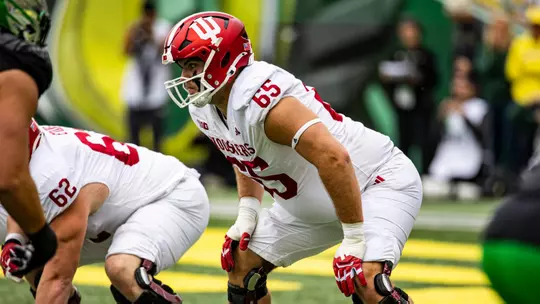
Like a lot of college athletes, offensive lineman Carter Smith enrolled early at IU after a standout career at Ohio’s Olentangy Liberty High School. He participated in spring practice in 2022, played in two games during that season and redshirted. He became a starter the next season, has started 36 consecutive games, and has developed into one of the nation’s best left tackles on one of college football’s best offensive lines.
By enrolling after the winter break, Smith says, he gave up a volleyball championship his high school team won that spring.
“That wasn't the greatest, but coming here early was definitely for the best. Going through spring ball as a true freshman was a blessing for me before going through a fall camp. It really opened my eyes to how much more of the game I needed to learn.”
Smith recommends early enrolling for every player.
“I think that's big for any recruit that comes in. (College) is a big step in your career. It's going to help you realize what you need to learn six months prior to when (the other freshmen are) getting there. It gives you a head start. You're already being developed by a college strength staff. There's really no downside to it.”
I would preach that to anyone who has the opportunity, should definitely give it a shot.
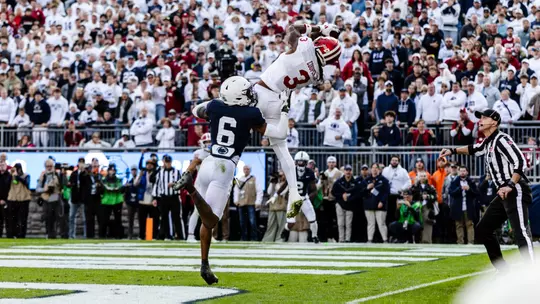
IU has thrived in pressure moments, has come up big amid fourth-quarter adversity, highlighted by the game-winning drive at Penn State capped by Omar Cooper Jr.’s dramatic back-of-the-end-zone catch. The Hoosiers’ veteran nature, Hemby says, “gives them an edge.”
“Having veterans on the field makes our job easy because we have that sense to where we've been through it before. A lot of our players have been in the situations that we're going to be in or have been in the past.
“That helps us to stay grounded. You look at us in the huddle. You have guys like (center) Pat Coogan who has been around, knows what he's talking about. You got other leaders like (quarterback Fernando Mendoza) and players like that.
“We have that mentality where we won't flinch. We go in the huddle, regardless of the situation, regardless of where we are in the game, we know that all it takes is for 11 guys to do their jobs. We're here for a reason, because we have 11 guys that can do their job. We trust each other. We have that love for one another. When we get out there on the field, we know that we're going to put it on display.
“Being older, I think it does help us to know that we've been through it. We're battle-tested. We play for one another. I feel like that really helps us to experience that grit feeling. That helps us to win those close games.”
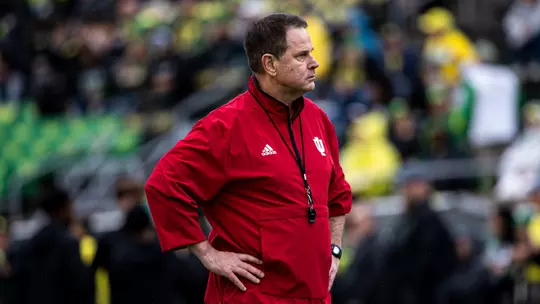
Head coach Curt Cignetti has had a huge influence on IU’s football culture (see his 25-2 Hoosier record), on player development and even, Black says with a smile, vacuuming.
“It’s his philosophy about being disciplined and smart,” Black says. “Making sure you're staying on track and want to be better in everything you do. It’s never being complacent in life, always wanting to get better in every single phase, whether that's cooking, vacuuming, cleaning up the house. Those things that you need a certain mindset from football that you learned from him translates to your everyday life.”
As far as Cignetti’s leadership, Black says it’s easy to get behind.
“He's about his business. He's going to be serious about everything that he does in football and even in life. He wants to see his guys improve, make those strides to become better players and better men.
“I'm glad that he came to IU and instilled this philosophy in this program. Everyone is getting behind him. We're just going to keep getting better as we go.”
Cignetti is known for his all-business approach. Sarratt says he’s that way all the time.
“When you come into this facility, you understand that it's time to go to work. When he comes into the team meetings, you understand what he's about, what he's saying. You believe what he's saying.
“He's about his business and about getting better every day. He wants to find a way to win the day every day.”

Despite IU’s unprecedented two-year run of success (a 25-2 record, the first outright Big Ten title since 1945, the first bowl victory since 1991, a first-ever No. 1 ranking), some outsiders still view the Hoosiers as the losingest major college program it was until this season.
“I don't know if we changed people's minds,” Hemby says. “We're not really in the business of trying to do that. We want to prove ourselves. That's our mantra and what we go to practice for every day.
“Hopefully we did (change some minds). At the end of the day, if we're winning games, we'll take it however we can.”
IU’s offensive balance -- it throws for 247.4 yards a game, runs for 220.7 -- allows offensive coordinator Mike Shanahan to call running plays in situations that seem to require passing.
The usual result -- big gains.
“That shines a light on Coach Shanahan,” Hemby says. “He's one of the greatest in the business. He does a great job putting us into situations to be successful.
“That's a testament that if we go out there and 11 guys do their jobs, every play will be successful. That really shows that.
“On a first-and-20, to be able to run the ball and have success like that, shows that if we’re able to execute every play that Coach calls, we'll have success and be where we want to be.”
Hemby says the key is having guys who “take pride in doing their one-on-one jobs and winning their one-on-one battles. That helps us as an offense and it helps us to keep moving forward and moving the chains, because that helps us to get points.”
Just as important, Black says, is IU’s effectiveness in running in key situations.
“Those are one of the things that we focus on in practice, those certain situations, those fourth-and-shorts, third-and-mediums. We have our great scheme for that.
“I give all the credit to the O-line and those tight ends and receivers who block their tails off out there, our coaching staff for putting us in the right position to be able to be successful in those situations.”