
Indiana University Athletics
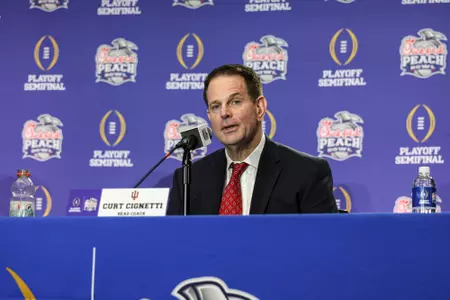
Peach Bowl Game Head Coaches Press Conference
1/8/2026 12:00:00 PM | Football
ATLANTA, GA. –––– Indiana football coach Curt Cignetti and Oregon football coach Dan Lanning addressed the media on Thursday (January 8) at the College Football Hall of Fame ahead of the College Football Playoff Semifinal at the Peach Bowl matchup against Oregon on Friday (January 9).
Below is a full transcript of the press conference, while video of the media session can be found on the right sidebar at IUHoosiers.com.
Curt Cignetti | Indiana Head Coach
Opening Statement
CC: Well, since Dan has drawn back on previous experiences in Atlanta and the Peach Bowl, I think my first Peach Bowl experience was '72, West Virginia-North Carolina State when Lou Holtz *slated to Bobby Bowden and then '75 when Bobby Bowden got his revenge on Lou Holtz, and then as a player in '81 in West Virginia when we beat Florida. I can't remember who the head coach of Florida, maybe Charlie Pell. But it's a great game.
Obviously it's an honor. It's great to be here. I can't say enough great things about Oregon. Really have a lot of respect for Coach Lanning, their team, what they've put on tape, what they've gotten done. In their recent history, they're good in all three phases, and they're a great football team. And people -- I know I said it's hard to beat a great team twice. Well, it's hard to beat a great team, period. So there is a reason for that.
So ought be a great game. Looking forward to getting better today, and we'll see everybody tomorrow.
Dan Lanning | Oregon Head Coach
Opening Statement
DL: First off, it's an incredible honor to be here. I want to thank Gary and his representatives here at the Peach Bowl. One thing that makes this game fun is recognizing how many things the Peach Bowl actually does outside of just this football game.
It's something my wife, Sauphia and I have been able to be a part of and really grateful for the service that the Peach Bowl provides. Truly honored to play a team like Indiana. They've obviously done an incredible job. You look at the body of work of Coach Cignetti and his crew and the way his team plays. They're playing as good as anybody else in the nation. I can speak to it already.
We already started off this morning of competing. He beat me here a little bit. I walked back there, and they're having us sign balls, and he got a jump start. So I quickly went into two-minute mode and was trying to catch up.
His signatures looked a lot better than mine, but I put some pressure on him at the end, but he still finished signing, I don't know how many balls there were, Coach. There were a bunch of them. It was a fun challenge.
This game is going to be what college football is about. I think you see two tough teams, two teams that are really complete. They play great on offense, defense and special teams. They don't have a weakness. And ultimately I think both these teams, as you watch them, it's about team football. It's not one player. It's not one individual. It's a group that have collectively made an effort to put themselves in this position. And obviously it's an honor for Oregon to be one of the teams participating in that.
On being 14-0 and so dominant so far…
CC: A couple of those teams were GV teams that had good years. We did have a big win against Illinois where they lost some guys in the secondary and got shorthanded as the game went on, but it is a credit to our players playing the first play, the last play the same regardless of the competitive circumstances.
But the bottom line is when you play really good people like tomorrow, you gotta win more battles, play in, play out than they win and do the things you gotta do to win football games, make sure you don't do the things that lose football games. It's all about preparation, having an edge mindset and then putting it on the field and play one to 150.
On the enforceability of contracts in college football…
DL: Yeah, I mean it would be great. I'll be honest, my entire focus right now is on this game. Yeah, contracts you'd love to say that they should be enforceable. At some point we'll see what that ends up looking like. But I think that's the secret behind a contract, right, is it's supposed to mean something.
CC: Yeah. My focus is on our prep, and the only thing I'm going to say about all this stuff is obviously there's a lot of loose ends, and it needs to be tied up in terms of the whole recruiting process. So there's a lot of work to be done, and that's one area.
On splitting time recruiting and preparing for the next game…
CC: Yeah. If I'm not mistaken, I think Oregon played the night before we played Alabama, but I could be wrong.
I gave the coaches off the next day. We got in 3:30, 4:00 in the morning. I went in the office around 2:00 in the afternoon because I knew I was going to lose some time the following day, which would have been a Sunday for us.
And on that Sunday, we had some official visitors in, and I probably lost six hours of prep, and I'm highly involved in our day-to-day situational preparation, particularly on offense, besides being the leader of the program.
So I lost a valuable six hours there and probably three or four the next day, too. So I was playing catch up most of the week, and you gotta rely on your people a little bit more. It also stresses you from the evaluation standpoint and the quality of the one-on-one meeting on the official visits, but it is what it is and you gotta make the best of it.
DL: Yeah, certainly a juggle. We played the first, similar to coach, but we played earlier in the day. But traveling back from Miami is a long trip. So we got back later that night. Had some guys in. You're juggling both, but I think it's really important that your focus -- as much as we can, we put our focus on this game.
And you try to make sure you communicate to the people you're recruiting, hey, I wish I could pay more attention to you right now, but the reality is we are really focused on this game, and if you want to be a part of games like this, this is what you have to look forward to and you'll want my focus to be on this game as well.
On the same note, recruiting is something that happens every single day. It happens in season. It's a little more highlighted right now in this moment. During football season, you don't not recruit. You do it all the time. It's something you always do. It might be a late phone call. It might be a late Zoom. It might be an early phone call. It might be stepping out of a meeting to get on a phone with a player. So we try to make those adaptions and still focus on our team and give them our best foot forward.
On his takeaways from learing from Kirby Smart in jumping from coordinator to head coach…
Yeah, I couldn't put into words the lessons I learned from Coach Smart. He's an unbelievable coach, unbelievable mentor, a guy I still talk to this day. We bounce ideas off of each other.
I noticed whenever he sends a text message asking me a question, I answer a lot quicker than whenever I send him a text message. (Laughs). That's just Kirby a little bit, but I'm picking up on that. So I'm a little more persistent.
But I learned so many lessons from Coach Smart on how to run a program. Being genuinely who you are. I think he coaches with the same passion and energy consistently every day. He runs the entire organization really to a T. He's incredibly intelligent.
So I try to take a lot of lessons from Coach Smart. And obviously he's done a lot of things right. You don't have the success he's had without doing that. And I think he's also been a guy that's always been willing to adapt. Grateful for my time with him. Certainly prepared me for moments like this. Glad I got to be a part of that here at Georgia.
On Dan's motivational tactics…
DL: Motivation is overrated. These players gotta go play the game. I've said that consistently. On the same note, I think it's my job to make sure these guys are ready to go and give them everything I've got in that moment. But if you can't get up for an opportunity to play Indiana especially when they had the better half of us last time, then shame on us.
On Fernando Mendoza stayig off social media…
CC: If he does that, that's really impressive. But I do think he prepares unlike anybody I've ever been around collegiately and at the quarterback position. He wants to be great. His idol was Tom Brady. He's a real intelligent guy.
And you've heard in his interviews how impressive he is, and I think he's somebody that can channel all his energy into one thing and has the discipline to do that and commitment to be great.
And his preparation is organized and specific and detailed. Like you can work, but you gotta work smart, right? And I think he's made a lot of improvement when you look at him from the first game to where he is now, and he's played really good at the end of the games, and he's a warrior.
I really can't say enough good things about what he's done since the day we got him till today, except he's gotta play damn good tomorrow. (Laughs).
On how the SEC and Big Ten power dynamics have changed since he left Georgia…
It's a good league. It's a good league, and there's great players that want to come here. Certainly part of the result of the portal has created -- it's tough to keep great players in one place. I think you've seen some transition where great players that aren't getting an opportunity look for an opportunity to go play. That has certainly taken place in our program and ultimately the portal. And NIL has probably created a little bit more parity in the sport.
That being said, there's some really good coaches in this league, and I think people realize you can do it in more than one place.
So when you have great teams like you do, academic tradition and things that exist in the Big Ten, a league that people can be a part of and still realize their dreams of NFL success and win games and compete for championships, I think that's just opened the spectrum to there's a lot of places you can have success and certainly the Big Ten is one of them.
On Jay Harris being available tomorrow…
DL: Yes.
On his coaching journey and how got to where he is at…
CC: Well, I got a really good break when I was young. I was 23 years old coaching the southwest conference back when that was one of the top conferences in the country. But it was at Rice, a program that doesn't do very well. And we played SMU before they had the death penalty. That's how long ago that was.
There three years and then you go to Temple, which has succeed Bruce Arians, and we had one outstanding year our second year, but we weren't very good years one, three and four. So I'm still an assistant coach. Now, that's great. I'm young, and I'm making okay money. But people tend to hire people from winning programs.
Johnny Majors gave me the opportunity at Pitt. Obviously he was a legend of the game, remembered him in '76, Tony Dorsett when we were at West Virginia then, but we had nothing at Pitt. Facilities were awful. We had no players. We had no money. There was no commitment. And Coach Majors didn't have a chance. And he got let go and then Walt Harris retained me, and we started to make some progress, and I learned a lot from Walt. He was a great quarterback coach.
And then after three years, I had the opportunity to go Chuck Amato. That was the first million dollar staff in college football, 2000. That's when nine assistant coaches' salaries equalled million dollars. Norm Child, and some other people on that staff.
And we had a quarterback, freshmen quarterback, there named Philip Rivers who the previous staff had actually recruited, and then we took it over in January and Philip was an early enrollee. And we had great success, so I think part of it was because I was with programs that weren't successful.
And then once I went with Nick, I felt like I got what I needed, really after year one. And I took -- I bet on myself. It was a very unorthodox move, I mean almost crazy move. And I thought I was crazy a few mornings waking up that first month, but here I am today.
And so when you look at the transfer portal and all the things that have gone on in college football, being a recruiting coordinator and a coach for 20 years, which, you know, every year I wanted to get out of the recruiting coordinator job and just -- I didn't like being a coach and a recruiting coordinator. And my dad used to tell me that's going to come in handy some day. And you circle back. I think my journey makes a lot of sense how it prepared me for this particular situation.
On the team's mindset of all they need is 11 players on the field…
DL: Yeah, we've talked about it all year, strength in numbers, and the strength in football is the team. It's not one up individual. And I truly believe that our coaches and our staff and our players prepared really hard all year to be ready for their opportunities, and sometimes peoples' roles change throughout the year. That's where you have to be selfless.
But we have some guys that can play winning football, and that's the key is do you have 11 guys that can go play winning football. And if there's a deficiency, can you cover that deficiency up. That's part of the strategy behind football as well.
Ultimately we're really excited about the guys that take the field. I've got complete trust in our players. And regardless of what happens in this game, you go play and you play to win the game. But when you are playing a great team like Indiana, regardless what happens, to be one of four teams left in college football is an unbelievable honor that we'll never recognize and we'd certainly never be satisfied with, regardless -- there's only one result that makes us happy at the end of the day, but I promise we'll have 11 guys on the field that are going to want to play winning football and play to the standard necessary for our team.
On the huge Indiana fan base and their consistency traveling…
CC: I don't think there's any doubt that when you have the fans behind you, they're in the stadium and they're loud after a big play, it just increases the energy level on your side. So we'll see what tomorrow night looks like. We are closer obviously to Bloomington than Eugene, Oregon, but we'll find out.
On facing the other coaching staff for a second time…
CC: The evolution? He's looked at things that they did well in all three phases and things they didn't do well. I've done the same thing. We've looked at things we did well and didn't do well.
And then, you know, teams evolve afterward. I think that was Game 5 or 6 at the time. There's been 14 games. And teams improve. And why do they improve, because of repetition. Repetition is the mother of learning, and then there's some schematic tweaks, but basically when you're successful and through repetition, guys are in the right place, it becomes secondhand. They react quicker and then it's a matter of kind of managing the health of your team and a few other variables.
So I don't have any idea what they're going to do. They don't know what we're going to do. And quite honestly as I sit here right now, I know everything we've practiced, but I have no idea what that tape is going to look like the day after. And that's every game, you know. What's actually going to get called, what'll work, what won't work, and what are they going to do different. And that's football. There are a lot of variables.
DAN LANNING: Yeah, half the game in football sometimes as coaches, you chase ghosts and you try to overanalyze things that happened before, but ultimately you try to stick to the same process you've used throughout the season. Just so happens you're playing the same team twice.
Part of the reason they're good is they're able to do the same thing over and over and over again really, really successfully. And that's one thing that's really clear about Indiana, they have an identity. They do their job extremely well. I would hope you would say thing about us. As you watch Oregon, we do a lot of the same things over and over again really, really well. So it'll be a combination of those things and certainly some tweaks within that.
On what you've learned about yourself throughout the season…
CC: I'm getting older. (Laughs).
DL: Yeah. And I'm aging quick. Just more than anything, how grateful I am to get to be a part of what I get to be a part of, you know. My three boys got to come on this trip. My wife got to come on this trip.
And you try not to be very selfish in this profession, but it was pretty fun stepping in that hotel room last night. And I just kind of joked with our boys, I said if your dad was a dentist, you wouldn't be doing this right now.
It could have gone a lot of different other ways, too. I was really lucky to be a part of a lot of winning teams. So probably more than anything, just gratitude that I get to be a part of something like this.
On what he remembers about when Frank Cignetti was inducted in the College Football Hall of Fame…
CC: Well, you know, it's been quite a week, honestly, with the portal and preparation for a great team and a few other things going on on the side, which as you get older, you have to deal with.
But found out last night when we got to the plane that I didn't realize that the press conference was here or the Dodd Award. And once I did -- so my dad was inducted in the College Football Hall of Fame in '13, as you said, and I was the only family member that couldn't make the ceremony, and my wife told me this morning that actually her and the kids had gone, but I couldn't go. We were in fall camp at IUP, and I wasn't going to miss practice.
My brothers and sisters all went. Frankie was probably coaching in the NFL or coordinating somewhere in college, I can't remember.
So this is the first time I've ever been in this building, and I did get to kind of see -- and it was nice to be able to do that.
I learned so much from my dad, you know. I don't even know where to start. He was a great leader, and he led by example, and he was a role model, and he was a strong man. He had a little John Wayne and Clint Eastwood in him.
And, you know, he -- I get letters, and I read things on social media about all the people he helped at West Virginia and at IUP, helped them in their lives. And I was the oldest, so the oldest always has it the roughest. And when I was growing up, we were at West Virginia, and the pressure was a little different than when the other ones were growing up when they were at IUP.
But I had a great upbringing. I knew in third grade I wanted to coach, and he had a lot of pearls of wisdom.
On IU being the only team that has advanced in the last two years with a bye and flipping the culture…
CC: I don't know what other people do in their prep, so I can't really answer that one. You go into a losing program, you gotta change the way people think. You gotta have a blueprint and a plan, standards, expectations, but it's all about people.
You have the right people upstairs that you hire as coaches, and you gotta have the right people in the locker room. And obviously we put a premium on certain things in the recruiting process. And fortunately I've had great continuity on my coaching staff. We're all on the same page, and I think that's critical, getting everybody to think alike and developing those intangibles as you enter the season.
But we're process driven, standards, expectations, accountability. I'm pretty direct in my messaging with the team. I try to make every word count. I don't put up with BS. I'm a little bit old school, like you gotta meet the bar, you know what I mean? And if you can't consistently meet the bar, you're in the wrong place.
And so but my coaches do a great job, and the players, we have smart guys that are good players. And when you have veteran smart guys that can do a lot, you can do a lot.
On getting to spend time with his family on this journey…
DL: Yeah, they're all unique and special. In our profession, we probably never take the time to sit back and smell the roses and enjoy it. At some point in life I'll probably get the chance to do that, but certainly grateful for this one.
On his coordinators juggling two different jobs…
DL: They've been going both, been going hundred miles an hour both since they hit that cycle where they have to do both. And I give them a lot of credit for the work they've done, the way they've been able to maintain focus in a piece that's extremely difficult.
I also give sa lot of credit to the sport staff around them and the coaches around them here that we have had and the ones that will be here moving forward that have handled some of that load as they go through it.
Again I've said it before, they realize they don't have those jobs if it isn't for the players and our team, and they feel like they owe the best effort to give them everything they have to continue to make the season special, and they've done a great job of doing that as well as doing a good job of establishing their new program.
On keys to winning the game…
DL: I think it always starts with the ball. The team that's able to take care of the ball. Last time we played, we didn't. You have to take care of the ball. We were able to create a takeaway as well, but we ended up having two. I think that's a big piece of this. And special teams in big games always makes a big impact. I think we have to play well on special teams.
CC: We talk about the same thing every single game, line of scrimmage, run the ball, stop the run, affect the quarterback, protect the quarterback, turnover ratio. We're number one in the country; explosive plays, runs plus 12, passes plus 15 on both sides, critical situations, third, fourth down, red area, two-minute before the half, end of the game, and teams has to be a win. Every game, same stuff.
DL: I should have named more. I thought we were just doing two.
CC: That was two.
DL: Gosh dang, Coach.
On him never being satisfied and never happy…
CC: Well, you know, I think you gotta put that in context. And you're talking about on a practice field or when you're evaluating tape and your performance in terms of standards, right? Because I do firmly believe you get better, you get worse, you never stay the same, right? And so you gotta keep that edge.
No, that's not right. I mean, there's a lot of times I am happy, I just don't show I'm happy. And if I'm going to ask my players, right, to play the first game, first play to play 150 the same regardless of the competitive circumstances, then I can't be seen on the sideline, right, high-fiving people and celebrating or what's going to happen? What's the effect going to be, right?
So that's why I am like I am during the game. Plus, I gotta make important decisions and manage the game. These decisions we have to make in terms of game management, when to use a timeout, when not to use a timeout, whether to be aggressive in two minute, right? I had to use a timeout on defense that I called against Alabama on 4th and 1, and it ended up being a pretty big sequence.
So you gotta be dialed in and thinking ahead. I'll smile and celebrate later in the coaches' room with the coaches, you know. Maybe have a beer.
Of course, in the playoffs, you gotta do nine or ten different press conferences after the game. So that's about an hour and a half later. People ask, are you ever -- do you ever get to enjoy this, and last week I asked Jeff Keag, I said, we just won the game and I got ten press conferences I gotta do after the game. When am I going to enjoy this? So no, I do smile and I am happy at times.
On the Indiana offensive line…
CC: I don't think the praise has anything to do with how we're going to perform. I think we've been pretty consistent all year long. We've been fairly healthy. There have been a couple games where we had to get our sixth guy in or maybe our seventh guy in.
But Coach Bostad does a great job with the offensive line. He's a veteran offensive line coach and does a really good job preparing. We got a lot of veteran guys, blue-collar, kind of blue-collar, steel-mill, lunch-pail type guys on our offensive line.
And we're pretty simple, as Coach said. I mean, we do this -- we do what we do. And so they get good at doing that, and then we got compliments that, you know.
But, look, Oregon, let me tell you something, they're as big of a challenge for any team in college football, their D-line, as anyone. They've got four to five to six inside guys, basing off of four down front, that are 320-plus, and maybe one of them is 310. And they're good. They are really good.
And they got two edge guys that are outstanding. And they can bring a third and a fourth in also. But I mean, what they can do to you inside when they cover your guards and then the ends. And then they got backer that can fly, a great football player, and safety too. They got a bunch of great football players. And schematically they do a great job.
It's going to be a huge challenge. It's going to be a huge challenge in terms of the run game, protecting the quarterback, and that's where it all starts, and they're really good there.
On Oregon's defense and secondary…
DL: It's really important we play well tomorrow, especially when you're playing one of the best offenses in college football, one of the best quarterbacks.
I think one of the things that really sticks out with Mendoza is he takes the ball where it's supposed to go. Everybody says that, and you realize in one I where he's taking the throw, okay, in two I where he's taking the throw, in zone, where does he take the throw. And doesn't get enough credit for his feet, is an unbelievable scrambler, was able to do that against us last time. Does a great job of taking off when it's there, when his first read is not there and he has great weapons to throw to.
So what do we have to do? Each guy has gotta farm his land. They have to do their 111th, gotta have 11 guys playing the same goal, gotta handle the variety that they provide because there's a lot of variety in this offense.
I think it starts with what Coach Cignetti and I both talked about earlier in the week, you have two teams that want to be able to run the ball and control the line of scrimmage. The team that can win line of scrimmage, that's a big, big piece of this game.
And once the line of scrimmage is determined, it's going to be about who can win one-on-ones outside with technique. So we need guys to go in this game and play with great technique. If you're on the field, there's a standard to play to. And obviously when you're playing a team that's as capable as Indiana is, you have to play your best.
FastScripts Transcript by ASAP Sports
Below is a full transcript of the press conference, while video of the media session can be found on the right sidebar at IUHoosiers.com.
Curt Cignetti | Indiana Head Coach
Opening Statement
CC: Well, since Dan has drawn back on previous experiences in Atlanta and the Peach Bowl, I think my first Peach Bowl experience was '72, West Virginia-North Carolina State when Lou Holtz *slated to Bobby Bowden and then '75 when Bobby Bowden got his revenge on Lou Holtz, and then as a player in '81 in West Virginia when we beat Florida. I can't remember who the head coach of Florida, maybe Charlie Pell. But it's a great game.
Obviously it's an honor. It's great to be here. I can't say enough great things about Oregon. Really have a lot of respect for Coach Lanning, their team, what they've put on tape, what they've gotten done. In their recent history, they're good in all three phases, and they're a great football team. And people -- I know I said it's hard to beat a great team twice. Well, it's hard to beat a great team, period. So there is a reason for that.
So ought be a great game. Looking forward to getting better today, and we'll see everybody tomorrow.
Dan Lanning | Oregon Head Coach
Opening Statement
DL: First off, it's an incredible honor to be here. I want to thank Gary and his representatives here at the Peach Bowl. One thing that makes this game fun is recognizing how many things the Peach Bowl actually does outside of just this football game.
It's something my wife, Sauphia and I have been able to be a part of and really grateful for the service that the Peach Bowl provides. Truly honored to play a team like Indiana. They've obviously done an incredible job. You look at the body of work of Coach Cignetti and his crew and the way his team plays. They're playing as good as anybody else in the nation. I can speak to it already.
We already started off this morning of competing. He beat me here a little bit. I walked back there, and they're having us sign balls, and he got a jump start. So I quickly went into two-minute mode and was trying to catch up.
His signatures looked a lot better than mine, but I put some pressure on him at the end, but he still finished signing, I don't know how many balls there were, Coach. There were a bunch of them. It was a fun challenge.
This game is going to be what college football is about. I think you see two tough teams, two teams that are really complete. They play great on offense, defense and special teams. They don't have a weakness. And ultimately I think both these teams, as you watch them, it's about team football. It's not one player. It's not one individual. It's a group that have collectively made an effort to put themselves in this position. And obviously it's an honor for Oregon to be one of the teams participating in that.
On being 14-0 and so dominant so far…
CC: A couple of those teams were GV teams that had good years. We did have a big win against Illinois where they lost some guys in the secondary and got shorthanded as the game went on, but it is a credit to our players playing the first play, the last play the same regardless of the competitive circumstances.
But the bottom line is when you play really good people like tomorrow, you gotta win more battles, play in, play out than they win and do the things you gotta do to win football games, make sure you don't do the things that lose football games. It's all about preparation, having an edge mindset and then putting it on the field and play one to 150.
On the enforceability of contracts in college football…
DL: Yeah, I mean it would be great. I'll be honest, my entire focus right now is on this game. Yeah, contracts you'd love to say that they should be enforceable. At some point we'll see what that ends up looking like. But I think that's the secret behind a contract, right, is it's supposed to mean something.
CC: Yeah. My focus is on our prep, and the only thing I'm going to say about all this stuff is obviously there's a lot of loose ends, and it needs to be tied up in terms of the whole recruiting process. So there's a lot of work to be done, and that's one area.
On splitting time recruiting and preparing for the next game…
CC: Yeah. If I'm not mistaken, I think Oregon played the night before we played Alabama, but I could be wrong.
I gave the coaches off the next day. We got in 3:30, 4:00 in the morning. I went in the office around 2:00 in the afternoon because I knew I was going to lose some time the following day, which would have been a Sunday for us.
And on that Sunday, we had some official visitors in, and I probably lost six hours of prep, and I'm highly involved in our day-to-day situational preparation, particularly on offense, besides being the leader of the program.
So I lost a valuable six hours there and probably three or four the next day, too. So I was playing catch up most of the week, and you gotta rely on your people a little bit more. It also stresses you from the evaluation standpoint and the quality of the one-on-one meeting on the official visits, but it is what it is and you gotta make the best of it.
DL: Yeah, certainly a juggle. We played the first, similar to coach, but we played earlier in the day. But traveling back from Miami is a long trip. So we got back later that night. Had some guys in. You're juggling both, but I think it's really important that your focus -- as much as we can, we put our focus on this game.
And you try to make sure you communicate to the people you're recruiting, hey, I wish I could pay more attention to you right now, but the reality is we are really focused on this game, and if you want to be a part of games like this, this is what you have to look forward to and you'll want my focus to be on this game as well.
On the same note, recruiting is something that happens every single day. It happens in season. It's a little more highlighted right now in this moment. During football season, you don't not recruit. You do it all the time. It's something you always do. It might be a late phone call. It might be a late Zoom. It might be an early phone call. It might be stepping out of a meeting to get on a phone with a player. So we try to make those adaptions and still focus on our team and give them our best foot forward.
On his takeaways from learing from Kirby Smart in jumping from coordinator to head coach…
Yeah, I couldn't put into words the lessons I learned from Coach Smart. He's an unbelievable coach, unbelievable mentor, a guy I still talk to this day. We bounce ideas off of each other.
I noticed whenever he sends a text message asking me a question, I answer a lot quicker than whenever I send him a text message. (Laughs). That's just Kirby a little bit, but I'm picking up on that. So I'm a little more persistent.
But I learned so many lessons from Coach Smart on how to run a program. Being genuinely who you are. I think he coaches with the same passion and energy consistently every day. He runs the entire organization really to a T. He's incredibly intelligent.
So I try to take a lot of lessons from Coach Smart. And obviously he's done a lot of things right. You don't have the success he's had without doing that. And I think he's also been a guy that's always been willing to adapt. Grateful for my time with him. Certainly prepared me for moments like this. Glad I got to be a part of that here at Georgia.
On Dan's motivational tactics…
DL: Motivation is overrated. These players gotta go play the game. I've said that consistently. On the same note, I think it's my job to make sure these guys are ready to go and give them everything I've got in that moment. But if you can't get up for an opportunity to play Indiana especially when they had the better half of us last time, then shame on us.
On Fernando Mendoza stayig off social media…
CC: If he does that, that's really impressive. But I do think he prepares unlike anybody I've ever been around collegiately and at the quarterback position. He wants to be great. His idol was Tom Brady. He's a real intelligent guy.
And you've heard in his interviews how impressive he is, and I think he's somebody that can channel all his energy into one thing and has the discipline to do that and commitment to be great.
And his preparation is organized and specific and detailed. Like you can work, but you gotta work smart, right? And I think he's made a lot of improvement when you look at him from the first game to where he is now, and he's played really good at the end of the games, and he's a warrior.
I really can't say enough good things about what he's done since the day we got him till today, except he's gotta play damn good tomorrow. (Laughs).
On how the SEC and Big Ten power dynamics have changed since he left Georgia…
It's a good league. It's a good league, and there's great players that want to come here. Certainly part of the result of the portal has created -- it's tough to keep great players in one place. I think you've seen some transition where great players that aren't getting an opportunity look for an opportunity to go play. That has certainly taken place in our program and ultimately the portal. And NIL has probably created a little bit more parity in the sport.
That being said, there's some really good coaches in this league, and I think people realize you can do it in more than one place.
So when you have great teams like you do, academic tradition and things that exist in the Big Ten, a league that people can be a part of and still realize their dreams of NFL success and win games and compete for championships, I think that's just opened the spectrum to there's a lot of places you can have success and certainly the Big Ten is one of them.
On Jay Harris being available tomorrow…
DL: Yes.
On his coaching journey and how got to where he is at…
CC: Well, I got a really good break when I was young. I was 23 years old coaching the southwest conference back when that was one of the top conferences in the country. But it was at Rice, a program that doesn't do very well. And we played SMU before they had the death penalty. That's how long ago that was.
There three years and then you go to Temple, which has succeed Bruce Arians, and we had one outstanding year our second year, but we weren't very good years one, three and four. So I'm still an assistant coach. Now, that's great. I'm young, and I'm making okay money. But people tend to hire people from winning programs.
Johnny Majors gave me the opportunity at Pitt. Obviously he was a legend of the game, remembered him in '76, Tony Dorsett when we were at West Virginia then, but we had nothing at Pitt. Facilities were awful. We had no players. We had no money. There was no commitment. And Coach Majors didn't have a chance. And he got let go and then Walt Harris retained me, and we started to make some progress, and I learned a lot from Walt. He was a great quarterback coach.
And then after three years, I had the opportunity to go Chuck Amato. That was the first million dollar staff in college football, 2000. That's when nine assistant coaches' salaries equalled million dollars. Norm Child, and some other people on that staff.
And we had a quarterback, freshmen quarterback, there named Philip Rivers who the previous staff had actually recruited, and then we took it over in January and Philip was an early enrollee. And we had great success, so I think part of it was because I was with programs that weren't successful.
And then once I went with Nick, I felt like I got what I needed, really after year one. And I took -- I bet on myself. It was a very unorthodox move, I mean almost crazy move. And I thought I was crazy a few mornings waking up that first month, but here I am today.
And so when you look at the transfer portal and all the things that have gone on in college football, being a recruiting coordinator and a coach for 20 years, which, you know, every year I wanted to get out of the recruiting coordinator job and just -- I didn't like being a coach and a recruiting coordinator. And my dad used to tell me that's going to come in handy some day. And you circle back. I think my journey makes a lot of sense how it prepared me for this particular situation.
On the team's mindset of all they need is 11 players on the field…
DL: Yeah, we've talked about it all year, strength in numbers, and the strength in football is the team. It's not one up individual. And I truly believe that our coaches and our staff and our players prepared really hard all year to be ready for their opportunities, and sometimes peoples' roles change throughout the year. That's where you have to be selfless.
But we have some guys that can play winning football, and that's the key is do you have 11 guys that can go play winning football. And if there's a deficiency, can you cover that deficiency up. That's part of the strategy behind football as well.
Ultimately we're really excited about the guys that take the field. I've got complete trust in our players. And regardless of what happens in this game, you go play and you play to win the game. But when you are playing a great team like Indiana, regardless what happens, to be one of four teams left in college football is an unbelievable honor that we'll never recognize and we'd certainly never be satisfied with, regardless -- there's only one result that makes us happy at the end of the day, but I promise we'll have 11 guys on the field that are going to want to play winning football and play to the standard necessary for our team.
On the huge Indiana fan base and their consistency traveling…
CC: I don't think there's any doubt that when you have the fans behind you, they're in the stadium and they're loud after a big play, it just increases the energy level on your side. So we'll see what tomorrow night looks like. We are closer obviously to Bloomington than Eugene, Oregon, but we'll find out.
On facing the other coaching staff for a second time…
CC: The evolution? He's looked at things that they did well in all three phases and things they didn't do well. I've done the same thing. We've looked at things we did well and didn't do well.
And then, you know, teams evolve afterward. I think that was Game 5 or 6 at the time. There's been 14 games. And teams improve. And why do they improve, because of repetition. Repetition is the mother of learning, and then there's some schematic tweaks, but basically when you're successful and through repetition, guys are in the right place, it becomes secondhand. They react quicker and then it's a matter of kind of managing the health of your team and a few other variables.
So I don't have any idea what they're going to do. They don't know what we're going to do. And quite honestly as I sit here right now, I know everything we've practiced, but I have no idea what that tape is going to look like the day after. And that's every game, you know. What's actually going to get called, what'll work, what won't work, and what are they going to do different. And that's football. There are a lot of variables.
DAN LANNING: Yeah, half the game in football sometimes as coaches, you chase ghosts and you try to overanalyze things that happened before, but ultimately you try to stick to the same process you've used throughout the season. Just so happens you're playing the same team twice.
Part of the reason they're good is they're able to do the same thing over and over and over again really, really successfully. And that's one thing that's really clear about Indiana, they have an identity. They do their job extremely well. I would hope you would say thing about us. As you watch Oregon, we do a lot of the same things over and over again really, really well. So it'll be a combination of those things and certainly some tweaks within that.
On what you've learned about yourself throughout the season…
CC: I'm getting older. (Laughs).
DL: Yeah. And I'm aging quick. Just more than anything, how grateful I am to get to be a part of what I get to be a part of, you know. My three boys got to come on this trip. My wife got to come on this trip.
And you try not to be very selfish in this profession, but it was pretty fun stepping in that hotel room last night. And I just kind of joked with our boys, I said if your dad was a dentist, you wouldn't be doing this right now.
It could have gone a lot of different other ways, too. I was really lucky to be a part of a lot of winning teams. So probably more than anything, just gratitude that I get to be a part of something like this.
On what he remembers about when Frank Cignetti was inducted in the College Football Hall of Fame…
CC: Well, you know, it's been quite a week, honestly, with the portal and preparation for a great team and a few other things going on on the side, which as you get older, you have to deal with.
But found out last night when we got to the plane that I didn't realize that the press conference was here or the Dodd Award. And once I did -- so my dad was inducted in the College Football Hall of Fame in '13, as you said, and I was the only family member that couldn't make the ceremony, and my wife told me this morning that actually her and the kids had gone, but I couldn't go. We were in fall camp at IUP, and I wasn't going to miss practice.
My brothers and sisters all went. Frankie was probably coaching in the NFL or coordinating somewhere in college, I can't remember.
So this is the first time I've ever been in this building, and I did get to kind of see -- and it was nice to be able to do that.
I learned so much from my dad, you know. I don't even know where to start. He was a great leader, and he led by example, and he was a role model, and he was a strong man. He had a little John Wayne and Clint Eastwood in him.
And, you know, he -- I get letters, and I read things on social media about all the people he helped at West Virginia and at IUP, helped them in their lives. And I was the oldest, so the oldest always has it the roughest. And when I was growing up, we were at West Virginia, and the pressure was a little different than when the other ones were growing up when they were at IUP.
But I had a great upbringing. I knew in third grade I wanted to coach, and he had a lot of pearls of wisdom.
On IU being the only team that has advanced in the last two years with a bye and flipping the culture…
CC: I don't know what other people do in their prep, so I can't really answer that one. You go into a losing program, you gotta change the way people think. You gotta have a blueprint and a plan, standards, expectations, but it's all about people.
You have the right people upstairs that you hire as coaches, and you gotta have the right people in the locker room. And obviously we put a premium on certain things in the recruiting process. And fortunately I've had great continuity on my coaching staff. We're all on the same page, and I think that's critical, getting everybody to think alike and developing those intangibles as you enter the season.
But we're process driven, standards, expectations, accountability. I'm pretty direct in my messaging with the team. I try to make every word count. I don't put up with BS. I'm a little bit old school, like you gotta meet the bar, you know what I mean? And if you can't consistently meet the bar, you're in the wrong place.
And so but my coaches do a great job, and the players, we have smart guys that are good players. And when you have veteran smart guys that can do a lot, you can do a lot.
On getting to spend time with his family on this journey…
DL: Yeah, they're all unique and special. In our profession, we probably never take the time to sit back and smell the roses and enjoy it. At some point in life I'll probably get the chance to do that, but certainly grateful for this one.
On his coordinators juggling two different jobs…
DL: They've been going both, been going hundred miles an hour both since they hit that cycle where they have to do both. And I give them a lot of credit for the work they've done, the way they've been able to maintain focus in a piece that's extremely difficult.
I also give sa lot of credit to the sport staff around them and the coaches around them here that we have had and the ones that will be here moving forward that have handled some of that load as they go through it.
Again I've said it before, they realize they don't have those jobs if it isn't for the players and our team, and they feel like they owe the best effort to give them everything they have to continue to make the season special, and they've done a great job of doing that as well as doing a good job of establishing their new program.
On keys to winning the game…
DL: I think it always starts with the ball. The team that's able to take care of the ball. Last time we played, we didn't. You have to take care of the ball. We were able to create a takeaway as well, but we ended up having two. I think that's a big piece of this. And special teams in big games always makes a big impact. I think we have to play well on special teams.
CC: We talk about the same thing every single game, line of scrimmage, run the ball, stop the run, affect the quarterback, protect the quarterback, turnover ratio. We're number one in the country; explosive plays, runs plus 12, passes plus 15 on both sides, critical situations, third, fourth down, red area, two-minute before the half, end of the game, and teams has to be a win. Every game, same stuff.
DL: I should have named more. I thought we were just doing two.
CC: That was two.
DL: Gosh dang, Coach.
On him never being satisfied and never happy…
CC: Well, you know, I think you gotta put that in context. And you're talking about on a practice field or when you're evaluating tape and your performance in terms of standards, right? Because I do firmly believe you get better, you get worse, you never stay the same, right? And so you gotta keep that edge.
No, that's not right. I mean, there's a lot of times I am happy, I just don't show I'm happy. And if I'm going to ask my players, right, to play the first game, first play to play 150 the same regardless of the competitive circumstances, then I can't be seen on the sideline, right, high-fiving people and celebrating or what's going to happen? What's the effect going to be, right?
So that's why I am like I am during the game. Plus, I gotta make important decisions and manage the game. These decisions we have to make in terms of game management, when to use a timeout, when not to use a timeout, whether to be aggressive in two minute, right? I had to use a timeout on defense that I called against Alabama on 4th and 1, and it ended up being a pretty big sequence.
So you gotta be dialed in and thinking ahead. I'll smile and celebrate later in the coaches' room with the coaches, you know. Maybe have a beer.
Of course, in the playoffs, you gotta do nine or ten different press conferences after the game. So that's about an hour and a half later. People ask, are you ever -- do you ever get to enjoy this, and last week I asked Jeff Keag, I said, we just won the game and I got ten press conferences I gotta do after the game. When am I going to enjoy this? So no, I do smile and I am happy at times.
On the Indiana offensive line…
CC: I don't think the praise has anything to do with how we're going to perform. I think we've been pretty consistent all year long. We've been fairly healthy. There have been a couple games where we had to get our sixth guy in or maybe our seventh guy in.
But Coach Bostad does a great job with the offensive line. He's a veteran offensive line coach and does a really good job preparing. We got a lot of veteran guys, blue-collar, kind of blue-collar, steel-mill, lunch-pail type guys on our offensive line.
And we're pretty simple, as Coach said. I mean, we do this -- we do what we do. And so they get good at doing that, and then we got compliments that, you know.
But, look, Oregon, let me tell you something, they're as big of a challenge for any team in college football, their D-line, as anyone. They've got four to five to six inside guys, basing off of four down front, that are 320-plus, and maybe one of them is 310. And they're good. They are really good.
And they got two edge guys that are outstanding. And they can bring a third and a fourth in also. But I mean, what they can do to you inside when they cover your guards and then the ends. And then they got backer that can fly, a great football player, and safety too. They got a bunch of great football players. And schematically they do a great job.
It's going to be a huge challenge. It's going to be a huge challenge in terms of the run game, protecting the quarterback, and that's where it all starts, and they're really good there.
On Oregon's defense and secondary…
DL: It's really important we play well tomorrow, especially when you're playing one of the best offenses in college football, one of the best quarterbacks.
I think one of the things that really sticks out with Mendoza is he takes the ball where it's supposed to go. Everybody says that, and you realize in one I where he's taking the throw, okay, in two I where he's taking the throw, in zone, where does he take the throw. And doesn't get enough credit for his feet, is an unbelievable scrambler, was able to do that against us last time. Does a great job of taking off when it's there, when his first read is not there and he has great weapons to throw to.
So what do we have to do? Each guy has gotta farm his land. They have to do their 111th, gotta have 11 guys playing the same goal, gotta handle the variety that they provide because there's a lot of variety in this offense.
I think it starts with what Coach Cignetti and I both talked about earlier in the week, you have two teams that want to be able to run the ball and control the line of scrimmage. The team that can win line of scrimmage, that's a big, big piece of this game.
And once the line of scrimmage is determined, it's going to be about who can win one-on-ones outside with technique. So we need guys to go in this game and play with great technique. If you're on the field, there's a standard to play to. And obviously when you're playing a team that's as capable as Indiana is, you have to play your best.
FastScripts Transcript by ASAP Sports


Players Mentioned
QB
/ FootballWednesday, June 03
Wednesday, May 27
Wednesday, May 20
Tuesday, May 05