
To Set A Trap – Haines’ ‘Illusion Defense’ Provides an Edge
Pete DiPrimio | IUHoosiers.com
BLOOMINGTON, Ind. - Mad Scientist? Sure, that fits when describing Indiana defensive coordinator Bryant Haines working his offense-ruining magic. Diabolical? Offensive coordinators throughout the Big Ten and beyond must feel that way when facing what Oregon coach Dan Lanning calls the Hoosiers’ “illusion defense.”
“I want to tell an offense a story,” Haines says with a hint of a smile, “and walk them into a trap.”
None of that is visible on a chilly January night. Inside a warm Mellencamp Pavillion, Haines runs practice drills as a teacher, a technician, a tactician. Hoosier linebackers attack a red sled while working on technique and form. Precision now could produce a difference-making play Friday night when the top-seeded Hoosiers (14-0) face the fifth-seeded Ducks (13-1) in the Chick-fil-A Peach Bowl playoff semifinals at Atlanta’s Mercedes Benz Stadium.
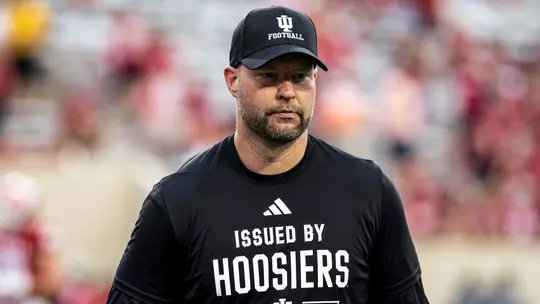
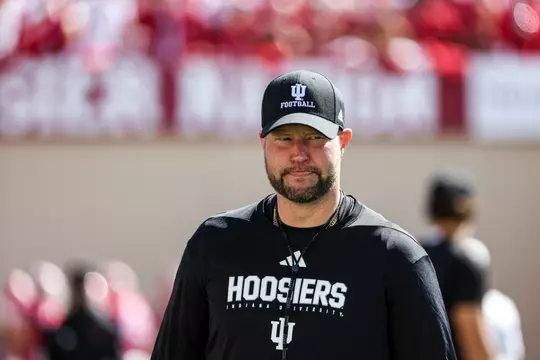
Haines coaches in black, including a ballcap. Hoosier players and coaches are scattered throughout the facility, drilling and thumping, running and catching, coaching and pushing, seeking to perfect their craft and deliver another playoff performance for the ages to earn a Jan. 19 national championship opportunity in Miami.
Outside, a lit-up Merchants Bank Field at Memorial Stadium showcases Hoosier facility resources amid transfer-portal urgency as head coach Curt Cignetti and his staff build for the next powerhouse team.
Inside Mellencamp, there’s execution to sharpen, mindsets to intensify and perhaps unique twists to try in preparation for Oregon. Linebacker Aiden Fisher is at the forefront, delivering a passionate get-after-it message that reflects his difference-making leadership.
Watching it all from midfield is Cignetti, whose 25-2 Hoosier record hints at the remarkable turnaround he’s delivered from the 9-27 struggles of the previous three seasons before he arrived. Off to the side is Haines, a defensive mastermind who leads a unit that allows just 10.3 points and 252.6 total yards a game through deception, innovation, and physicality.
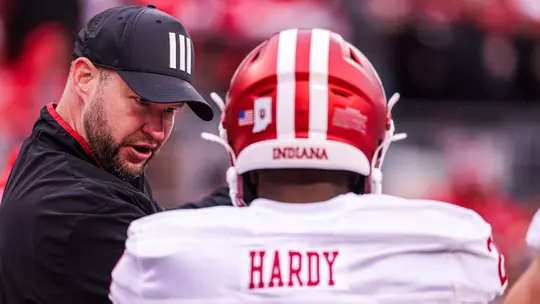
“Coach Haines is the best defensive coordinator I've been a part of,” linebacker Rolijah Hardy says. “He’s one of the top coordinators in the country. He’s also a great linebacker coach. It's great to play for him.”
IU offensive coordinator Mike Shanahan, nationally renowned for his balanced attack, vouches for that. He and Haines have gone head-to-head in spring practice and fall camp for years, first at James Madison, now with Indiana.
“Going against our defense makes for some long days and nights,” Shanahan says. “They force you to have sound rules, which benefits us during the season.
“They never sit there letting you diagnose coverage. Up front, they’re moving and twisting and doing all kinds of things to make sure the offensive line is challenged, and that the line and the tight ends are all on the same page.
“Schematically, they pose all kinds of issues for you. Coach Haines’ scheme has evolved and gotten better. All the defensive coaches do a great job. The whole unit is a pain in the butt to go against.”
Lanning felt that pain during Indiana’s 30-20 October victory. Oregon came in with one of the nation’s most prolific attacks and left with just 13 offense-generated points. The other seven came from a pick-six.
“They show you one thing,” Lanning says, “and take something else away. They're really good at post-snap movement, which makes it difficult for the quarterback. Their defensive line plays with relentless effort. They're tough to block up front. And then the technique continues to show up.
“They've got a guy (Fisher) basically playing quarterback at linebacker that's able to get them lined up and execute. They've got a strong corner in (D’Angelo Ponds). They fly to the ball and they attack it in the air.
“It’s probably the best zone break defense I've seen this year in college football. They do an unbelievable job there, and they get hats on the ball. Obviously, it all starts with stopping the run. They do a great job with that.”
Where does greatness come from? How has Haines, a former Ball State linebacker who worked his way up the coaching ladder that included a $7,000-a-year part-time job at Indiana University-Pennsylvania, evolved into perhaps the nation’s best defensive coordinator?
Let’s take a look.
Less is more. Let’s start with that in explaining Haines’ defensive approach, the one that crushed Alabama’s previously potent attack in the Rose Bowl, the one that has reduced offenses to rubble from coast to coast.
“If I’m good at anything in the coaching world,” Haines says, “it’s that I’m a teacher. I think I communicate somewhat effectively in my (linebacker) room. I try to say the most impactful things, whether I’m teaching a scheme or designing a blitz, in the least amount of words with the largest amount of impact. I urge the rest of the staff to do the same.
“I like to break it down to the smallest microcosm of what a football play is. It’s 11 guys who have independent job descriptions. Just complete your job description within the framework of the call.
“While it looks like a lot of moving parts, it’s really just 11 one-person jobs. If you can do your 1/11th well, you end up with a nice, tight scheme.”
Specifically, you get schemes that shatter the norm through deception and confusion. Rubik’s Cubes are less challenging.
“Coach Haines comes up with defensive schemes you couldn’t draw up in your dreams,” linebacker Isaiah Jones says. “The guys all buy into it and play hard. That’s what makes it elite.”
The Hoosiers love it.
“Coach Haines is the best defensive coordinator I’ve ever been around,” Jones says. “It’s the way he game plans. It’s very tailored to each opponent. It’s not a vanilla defense. Each week there are different wrinkles and schemes.
“We try to exploit the offense’s weakness. For most teams, the offense dictates terms and the defense has to react. We like to dictate terms to the offense.
“We don’t want to give the quarterback time. We try to speed up his clock. If the team is focused on running, we’ll get big and stop the run. We make them play with their opposite hand. That’s what we do well.”
Or, as Ponds puts it, “Coach Haines puts us in the right positions. He attacks the offense’s weaknesses. He confuses quarterbacks. They see it on film, but when a quarterback gets in the game, they don’t know what they’re seeing.”
And then, “We all play together as one.”
The results are Big Ten-leading totals of 42.0 sacks and 118 tackles for loss, combined with 17 interceptions (second in the Big Ten to Maryland’s 19) and 11 forced fumbles (tied for the conference lead).
Haines does this even while dialing back the aggression from his younger days.
“I think I’m a little less aggressive than when I first started,” he says. “Part of that is being naïve. There’s a little less fear when you’ve never been hurt by anything before. If you bring enough six- and seven-man pressures, at some point, you get bit. It stings and you remember that feeling and you’re nervous to call it again.
“I’ve dampened that down. I’ve become more multiple with coverages. I have more confidence in what I want the coverage shell to look like. Working against Coach Shanahan, (offensive line coach Bob Bostad), and the offensive staff, whether they know it or not, I’m able to learn from them in how to attack more effectively. It’s years of that.
“What if I move my three technique over there? What happens then? What if I move (defensive lineman) Mikail Kamara over here, and I walk Aiden Fisher in the V gap? What happens then?
“I learn the offense’s rules and then attack their rules. That’s something I’ve learned. I’m always growing every year.”
Does Haines’ creative pressures inspire the Hoosiers to devise their own innovative blitzes?
Not exactly.
“Coach Haines is extremely innovative, extremely smart,” Fisher says. “Most of it he does on his own. We'll pitch a couple of ideas here and there, but for most of it, he's the mastermind behind it.”
Linebackers are the biggest beneficiaries.
“It's fun to play in this defense because, especially playing linebacker, you can really do anything,” Fisher says. “You can be a man covering, zone coverage, you blitz, you're in run fits. You really do it all.”
The result is a diversified attack where, Fisher says, “we can show a blitz when we're not coming; we can show a blitz when we are coming. For a quarterback or an offensive line, that really messes with your head. It throws off a lot of protections. The quarterback doesn't know what coverage we're in. We do a lot of things to get a step ahead scheme-wise. It’s obviously paid off for us.”

Every coach talks about putting players in the best positions to make plays. Few do it better than Haines, a Broyles Award finalist the last two seasons and the American Football Coaches Association (AFCA) Assistant Coach of the Year in the FBS.
“He makes it favorable for us,” Jones says. “You might not have the biggest defensive tackles, but they can move and stunt and make the offensive linemen miss and play vertical. That makes it easy for the linebackers to play off that.
“It makes the lanes open up for the running backs, but as linebackers, we see those same lanes. It helps us in the back end. The linebackers play off the defensive line. The safeties play off the linebackers. It’s about playing to our strengths and make sure our strengths attack their weaknesses.”
Haines’ less-is-more approach is a catalyst. He breaks his defense down into short, understandable segments. Over the last four years, Fisher has reaped the benefits.
“Coach Haines has always been a great teacher, and he’s gotten better over the years I’ve been with him. His scheme has blossomed into something that everybody is taking notice of around the country.”
Haines refines his teaching without sacrificing the scheme’s complexity.
“The teaching was there; the coaching was there; now it’s why are we doing it, when are we doing it, how are we doing it?” Fisher says. “It’s not just this is what you need to do. It’s why, when and where are we doing. That’s made a big difference.
“He’s taken all the right steps to be a great coach and mentor. He’s done a great job in developing players and the scheme into exactly what fits this defense. He deserves every award that comes his way.”
Under Haines, Fisher has developed into one of the nation’s best linebackers. Last year, he had a team-leading 118 tackles. This season, despite missing a game with an injury, he has 84 tackles.
“He instills a lot of confidence in me,” Fisher says. “I wouldn’t be where I am without a coach like that. He’s a great person to be around. He’s someone who believes in his players. That why we play with confidence because he has the confidence in us.”
Hardy, who leads the team with 92 tackles and eight sacks, has thrived with that confidence.
“You have to be smart to play in this defense,” he says. “At first, it’s hard. You have to take your time to learn the ins and outs of the system. A lot of it is knowing everybody’s job.”
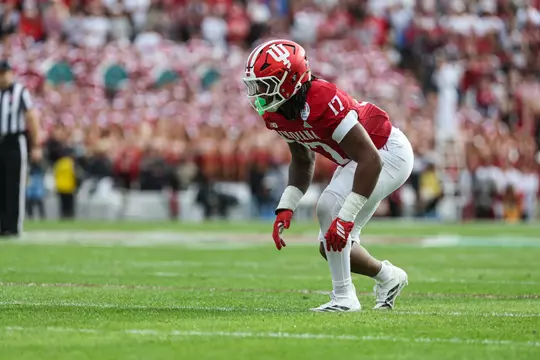
Season-ending injuries to standout defensive linemen Stephen Daley and Kellan Wyatt could have rocked the defense, but no team is better at next-man-up success than the Hoosiers.
The result -- sophomore reserve defensive lineman Daniel Ndukwe has stepped in, and the defense continues to thrive.
“It’s the same with all positions, it is always next man up,” Haines says. “I expect that when Daniel Ndukwe’s number is called, he'll be ready just like everybody that came before him and everybody that is going to come after him.
“We had some injuries at linebacker during the middle of the year and guys like Jeff Utzinger and Kaiden Turner showed up. There is a job description that needs to be done, find a way to get it done.
“It’s on me to adapt the scheme that fits what those guys are capable of; whether it is Daniel Ndukwe or whoever shows up at field end. I need to put them in a great spot to be successful. That is what I get paid to do and so I will fight my tail off to get that done.”
It's a fight Haines keeps winning.
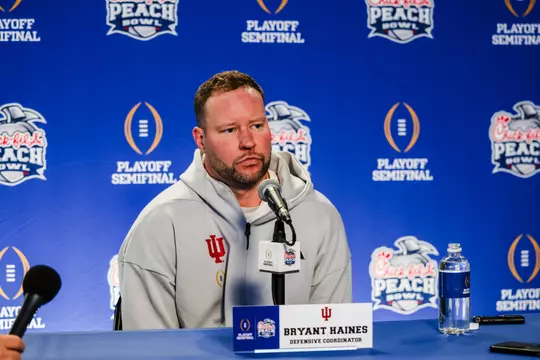
The Hoosiers have arrived at Mercedes-Benz Stadium, less than 48 hours before the Peach Bowl, and podiums are set up for players and coaches. Haines is asked where the ideas for his blitzes, stunts and schemes come from.
Like Cignetti, Haines calls himself a film junkie, although not quite at his head coach’s level; he insists he learns from others.
“I’m not somebody who reinvented the wheel,” he says. “There are a lot of good defensive coordinators who are doing unique things.
“I try to utilize things that I think fit us. I try not to chase too many ghosts. There are a lot of great schemes out there that aren’t who we are. I want to be true to what we do.
“I’m a fan of angles. I’m a fan, as Coach Lanning says, of illusions. I’m trying to control the terms of an offense.
“How do you get that done? In a number of ways. A lot of it is copycat.”
Perhaps, but in the end, that might be the biggest illusion of all.