
Indiana University Athletics
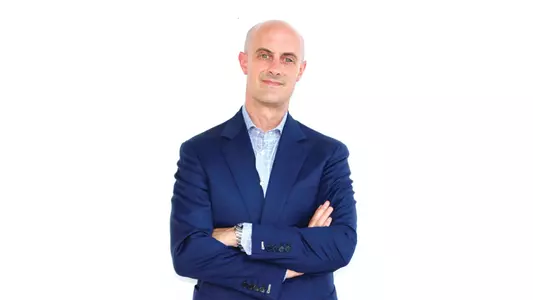
A Growing Game: Wright Leading U.S. Soccer through Momentous Era
1/1/2024 4:16:00 PM | Men's Soccer
"It will be the most successful sporting event of all time by far."
David Wright, Chief Commercial Office for the U.S. Soccer Federation, is confident the 2026 World Cup will lead to the game's unprecedented growth in the United States.
"To host the World Cup in this region at this moment in time is incredibly powerful. There's a ton of research that supports that global events in home territories have a profound impact on growing the game, and we expect the same to hold true here."
And he should know – the theme of his career, both personally and in practice, is growth.
"I learned early on in my career, I love the build," Wright said. "I love having impact. I love being able to think critically and evolve organizations that then go on and to realize exponential growth. And that's exactly what we've done at U.S. Soccer. And it's been an incredible five-year journey."
Wright remembers his first IU soccer training sessions in 1991 – joining 16 fellow freshman recruits and no longer being the top dog that he had been for Kansas City prep soccer. He learned quickly that he would have to get better every day or risk losing his spot in the rotation.
"When you go from being the top player to one where you have to fight every single time you step on the field, it's a new environment," he said. "Among the many things I remember from my days at IU is just the competitiveness. Every single time you stepped on the field, whether it was during training or in a game, you were competing."
"And now thinking forward to my career, there's a competitive spirit in everything that I do. And I enjoy creating teams that embody that competitive spirit that I think have given us the ability to compete off the field."
And that's just one of the many skills he started developing at Indiana.
"Similar to high-performing teams on the field, it's the collection of individual talent that ultimately wins the day. I often talk about intangible skills, those things skills you don't necessarily see on a resume. When I'm hiring, I often say, I'm not hiring Dave Wright. I've got Dave Wright covered. I'm hiring someone who's going to make me better, make the team better, make the organization better – and in some cases may be better than me in many areas (of the business).
"I learned or refined those intangible skills during my time in Bloomington. A focus on controlling the controllable. I may not have been the most technical player, but one of my strengths was I was always going to be the most fit. So, the work you do in preparation in the leadup to preseason, how you take care of your body, all those things contributed to being incredibly fit, which was a point of difference for me on the field.
"The power of leadership. Whether you're the star player or the last player on the roster, there's meaningful opportunities to lead, and you can lead by example, you can lead through encouragement, you can lead through adversity and how you adapt to challenging situations.
"The ability to relate. Relationships are really important. Some of my closest friends are teammates of mine from 30 years ago. Now, thinking ahead to my career, relationships are paramount to being able to succeed at a high level."
"Those intangible skills were developed day in and day out at Bill Armstrong Stadium and have now transferred to the real world."
"Finally, and worth mentioning, what you see on the field (intangible skills), is ultimately what you see in a business setting, and in life."
After graduating from Indiana, Wright moved on to the University of Massachusetts to pursue a Master of Science in sport management while also working under and learning from then-head soccer coach, the late Sam Koch – a connection made through Coach Jerry Yeagley – thinking the experience would lend to a career in coaching. Instead, his eyes were opened to the bigger picture: operating a business, marketing products and leading teams in different formats within the sporting context excited Wright and ultimately led to an opportunity at Major League Soccer in the league's early years.
Wright spent 15 years with MLS, growing his career from manager of fan development, managing the Pepsi Dribble, Pass and Score promotion, to eventually overseeing the league's global partnership portfolio. Wright was a crucial player for a league that has now grown to 30 clubs, the most of any topflight professional league in the world.
"Among the many great things about being at a growth organization like MLS, at the time, is every three or four years when you kind of get antsy for that next opportunity, there was always that next opportunity," Wright said. "So, in part, I was growing with the league, I couldn't have asked for a better environment to gain experience and to position me for bigger things down the road."
Even after all of his success at MLS, Wright maintained a growth mindset. "I needed to challenge myself," he said. "[...] Spread my wings." And that led him to Minor League Baseball – he was a former college soccer player leaving an executive role in a top flight league to go to a totally different sport and tier system; from Manhattan to St. Petersburg, Florida. The reason: growth.
"I've always been a big believer in you grow the most when you when you stretch yourself," he said. "Very similar to being an athlete, right? You develop the most when you push yourself beyond your limits."
And the result was MiLB's growth beyond its limits. As Chief Marketing and Commercial Officer, Wright oversaw the MiLB Enterprise initiative, "designed to maximize enterprise value through integrated national and regional partnerships by leveraging the power and overall scale of the 160 member clubs." National enterprise revenue grew by 120 percent, and Wright and his team were recognized by the Sports Business Journal.
In 2020, U.S. Soccer came calling, approaching a momentous era for the sport in the United States: The expansions of MLS and NWSL. The World Cup in 2026. LA28. The 2031 Women's World Cup.
"This is a period unlike any other that is going to be incredible for the sport and for those of us that are close to it. There's a lot of reason to be optimistic.
"I have an incredible responsibility and opportunity to have a front row seat at growing the game at every level, and I'm very fortunate to work with some of the most talented individuals in the business."
His advice to current Hoosiers, whether on the path to the pros or seeking success through other avenues? Embrace a growth mindset.
"Enjoy your time in Bloomington, seize every moment to develop meaningful relationships and push yourself to become the best version of yourself day in and day out. The environment is there to do that, it's up to you to seize the incredible opportunity."
David Wright, Chief Commercial Office for the U.S. Soccer Federation, is confident the 2026 World Cup will lead to the game's unprecedented growth in the United States.
"To host the World Cup in this region at this moment in time is incredibly powerful. There's a ton of research that supports that global events in home territories have a profound impact on growing the game, and we expect the same to hold true here."
And he should know – the theme of his career, both personally and in practice, is growth.
"I learned early on in my career, I love the build," Wright said. "I love having impact. I love being able to think critically and evolve organizations that then go on and to realize exponential growth. And that's exactly what we've done at U.S. Soccer. And it's been an incredible five-year journey."
Wright remembers his first IU soccer training sessions in 1991 – joining 16 fellow freshman recruits and no longer being the top dog that he had been for Kansas City prep soccer. He learned quickly that he would have to get better every day or risk losing his spot in the rotation.
"When you go from being the top player to one where you have to fight every single time you step on the field, it's a new environment," he said. "Among the many things I remember from my days at IU is just the competitiveness. Every single time you stepped on the field, whether it was during training or in a game, you were competing."
"And now thinking forward to my career, there's a competitive spirit in everything that I do. And I enjoy creating teams that embody that competitive spirit that I think have given us the ability to compete off the field."
And that's just one of the many skills he started developing at Indiana.
"Similar to high-performing teams on the field, it's the collection of individual talent that ultimately wins the day. I often talk about intangible skills, those things skills you don't necessarily see on a resume. When I'm hiring, I often say, I'm not hiring Dave Wright. I've got Dave Wright covered. I'm hiring someone who's going to make me better, make the team better, make the organization better – and in some cases may be better than me in many areas (of the business).
"I learned or refined those intangible skills during my time in Bloomington. A focus on controlling the controllable. I may not have been the most technical player, but one of my strengths was I was always going to be the most fit. So, the work you do in preparation in the leadup to preseason, how you take care of your body, all those things contributed to being incredibly fit, which was a point of difference for me on the field.
"The power of leadership. Whether you're the star player or the last player on the roster, there's meaningful opportunities to lead, and you can lead by example, you can lead through encouragement, you can lead through adversity and how you adapt to challenging situations.
"The ability to relate. Relationships are really important. Some of my closest friends are teammates of mine from 30 years ago. Now, thinking ahead to my career, relationships are paramount to being able to succeed at a high level."
"Those intangible skills were developed day in and day out at Bill Armstrong Stadium and have now transferred to the real world."
"Finally, and worth mentioning, what you see on the field (intangible skills), is ultimately what you see in a business setting, and in life."
After graduating from Indiana, Wright moved on to the University of Massachusetts to pursue a Master of Science in sport management while also working under and learning from then-head soccer coach, the late Sam Koch – a connection made through Coach Jerry Yeagley – thinking the experience would lend to a career in coaching. Instead, his eyes were opened to the bigger picture: operating a business, marketing products and leading teams in different formats within the sporting context excited Wright and ultimately led to an opportunity at Major League Soccer in the league's early years.
Wright spent 15 years with MLS, growing his career from manager of fan development, managing the Pepsi Dribble, Pass and Score promotion, to eventually overseeing the league's global partnership portfolio. Wright was a crucial player for a league that has now grown to 30 clubs, the most of any topflight professional league in the world.
"Among the many great things about being at a growth organization like MLS, at the time, is every three or four years when you kind of get antsy for that next opportunity, there was always that next opportunity," Wright said. "So, in part, I was growing with the league, I couldn't have asked for a better environment to gain experience and to position me for bigger things down the road."
Even after all of his success at MLS, Wright maintained a growth mindset. "I needed to challenge myself," he said. "[...] Spread my wings." And that led him to Minor League Baseball – he was a former college soccer player leaving an executive role in a top flight league to go to a totally different sport and tier system; from Manhattan to St. Petersburg, Florida. The reason: growth.
"I've always been a big believer in you grow the most when you when you stretch yourself," he said. "Very similar to being an athlete, right? You develop the most when you push yourself beyond your limits."
And the result was MiLB's growth beyond its limits. As Chief Marketing and Commercial Officer, Wright oversaw the MiLB Enterprise initiative, "designed to maximize enterprise value through integrated national and regional partnerships by leveraging the power and overall scale of the 160 member clubs." National enterprise revenue grew by 120 percent, and Wright and his team were recognized by the Sports Business Journal.
In 2020, U.S. Soccer came calling, approaching a momentous era for the sport in the United States: The expansions of MLS and NWSL. The World Cup in 2026. LA28. The 2031 Women's World Cup.
"This is a period unlike any other that is going to be incredible for the sport and for those of us that are close to it. There's a lot of reason to be optimistic.
"I have an incredible responsibility and opportunity to have a front row seat at growing the game at every level, and I'm very fortunate to work with some of the most talented individuals in the business."
His advice to current Hoosiers, whether on the path to the pros or seeking success through other avenues? Embrace a growth mindset.
"Enjoy your time in Bloomington, seize every moment to develop meaningful relationships and push yourself to become the best version of yourself day in and day out. The environment is there to do that, it's up to you to seize the incredible opportunity."

Wednesday, August 12
Wednesday, August 12
Tuesday, August 11
Tuesday, August 11