Indiana University Athletics
Rowing 101 - A Rowing Primer for the Uninitiated
10/11/2006 12:00:00 AM | Women's Rowing
Oct. 11, 2006
The sport of rowing is still relatively new to Indiana University. Established as a varsity program prior to the 1999-2000 campaign, IU's rowing team is entering just its eighth season of competition this year. While interest in rowing is gaining momentum in Bloomington and the Indiana community, there are still newcomers to the sport learning about the Indiana rowing team, and rowing itself, each day. With that in mind, the following should serve as sort of a rowing primer for the uninitiated.
Rowing became an NCAA championship sport in time for the 1996-97 season, with the inaugural championship being held in Sacramento, Calif., in 1997. The NCAA Championships include three events over three days, including heats, repechage (a second chance race for those not qualifying directly from the heats), semifinals and finals for the varsity eight, the second varsity eight and the varsity four.
Each team has varsity and novice squads. The varsity squad is composed of the most skilled rowers on the team and those with at least one year of collegiate rowing experience, while the novice includes those with no collegiate rowing experience. While it is possible for rowers with no collegiate experience to row with the varsity, it is not permitted for rowers who have collegiate experience to row with the novice.
Collegiate racing includes crews of eight rowers, called eights, or crews of four rowers, called fours. The varsity eight, or first varsity eight, for each team includes the top eight rowers on the team. The second varsity eight is composed of the next-best eight rowers, and the varsity four includes the four best rowers after that. Most college teams also field a second varsity four and have other rowers on the roster to fill in in case of injuries, illness, etc. The same rank order holds true for the novice eight, second novice eight and novice four.
The boats themselves are made of lightweight carbon fiber. The eights are about 60 feet long and weigh just over 200 pounds, while the fours are about 40 feet long. The boats, or shells, can cost upward of $35,000. Riggers attached to the sides, or gunwales, of the boat hold the oars that propel the shell. The oars, also called blades, are also made of lightweight carbon fiber, and are approximately 12 feet long and five pounds each. They cost about $300 apiece.
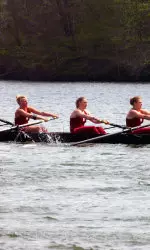
The rowers in each boat are numbered sequentially from bow (front) to stern (back). The bow seat is number one, although the rower seated there is generally just called the bow. The stern-most seat is number eight, but the seat is generally referred to as the stroke seat, as the rower seated there is called the stroke. In the eights, the middle four seats (three, four, five and six) are referred to as the engine room, and are generally occupied by the biggest and strongest rowers in the boat. The bow and two seats are commonly called the bow pair. They can be more technically proficient and are generally smaller than the rest of the rowers. The seven and the stroke are called the stern pair, and are usually the most technically sound rowers in the boat. They are generally the leaders of the crew.
On average, female rowers are taller than 5'10" and weigh at least 160 pounds. An ideal rower embodies the right mix of strength and stamina.
Each boat also has a coxswain, who is much smaller than the rowers, and weighs in at or less than 110 pounds. She is responsible for steering the boat and instructing the rowers. In bow-loaded boats (most fours in collegiate rowing), the coxswain sits with her back to the rowers and has a clear view of what is in front of the boat. In stern-loaded shells (the eights), the coxswain sits in the stern of the boat, facing the rowers and the direction of travel. She might have slightly less visibility because of the eight rowers seated in front of her, but can see what the rowers are doing right and wrong, and can adjust them accordingly. The coxswain uses a speaker system called a cox box to communicate calls, changes, racing moves and any necessary information to the rowers. In addition to allowing the rest of the rowers to hear the coxswain, the cox box also keeps track of boat speed, strokes per minute and time.
Rowing has both a fall season and a spring season in the collegiate setting, with its championship season being in the spring. During the fall season, the Hoosiers will compete in several 5,000-meter head races - races against the clock, with staggered starts. Races during the spring season are head-to-head, with all the boats starting at the same time. Spring races are 2,000 meters long, and are rowed at a higher intensity with more strokes per minute taken.
Indiana's program was started in 1999 by head coach Mark Wilson. After four years at the helm, Wilson stepped down and was replaced by current head coach Steve Peterson. The Hoosier program has grown significantly each season under Peterson, with the varsity eight posting school-record win totals in each season. In 2005, Peterson led IU to a sixth-place finish at the Big Ten Championship, good for the best finish in school history. The Indiana coaching staff also has experience at the NCAA Championship level, as Peterson coached George Washington to a berth in 1998, and assistant coach Carmen Mirochna rowed for Rutgers at the inaugural championship in 1997. Assistant coach Fran O'Rourke and Mirochna both appeared at the 2002 edition in Indianapolis, with O'Rourke rowing and Mirochna coaching for Cornell.
Indiana competes in one of the toughest rowing conferences in the nation, as the Big Ten has had four of its seven rowing schools compete in the NCAA Championship, either as a team or an at-large boat, in each of the last five years. The NCAA takes just 12 teams and four at-large boats per year, meaning the Big Ten has accounted for a quarter of the NCAA field for the last five seasons.
The Hoosiers row on Lake Lemon, a 3.5-mile long man-made lake located about 10 miles from the IU campus. The Lake Conservancy, a residential membership organization, governs and cares for the lake health and any public use. The lake is very sheltered and is not used for commercial use, therefore it is flat, with no current or tides, making it ideal for rowing.
IU will host Cincinnati in a scrimmage on Oct. 15 at Lake Lemon, and will have partial team race on Oct. 21 against Louisville, while the varsity eight will be competing at the prestigious Head of the Charles regatta in Boston, Mass. Other fall races for the Hoosiers include the Head of the Hooch in Chattanooga, Tenn., and an intra-squad meet on Nov. 11. Indiana will train indoors throughout the winter, then have winter and spring training trips before opening the season at Clemson on March 17. The first home race will be on March 24 at Lake Lemon's Riddle Point against Wisconsin.