
Indiana University Athletics
DIPRIMIO-- Far From Home – Passion Fuels Indiana’s International Track Athletes
1/30/2019 12:08:00 PM | Track and Field
BY PETE DIPRIMIO
IUHoosiers.com
BLOOMINGTON, Ind. -- Take it easy? Are you kidding? Rikkoi Brathwaite had no time for that. His track shoes proved it. His on-his-own work confirmed it.
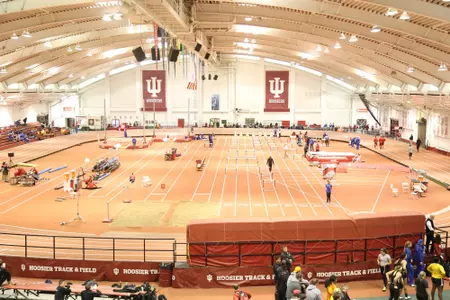
The Indiana redshirt freshman sprinter wasn't competing on this cold Friday night before a big January snow storm. He was at Harry Gladstein Fieldhouse to support teammates participating in the Gladstein Invite. His track shoes should have been in a bag or in his locker, rather than on his feet.
But that's no way to get good. Not at the level Bradwaite wants.
So track shoes came on and a mini training session began at the far end of the Fieldhouse. Brathwaite worked on a few minor fundamentals that, on appearance, seemed of little consequence, but in reality, could mean everything.
On the opposite side of the Fieldhouse, sophomore sprinter Zubin Muncherji buzzed the perimeter. He was a Hoosier on the move, here one minute, there the next, recognizing that standing, even on a night off, can get you beat.
Neither of these emerging track standouts are here for that.
Welcome to international opportunity at work. Brathwaite is from the British Virgin Islands. Muncherji is from Singapore. They bring attributes that transcend the ability to run very fast, although they do that well enough to be national record holders in their respective countries.
Both have come a long way to find greatness.
Will they succeed?
Why not, asks IU track coach Ron Helmer.
"These guys grew up without all of the things American kids take for granted. They're very appreciative individuals. They care a lot about this opportunity and intend to make the most of it.
"We need to do our part and support them, push them, and challenge them appropriately so we can get the best out of them."
He pauses.
"I'm very optimistic we're up for it and they're up for it."
Muncherji and Brathwaite bring an intensity and focus rarely found in most young American track athletes, Helmer adds.
"What I like about them is they didn't grow up here. Every culture is different, but a guy who has been in the Army for two years, like Zubin has, and then comes in as a 21-year-old freshman, sees the world differently than a typical American 18-year-old. He's more mature. He has a really good work ethic.
"With Rikkoi, he conducts himself in a very professional way. He consistently works at a very high level. His attitude about what needs to be done is very mature.
"He's accepted the fact that if he wants to accomplish things, he has to work at a certain way and at a certain level. That is a maturity we don't always see from 17 to 18 year olds who come from this country and who have gotten a whole lot of attention for doing modest things in most cases."
How did IU find athletes so far beyond its typical recruiting territory?
In Muncherji's case, it was an aunt, former IU tennis standout Natasha Joshi (a member of three Big Ten title teams in the mid-1990s), who lives in Fort Wayne.
"I wanted to get into a Division I school," he says. "I knew if I stayed in Singapore … Singapore is great, but in terms of track, the U.S. is the place to be. I knew IU was a top program. If I wanted to get better, I had to train with the best in the country, so I figured I'd come here.
"IU is also closer to home in a way because of my aunt. I know a lot of family members who went to IU."
During a summer visit to his aunt a couple of years ago, Muncherji swung by Indiana's campus, met Helmer and associate head coach Ed Beathea, and quickly formed a bond.
"He said he would come," Beathea says, "and after two years in the military, he stuck to it."
In Brathwaite's case, it was a former Hoosier track manager now coaching at IMG Academy in Florida, where Brathwaite went for high school, who passed on word about his potential.
"That's how we got to know him," Helmer says. "All he knew was high-level track and field. He was one of the best in the Virgin Islands in his age group."
That best should boost a program ranked No. 14 nationally and No. 1 in the Big Ten by the NCAA rating index.
How?
Let's take a look.
*****
For Brathwaite, track is a passion.
"I've always loved it -- the competing, the travel, getting to meet new people, new places, new experiences. The adrenaline you get from running in different stadiums. You get faster because of it."
You also get faster by getting out of your comfort zone. In his case, it meant giving up a mountainous Caribbean island known for reef-lined beaches and sailing for southern Indiana reality -- farm fields, rolling hills, cold winters and food that doesn't jolt the senses.
"The snow isn't too tough as long as you buy the proper clothes," he says with a smile. "Thank God we have an indoor track. If not, I don't know what I would have done.
"The food isn't as spicy here, but it's all good."
Brathwaite grew up in a family of track athletes. He started running when he was around 7, hurt his knee at 13, and didn't return to the sport until he was 16. His best time of 11.1 seconds in the 100 meters drew little attention. Then he found inspiration after going to a major track meet. He changed his training -- adding beach workouts, among other things -- and within a year dropped his time to 10.6.
That got attention.
An offer to run at the prestigious IMG Academy in Florida soon followed.
"It was hard work," he says, "but as long as you have the mindset for it, it should be good. You should run fast."
He has.
Brathwaite's 10.3-second 100 time in the high school nationals had college coaches around the country recruiting him.
He wound up a Hoosier.
Why?
"
Because of the coaching here," he says.
That coaching has led to a time of 6.68-seconds in the 60-meter dash to set the British Virgin Island's national record.
"When I heard I had the national record, I was happy. It was like, Thank God I do track. I didn't know what the record was."
Last year while redshirting, Brathwaite won a couple of races in indoor and outdoor meets.This season his 60-meter time ranks ninth nationally.
How much faster can he get?
"Hopefully I can get to 6.3 by my senior year," he says. "I'm ready for the work. As long as Coach Beathea is ready, I'm ready."
****
Muncherji is a Singapore track superstar. He holds national records in the 200 (22.6 seconds), 400 (47.82), 500 (1:04.38) and 600 (1:21.99).
He said Singapore has the facilities to develop elite athletes, but "track itself is still in its so-called infancy (because) sports are not generally a priority there. So there was a lack of competition and full expertise."
In the United States, Muncherji has shown enough promise to help IU finish second in last season's Big Ten Championships distance medley relay, as well as winning three indoor races.
Still, it wasn't instant success.
"It was such an eye opener to come here and compete with these guys," he says.
"Not to sound arrogant, but you're so used to winning (in Singapore), and when you come here, it's a big slap to your face. This is what reality is. This is how good people really are. That was the hardest part about adjusting, learning how to lose before learning how to get better and start winning."
Not everyone could handle that learning.
"For a while, it did break me. I hadn't (run a personal best) in about four years, from like 2014 to May of 2018.
"It happened at the (Big Ten outdoor meet). It was so emotional because of the journey over those last four years."
Before coming to IU, Muncherji spent two years in the Singapore Army -- six months in infantry, the rest in the military police.
It wasn't ideal track preparation.
"In terms of track, it was the worst two years of my life. I had understanding commanders who enabled me to still train, but only a couple of times a week. You're not going to get the results you want training like that. It was the biggest speed bump to my progress.
"I kept thinking, 'It will be OK. I'm going to the United States. I'll be training with the best.'
"Once I got here, it didn't take me long to get it back. The program here works. You just have to trust the process."
That process has Muncherji aiming for a 47.0 in the 400, with a longer-range goal of 46.0 because "No Singapore runner has ever done that."
As far as adjusting to Midwestern life, Muncherji says, "I never expected to make friends as fast as I did. It was hard to get used to the training, and a lot of the seniors helped me."
Help, in fact, is everywhere he looks, something that didn't always happen in Singapore.
"We have training tables, we have facilities and equipment. We have everything you need as an athlete."
****
With Muncherji and Brathwaite, Helmer says, the best is still ahead.
"They both came from places that didn't have the facilities and the support and what they have here on an everyday basis. They're smart enough to take full advantage and use it to help propel them forward.
"They both have just scratched the surface. When Zubin runs a mediocre time and is the national record holder, that tells you about the competition.
"We all rise to the level of our competition."
Bethea fully appreciates that rise.
"I don't know what the ceiling is for Rikkoi. He redshirted last year so he didn't compete that much. He came out and started well this indoor season. He had a good fall of training. He's a hard worker. He wants to be good. He cares about being good. He's willing to do the little things to be good.
"With Zubin, he comes in a little more mature. He's a hard worker, too. He is very committed to being competitive. That helps him. His drive is good. He's a guy who has been through the military. He brings something different to the group.
"He could go pretty low in the 400. He's only been here a year. He's off to a good start."
As a business major, Muncherji plans on joining his father's hotel management company when track is over, which he hopes is years away.
"I want to turn pro in Singapore. I'd still train here, but compete internationally for my country. A lot of Asian athletes do that."
Brathwaite hopes to become a physical therapist after track.
"I know how athletes feel because I'm a college athlete, so that will help. It could open different job opportunities."
Opportunities are why Brathwaite and Muncherji are Hoosiers.
That makes all the difference.
IUHoosiers.com
BLOOMINGTON, Ind. -- Take it easy? Are you kidding? Rikkoi Brathwaite had no time for that. His track shoes proved it. His on-his-own work confirmed it.
The Indiana redshirt freshman sprinter wasn't competing on this cold Friday night before a big January snow storm. He was at Harry Gladstein Fieldhouse to support teammates participating in the Gladstein Invite. His track shoes should have been in a bag or in his locker, rather than on his feet.
But that's no way to get good. Not at the level Bradwaite wants.
So track shoes came on and a mini training session began at the far end of the Fieldhouse. Brathwaite worked on a few minor fundamentals that, on appearance, seemed of little consequence, but in reality, could mean everything.
On the opposite side of the Fieldhouse, sophomore sprinter Zubin Muncherji buzzed the perimeter. He was a Hoosier on the move, here one minute, there the next, recognizing that standing, even on a night off, can get you beat.
Neither of these emerging track standouts are here for that.
Welcome to international opportunity at work. Brathwaite is from the British Virgin Islands. Muncherji is from Singapore. They bring attributes that transcend the ability to run very fast, although they do that well enough to be national record holders in their respective countries.
Both have come a long way to find greatness.
Will they succeed?
Why not, asks IU track coach Ron Helmer.
"These guys grew up without all of the things American kids take for granted. They're very appreciative individuals. They care a lot about this opportunity and intend to make the most of it.
"We need to do our part and support them, push them, and challenge them appropriately so we can get the best out of them."
He pauses.
"I'm very optimistic we're up for it and they're up for it."
Muncherji and Brathwaite bring an intensity and focus rarely found in most young American track athletes, Helmer adds.
"What I like about them is they didn't grow up here. Every culture is different, but a guy who has been in the Army for two years, like Zubin has, and then comes in as a 21-year-old freshman, sees the world differently than a typical American 18-year-old. He's more mature. He has a really good work ethic.
"With Rikkoi, he conducts himself in a very professional way. He consistently works at a very high level. His attitude about what needs to be done is very mature.
"He's accepted the fact that if he wants to accomplish things, he has to work at a certain way and at a certain level. That is a maturity we don't always see from 17 to 18 year olds who come from this country and who have gotten a whole lot of attention for doing modest things in most cases."
How did IU find athletes so far beyond its typical recruiting territory?
In Muncherji's case, it was an aunt, former IU tennis standout Natasha Joshi (a member of three Big Ten title teams in the mid-1990s), who lives in Fort Wayne.
"I wanted to get into a Division I school," he says. "I knew if I stayed in Singapore … Singapore is great, but in terms of track, the U.S. is the place to be. I knew IU was a top program. If I wanted to get better, I had to train with the best in the country, so I figured I'd come here.
"IU is also closer to home in a way because of my aunt. I know a lot of family members who went to IU."
During a summer visit to his aunt a couple of years ago, Muncherji swung by Indiana's campus, met Helmer and associate head coach Ed Beathea, and quickly formed a bond.
"He said he would come," Beathea says, "and after two years in the military, he stuck to it."
In Brathwaite's case, it was a former Hoosier track manager now coaching at IMG Academy in Florida, where Brathwaite went for high school, who passed on word about his potential.
"That's how we got to know him," Helmer says. "All he knew was high-level track and field. He was one of the best in the Virgin Islands in his age group."
That best should boost a program ranked No. 14 nationally and No. 1 in the Big Ten by the NCAA rating index.
How?
Let's take a look.
*****
For Brathwaite, track is a passion.
"I've always loved it -- the competing, the travel, getting to meet new people, new places, new experiences. The adrenaline you get from running in different stadiums. You get faster because of it."
You also get faster by getting out of your comfort zone. In his case, it meant giving up a mountainous Caribbean island known for reef-lined beaches and sailing for southern Indiana reality -- farm fields, rolling hills, cold winters and food that doesn't jolt the senses.
"The snow isn't too tough as long as you buy the proper clothes," he says with a smile. "Thank God we have an indoor track. If not, I don't know what I would have done.
"The food isn't as spicy here, but it's all good."
Brathwaite grew up in a family of track athletes. He started running when he was around 7, hurt his knee at 13, and didn't return to the sport until he was 16. His best time of 11.1 seconds in the 100 meters drew little attention. Then he found inspiration after going to a major track meet. He changed his training -- adding beach workouts, among other things -- and within a year dropped his time to 10.6.
That got attention.
An offer to run at the prestigious IMG Academy in Florida soon followed.
"It was hard work," he says, "but as long as you have the mindset for it, it should be good. You should run fast."
He has.
Brathwaite's 10.3-second 100 time in the high school nationals had college coaches around the country recruiting him.
He wound up a Hoosier.
Why?
"
Because of the coaching here," he says.
That coaching has led to a time of 6.68-seconds in the 60-meter dash to set the British Virgin Island's national record.
"When I heard I had the national record, I was happy. It was like, Thank God I do track. I didn't know what the record was."
Last year while redshirting, Brathwaite won a couple of races in indoor and outdoor meets.This season his 60-meter time ranks ninth nationally.
How much faster can he get?
"Hopefully I can get to 6.3 by my senior year," he says. "I'm ready for the work. As long as Coach Beathea is ready, I'm ready."
****
Muncherji is a Singapore track superstar. He holds national records in the 200 (22.6 seconds), 400 (47.82), 500 (1:04.38) and 600 (1:21.99).
He said Singapore has the facilities to develop elite athletes, but "track itself is still in its so-called infancy (because) sports are not generally a priority there. So there was a lack of competition and full expertise."
In the United States, Muncherji has shown enough promise to help IU finish second in last season's Big Ten Championships distance medley relay, as well as winning three indoor races.
Still, it wasn't instant success.
"It was such an eye opener to come here and compete with these guys," he says.
"Not to sound arrogant, but you're so used to winning (in Singapore), and when you come here, it's a big slap to your face. This is what reality is. This is how good people really are. That was the hardest part about adjusting, learning how to lose before learning how to get better and start winning."
Not everyone could handle that learning.
"For a while, it did break me. I hadn't (run a personal best) in about four years, from like 2014 to May of 2018.
"It happened at the (Big Ten outdoor meet). It was so emotional because of the journey over those last four years."
Before coming to IU, Muncherji spent two years in the Singapore Army -- six months in infantry, the rest in the military police.
It wasn't ideal track preparation.
"In terms of track, it was the worst two years of my life. I had understanding commanders who enabled me to still train, but only a couple of times a week. You're not going to get the results you want training like that. It was the biggest speed bump to my progress.
"I kept thinking, 'It will be OK. I'm going to the United States. I'll be training with the best.'
"Once I got here, it didn't take me long to get it back. The program here works. You just have to trust the process."
That process has Muncherji aiming for a 47.0 in the 400, with a longer-range goal of 46.0 because "No Singapore runner has ever done that."
As far as adjusting to Midwestern life, Muncherji says, "I never expected to make friends as fast as I did. It was hard to get used to the training, and a lot of the seniors helped me."
Help, in fact, is everywhere he looks, something that didn't always happen in Singapore.
"We have training tables, we have facilities and equipment. We have everything you need as an athlete."
****
With Muncherji and Brathwaite, Helmer says, the best is still ahead.
"They both came from places that didn't have the facilities and the support and what they have here on an everyday basis. They're smart enough to take full advantage and use it to help propel them forward.
"They both have just scratched the surface. When Zubin runs a mediocre time and is the national record holder, that tells you about the competition.
"We all rise to the level of our competition."
Bethea fully appreciates that rise.
"I don't know what the ceiling is for Rikkoi. He redshirted last year so he didn't compete that much. He came out and started well this indoor season. He had a good fall of training. He's a hard worker. He wants to be good. He cares about being good. He's willing to do the little things to be good.
"With Zubin, he comes in a little more mature. He's a hard worker, too. He is very committed to being competitive. That helps him. His drive is good. He's a guy who has been through the military. He brings something different to the group.
"He could go pretty low in the 400. He's only been here a year. He's off to a good start."
As a business major, Muncherji plans on joining his father's hotel management company when track is over, which he hopes is years away.
"I want to turn pro in Singapore. I'd still train here, but compete internationally for my country. A lot of Asian athletes do that."
Brathwaite hopes to become a physical therapist after track.
"I know how athletes feel because I'm a college athlete, so that will help. It could open different job opportunities."
Opportunities are why Brathwaite and Muncherji are Hoosiers.
That makes all the difference.

Players Mentioned

Sprints
/ Track and Field


Sprints
/ Track and FieldThursday, August 13
Thursday, August 13
Wednesday, August 12
Wednesday, August 12