Indiana University Athletics
24 Sports, One Photographer
11/29/2010 12:00:00 AM | Varsity Club
Nov. 29, 2010
by Stephanie Kuzydym
Two hours remain until Mike Dickbernd will take the field. His eyes are focused intently at a message on his computer screen; a red IU emblem blazes from his white shirt. His head bobs in rhythm to the beat of the music.
Dickbernd is calm. He's not worried about today's game. After three years around IU Athletics, he's a veteran.
There's an hour until game time and Dickbernd is done checking his e-mails. He goes to his locker and grabs his gear and walks down the hallways of Assembly Hall. Athletes dressed in IU red walk past him. They only glance to look at what he's carrying, but none of them acknowledge him.
There's just minutes left on the stadium clock until the start of the game and Dickbernd is standing in the middle of the field. Fireworks explode. Fans cheer. Dickbernd springs into action.
A burst of noise comes from Dickbernd's gear.
Click-click-click-click-click-click.
Click-click-click-click.
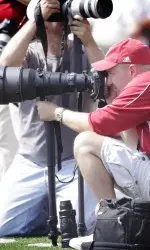
He follows the football players running below a haze of firework smoke before jogging to the sidelines north of where the team stands. As Dickbernd jogs to his spot, none of the 52,929 fans cheer that he is coming close. To them, he's just a man carrying a monstrous lens over his shoulder. None of them realize Dickbernd's role in IU Athletics.
But he doesn't mind. He'd rather be behind the camera. He lifts the barrel of a 400 millimeter lens off his shoulder and lowers his tripod until he can kneel on the ground. He has no jersey number. He isn't listed on any team roster. But as the only Hoosier photographer, Dickbernd is the official eyes of IU Athletics.
It's the end of the race. The swimmer's goggles rest on his forehand. His left arm extends outward, a clenched fist at the end. His head tilts backwards in triumph. He is the king of the water.
This vertical photo is five rows above Dickbernd's computer. The photo is one of over 50 posters, media guides and program covers that line the off-white cinder block walls of Dickbernd's office that lies in the basement of Assembly Hall.
"Oh, you should never drop your camera when you think a play is over or the action has stopped," Dickbernd says. He's been clicking through game photos on his computer and stops on one that has a photographer with her camera down when two football players are celebrating after a touchdown. "It's that after-emotion you want to capture."
The swimming photo is the perfect example of why Dickbernd leaves his camera up when the action has stopped - as is the two football players leaping in the air after a touchdown and the basketball player on the court with his tongue out after he scored a three-point basket under double coverage. That's the action. And the action is what people like to see.
"People remember still photos," Dickbernd says. "From a historical standpoint, that moment is frozen forever."
Capturing history is Dickbernd's job, but the job is more than standing on the sideline.
Take photos. Edit photos. Upload photos. Organize photos. Start again. For a football game, Dickbernd will shoot between 500 to 700 photos. Once back in his office, he looks at every image, deleting one third of them. Of the remaining images, he selects and edits about 35 of his best photo for an online photo gallery.
After completing the gallery, Dickbernd goes through all the photos he didn't delete and sorts them by player for the department's use. The editing time after any one game is about three hours - with football being the longest.
"Usually, I spend as much time editing as I do shooting the actual event, if not more," Dickbernd says.
But he isn't complaining. The hours he spends at all those events produce the photos that line his office walls.
"I like the feeling of getting a great shot," Dickbernd says. "And I like getting to know the athletes so that when they win you can celebrate with them. I like the atmosphere. I like sitting in Assembly Hall surrounded by 17,500 people and watching them cheer. That's a great feeling."
Dust rises around their cleats; most of their faces are shadowed by the brim of their ball cap, but the light shines at the right angle to illuminate the baseball players' lips. They are caught in celebration, midway into a dog pile.
The shot is the only baseball celebration hanging among the photos in Dickbernd's office. A baseball celebration doesn't happen every game. But even if it did Dickbernd is unable to stay for every full baseball game. The factor? Time. Some games can last up to four hours, with little action. Covering all the spring sports, including men's and women's golf, tennis, swimming and diving, track and field, as well as softball and women's water polo, and often covering multiple sports on the same day, forces Dickbernd to leave many games before they are completed. He tries to give equal coverage to the sports, while staying within a 40-hour workweek.
"Sometimes I have to leave because I don't have enough hours to stay there the whole time," Dickbernd says. "I have to control my schedule and I can't go radically over hours. It's not possible for me to cover every single game there is. I just can't do it. But if it's a situation where it's a championship game or a post-season game, I'm there as long as it takes."
Last baseball season, Dickbernd was at a baseball game that lasted into extra innings. He left the game before it finished to begin processing his photo and missed the walk-off homerun that gave the Hoosiers the victory.
"It's frustrating when you miss the moment that tells the whole story, but it's just impractical to think that I can stay for every event and as long as it takes," Dickbernd says.
During basketball season, Dickbernd will cover over 40 games between the men's and women's teams - and there are still 15 other sports he will photograph. With so many sports and so little extra help, the job as an official athletic photographer is known to photographers as a burn-out job. Even his fellow photographs see the long hours Dickbernd puts in.
"I've seen him out at times at 9 a.m. and he tells me he was uploading until midnight the night before," Pat Lovell, a fifteen-year photographer who sits next to Dickbernd on the sidelines says. "But he's not pushed by the pressure. He does what he needs to do and doesn't get stressed."
But, Dickbernd just doesn't show it.
"It's affected my health and my blood pressure," Dickbernd says. "I have felt sick a lot more often this year and that could be attributed to the long hours, the stress and the schedule."
The truth is the hours and the stresses are beginning to take their toll on Dickbernd.
Five soccer players crowd together in a half circle with jubilant smiles on their faces. Their teammate, who just scored a last minute goal, is in a handstand after being knocked backwards by a charging teammate. It's Dickbernd's favorite shot. To him, it tells the viewer what happened in the game.
"It's about telling a story," Dickbernd says.
People who enter Dickbernd's office always ask about his photos. The natural reaction for those who enter is to study the photos on his walls. Even his coworkers have their favorites picked out.
"I have some favorites," John Buuck, Dickbernd's officemate says. "There's a picture of the soccer player doing a flip. There's a picture of a steeple chaser splashing through the water, and then there are others."
Buuck points from one picture to the next - two doubles partners shouting in triumph and a football player screaming through his mask with a tight grip on the football in his right hand. In the end, he doesn't settle on one photo.
"His work is really good," Buuck says. "I don't know how much of a sports fan he is, but he seems to be in the right place and his timing seems to be really good."
The last time Dickbernd competed in a competitive sport was middle school, but he said he has always had a love of sports. Local photographers see his sports love coming through in the quality of his shots.
"He looks at it from a different perspective," Lovell says. "This soccer game a few weeks ago comes to mind. He was over doing some crowd shots and he got way down on the ground. ... I was just kind of shooting straight on getting all of their faces front on, and he was shooting it from underneath. He definitely looks at things from a different perspective from a standard sports guy."
Peter Stevenson, a senior and the head photographer at IU's Indiana Daily Student, notices the way Dickbernd looks at sports differently. Stevenson said he strives to learn from Dickbernd's technique.
"He really pays attention to the game in a way I wasn't used to at all," Stevenson says. "He seems to always know where to be when the big play comes and how the action isn't always where the ball is."
Dickbernd, who graduated from Iowa University BA'91 with a photojournalism degree, has won over 30 awards in his 17 years of photography - including Time.com's Best Photo of the Week in 2002. When three swimmers embraced each other after a race, Dickbernd took the photo. When a field hockey player scored a game-winning goal, Dickbernd caught her teammates' reaction. When a freshman point guard made his first oncourt appearance to Hoosier Nation, Dickbernd captured his leap over a group of six children on his way to the hoop for a dunk. It's Dickbernd's job and it's what he sees.
Less than two minutes remain on the scoreboard and the noise inside Memorial Stadium is deafening.
"This is the biggest crowd I've seven seen at an IU football game," Dickbernd says as he briefly takes his eyes off the field. His thumb rests on the back of his camera to focus while his pointer finger lightly rests on the shutter button, waiting to spring into action. Then, the opposing team goes back to pass.
Click-click-click-click-click-click-click-click-click.
Click-click-click-click-click-click-click-.
Another burst of photos are captured as a Hoosier crosses the goal line. The wide receiver leaps in the air and celebrates with his teammates with a tie score on the board. But when the game ends a minute later, after a last-second score by the opponent, Dickbernd hoists his camera to his shoulder and begins his walk back to Assembly Hall.
Dickbernd has 700 photos to process. As he sits back in his office flipping through his photos on his computer, Mark Morrison's "Return of the Mack" plays from his 27-inch computer screen. Dickbernd's mouth moves along to the words as he clicks from one picture to the next. Three hours later, he turns off his computer. Only the creaking sounds of Assembly Hall fill the silence. Dickbernd locks his door to his photographic lab. It's after one a.m. and only eight hours remain until he is back on a sideline.
Stephanie Kuzydym is an IU Junior majoring in Journalism with a second concentration in Marketing.